
Company liquidation in Switzerland: Step-by-step guide
- Apr 30
- 9 min read

TL;DR:
Swiss company liquidation is a legal process for solvent companies to wind up and distribute assets.
Proper steps and documentation are essential to avoid delays, liabilities, and legal issues.
Recent reforms have streamlined creditor notices and simplified procedures for dormant or compliant companies.
Many business owners assume liquidation means failure. In Switzerland, that assumption is simply wrong. For AG and GmbH structures, voluntary liquidation is a carefully regulated legal process, often chosen by solvent companies as part of a planned exit, reorganization, or tax strategy. Getting it wrong, however, can expose directors to personal liability, trigger unexpected tax costs, and delay closure by months. This guide covers definitions, procedures, creditor rules, and the 2023 legal changes so you can make confident, informed decisions about winding up a Swiss company.
Table of Contents
Key Takeaways
Point | Details |
Voluntary vs. bankruptcy | Swiss liquidation is often a voluntary, regulated process, not just for insolvency. |
Legal steps required | Each liquidation stage carries specific legal requirements, waiting periods, and filings. |
Recent reforms | 2023 changes simplified creditor calls and created a faster process for dormant companies. |
Plan strategically | Treating liquidation as a planned business tool can minimize financial and legal risks. |
What is company liquidation in Switzerland?
Now that you understand liquidation is not always a crisis, let’s define exactly what it means in Switzerland.
Company liquidation in Switzerland refers to the formal process of winding up a company’s affairs, converting its assets to cash, settling all liabilities, and distributing any remaining value to shareholders. The Swiss Code of Obligations governs this process, covering AG companies under Articles 736 to 747 and GmbH companies under Articles 821 to 826. These articles set out the exact rights, duties, and timelines that apply. Failing to follow them creates legal exposure for directors and shareholders alike.
There are two fundamentally different types. Voluntary liquidation happens when the shareholders or members themselves decide to dissolve the company. The company is typically solvent, meaning it can pay all its debts. Involuntary liquidation, by contrast, is initiated by a court, often triggered when the company is over-indebted and cannot meet its financial obligations. The two processes differ in control, cost, timing, and consequence.
Voluntary liquidation is a controlled, legally regulated process. It puts decision-making power in the hands of the owners. Involuntary liquidation removes that control entirely and hands it to court-appointed administrators.
Common reasons companies opt for voluntary liquidation include:
A founder retiring or relocating without a succession plan
A restructuring that replaces one legal entity with another
A holding company becoming redundant after a subsidiary sale
Tax efficiency planning where continued dormancy is more expensive than closure
Investor exits following the completion of a project
“Company liquidation in Switzerland primarily refers to the voluntary winding-up process for solvent corporations like AG and GmbH.” This is important because it means liquidation is a choice, not a judgment, for most Swiss companies.
Crucially, liquidation also becomes a legal obligation in specific circumstances. If the equity of an AG falls below half of the combined share capital and legal reserves, the board must act. Ignoring this obligation carries real personal risk for directors. Understanding how Swiss corporate law impacts your entity type is essential before you reach that threshold.
Pro Tip: Liquidation is not synonymous with bankruptcy. Many completely healthy, profitable companies in Switzerland choose voluntary liquidation simply because the business purpose has been fulfilled or ownership plans have changed.
The step-by-step voluntary liquidation process
With the definition clear, let’s break down each step of the voluntary liquidation procedure.
Voluntary liquidation follows a defined sequence. Missing or mishandling any step can reset the timeline or trigger compliance issues. Here’s how the process works in practice:
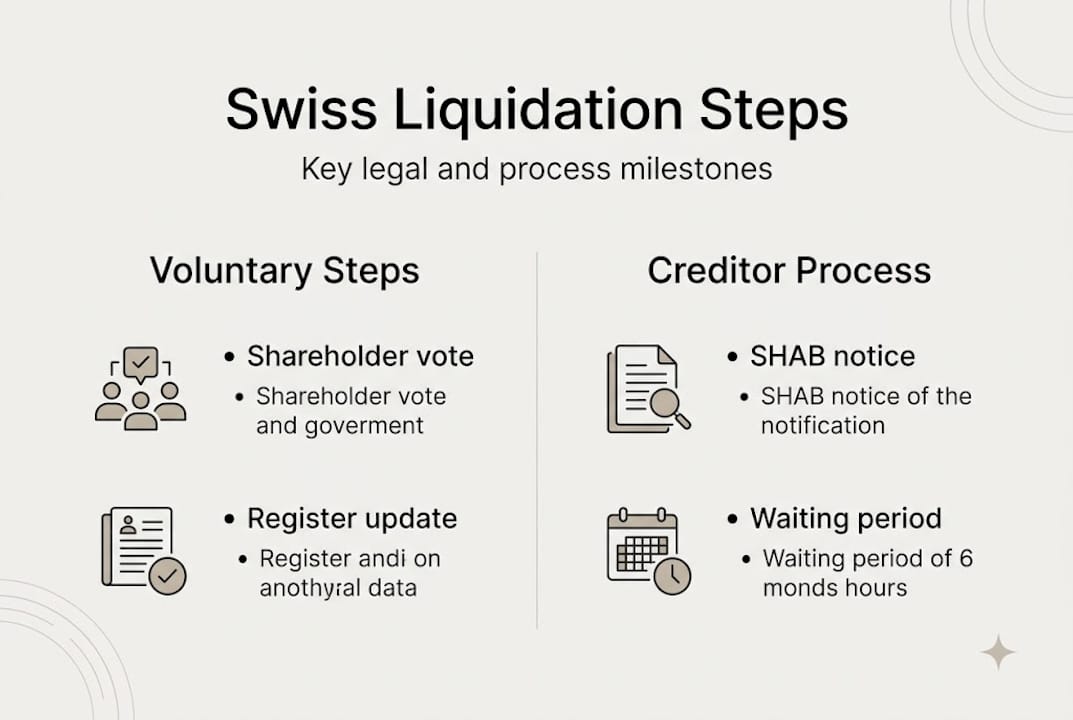
Shareholder resolution. The shareholders or members pass a formal resolution to dissolve the company. For an AG, this requires a two-thirds majority of votes represented at a general meeting. For a GmbH, it requires a three-quarters majority unless the articles specify otherwise.
Notarization. The dissolution resolution must be certified by a notary in most cases. This is not optional.
Commercial Register filing. The notarized resolution must be filed with the Commercial Register within 30 days of the decision. This is a firm legal deadline and applies to both AG and GmbH.
Liquidator appointment. A liquidator is officially named. This can be an existing board member, a shareholder, or an external professional. The liquidator is then responsible for realizing assets, settling all debts, and preparing final accounts.
Adding “in liquidation” to the company name. The registered name of the entity must be updated to include “in Liquidation” or the equivalent in the relevant Swiss language. This prevents confusion with third parties.
Creditor call publication. A notice is published in the Swiss Official Gazette of Commerce (SHAB) inviting creditors to submit claims. This starts the creditor waiting period.
Asset realization and debt settlement. The liquidator sells assets, collects receivables, and pays all known and filed creditors.
Tax clearance. The company must obtain final tax assessments and confirmation from cantonal and federal tax authorities that all obligations are met.
Final balance sheet and surplus distribution. After waiting periods and tax clearance, the liquidator prepares a final balance sheet, which shareholders approve. Any remaining surplus is distributed.
Deletion from the Commercial Register. The deletion process takes approximately 2 to 4 weeks after the final steps are completed.
Voting requirements at a glance:
Requirement | AG | GmbH |
Minimum majority for dissolution | Two-thirds of votes represented | Three-quarters of all votes |
Notarization required | Yes | Yes |
Commercial Register deadline | 30 days | 30 days |
Name change required | Yes (add “in Liquidation”) | Yes (add “in Liquidation”) |
Pro Tip: Update your company’s registered name immediately after the resolution. Failing to add “in liquidation” can create confusion with ongoing contracts and banking relationships, potentially creating new liabilities.
Consulting the annual administration guide for Switzerland helps you understand what administrative tasks to complete or close out before the liquidation process begins. If you are still in the formation stage or considering restructuring, reviewing the AG incorporation process gives valuable context on what a proper corporate structure looks like from the start.

Creditor protection, waiting periods, and simplified liquidation
Once the process starts, protection for creditors and timeline management becomes crucial.
Creditor protection rules exist to ensure that no company disappears overnight, leaving unpaid suppliers or lenders with no recourse. Switzerland’s rules on this point have evolved meaningfully since 2023.
Since the 2023 legal update, only one SHAB publication is now required. Previously, creditors needed to be called three times. The waiting period remains 12 months by default, but this can be reduced to just 3 months if a licensed auditor confirms that no creditor claims are outstanding or at risk. This single change has dramatically shortened timelines for well-documented companies.
For dormant companies, there is an even faster route. The simplified dissolution process allows companies with no assets and no liabilities to close in as little as 2 to 6 months.
Conditions for simplified dissolution include:
No assets of significant value remain in the company
No outstanding debts or creditor obligations exist
No ongoing legal disputes or proceedings
Tax authorities have no unresolved claims
The company has been effectively dormant, with no business activity
Timeline and cost comparison:
Process type | Estimated timeline | Estimated cost range |
Standard voluntary liquidation | 12 to 18 months | CHF 5,000 to 20,000+ |
Auditor-confirmed accelerated liquidation | 3 to 6 months | CHF 3,000 to 10,000 |
Simplified dissolution (dormant company) | 2 to 6 months | CHF 1,500 to 5,000 |
Involuntary liquidation (bankruptcy) | 12 to 36 months | CHF 5,000 to 50,000+ |
“Smart companies don’t wait until year-end to assess their liquidation readiness. Clean books and zero outstanding creditor obligations make the 2023 simplified path genuinely accessible, not just theoretical.”
Understanding creditor protection rules is also essential because distributing assets before the waiting period ends is illegal. Any premature distribution can be reversed by a court, and the liquidator can face personal liability.
Pro Tip: Dormant or shell companies with no liabilities and no assets are prime candidates for the simplified dissolution route. If your company fits this profile, you may be able to close it in as little as two months, saving significant fees and administrative work.
Checking our formation checklist for Switzerland is useful not just when opening a company but also when planning its closure, since many documentation requirements mirror each other. Equally, knowing how to handle preparing company documents correctly will reduce processing delays during liquidation.
Involuntary liquidation: Over-indebtedness and bankruptcy
But what if your company faces debt it cannot repay? It’s critical to understand the special rules for bankruptcy.
When a Swiss company’s liabilities exceed its assets, its directors are legally required to act. This is not discretionary. Under the Swiss Bankruptcy Law (DEBA), directors must notify the bankruptcy court if the company is over-indebted. The court then appoints a liquidator, and control passes entirely out of the founders’ hands. This is a fundamentally different situation from voluntary liquidation.
The court-appointed liquidator’s job is to maximize recovery for creditors, not to protect shareholder value. Any remaining assets are distributed in a strict legal priority order: secured creditors first, then preferred claims, then unsecured creditors. Shareholders receive nothing unless every creditor is fully satisfied, which is rare.
Key differences between voluntary and involuntary liquidation:
Who initiates it. Voluntary is shareholder-driven. Involuntary is court-ordered.
Who controls the process. Voluntary gives control to the appointed liquidator (often an insider). Involuntary gives control to a court administrator.
Speed and cost. Involuntary proceedings can cost CHF 5,000 to CHF 10,000 just to start, and complex cases run far higher.
Director exposure. In voluntary proceedings, directors who followed proper duties are generally protected. In bankruptcy proceedings, directors who delayed notification can face personal liability.
Shareholder outcome. Voluntary liquidation often returns surplus to shareholders. Involuntary liquidation rarely does.
“Over 50% of Swiss bankruptcy proceedings are discontinued because the costs of the proceedings exceed the remaining assets of the company. This means shareholders recover nothing and the process still costs them.”
This is why early action matters enormously. If your company’s financial position is deteriorating, the window to choose voluntary liquidation closes fast. Once over-indebtedness is confirmed, Swiss law takes that choice away.
Directors are also personally exposed when insolvency is mismanaged. If a director continues to trade, incur new debts, or delay court notification after over-indebtedness is confirmed, they can be held personally responsible for any resulting losses to creditors.
Understanding the differences between AG vs GmbH structure is relevant here too, since the specific thresholds and director duties vary depending on which entity type you operate.
Pro Tip: If your balance sheet shows equity erosion approaching the legal thresholds, consult a licensed fiduciary or attorney immediately. Acting six months early could preserve voluntary liquidation as an option. Waiting until the threshold is breached could cost you that choice entirely.
The real impact of Swiss liquidation laws: What most guides don’t tell you
Most articles about Swiss liquidation focus on the mechanics. What they miss is the strategic layer.
We’ve worked with founders who spent years maintaining a dormant company simply to avoid the perceived hassle of liquidation. When they finally proceeded, the costs of back-filed accounts, accumulated cantonal fees, and delayed tax clearance dwarfed what proper annual compliance would have cost. Dormancy is not free storage. It accumulates obligations silently.
The 2023 reforms are genuinely significant. The critical law changes for investors created real pathways for faster, cheaper closures. But they reward companies that maintained clean documentation. Companies with messy accounts or unresolved creditor questions gained very little from the reforms because they cannot access the simplified or accelerated routes.
Here is the contrarian insight most advisors won’t say directly: liquidation, when planned in advance, is a strategic tool. It protects reputation, releases capital, and can be coordinated with asset transfers or successor entity creation in a way that minimizes tax friction. Founders who build an exit timeline into their company lifecycle from day one are consistently better positioned than those who treat liquidation as an emergency measure.
Maintain clear books. File annual reports on time. Keep corporate resolutions documented. These habits aren’t just about compliance. They are what determine whether you get a 3-month closure or a 3-year ordeal.
Get expert support for every step in Swiss liquidation
Armed with knowledge and perspective, partnering with specialists can save significant time and cost.
Navigating Swiss liquidation requires precise documentation, strict deadlines, and coordination across tax authorities, notaries, and the Commercial Register. A missed step doesn’t just slow things down. It can restart timelines entirely or create unexpected liability.
At RPCS, we support international entrepreneurs and investors through every phase of their Swiss company’s lifecycle. From initial company formation services to structured wind-down, our team manages the filings, notarizations, creditor publications, and tax clearance coordination on your behalf. Our Swiss accounting experts ensure your books are clean and compliant before closure begins, which is the single most important factor in accessing the faster simplified routes. Whether you’re planning an exit or responding to an urgent change in circumstances, we make the process clear and manageable.
Frequently asked questions
What is the minimum duration for a voluntary company liquidation in Switzerland?
A standard voluntary liquidation takes at least 12 months due to the creditor waiting period, but the simplified route for dormant companies with no assets or liabilities can close in as little as 2 to 6 months.
Are creditor notifications still published three times in Switzerland?
No. Since 2023, only one publication in the Swiss Official Gazette of Commerce is required, which officially starts the creditor waiting period. This change significantly reduces both time and administrative cost.
What happens if my company is over-indebted?
Over-indebted companies must immediately report to the bankruptcy court under DEBA statutes. The court appoints a liquidator, and voluntary dissolution is no longer an option for directors.
Can you distribute company assets before the legal waiting period ends?
No. Distribution of surplus assets is only legally permitted after the creditor waiting period has expired and full tax clearance from the relevant authorities has been obtained. Early distribution can be clawed back by the courts.
Recommended
Comments