Corporate Substance in Switzerland: A Guide
Discover what corporate substance in Switzerland means, and the steps that show a company genuinely operates where it says it does.

Corporate substance requires genuine Swiss activity, resources, and decision-making authority to access tax benefits. Meeting at least one of three core criteria, local staff and premises, managing foreign holdings, or sufficient equity, is essential. Insufficient substance risks losing treaty benefits, facing banking rejection, and double taxation.
Registering a Swiss company and receiving a Geneva or Zurich business address feels like a major milestone, but that address alone is not enough to access Switzerland's renowned tax advantages. Corporate substance refers to the economic reality of a company, demonstrated by real activities, actual resources such as staff and offices, and a genuine role within its corporate group. Without it, Swiss tax authorities and banks will treat your entity as a shell, blocking access to treaty benefits, withholding tax refunds, and even basic banking services. This guide walks you through what substance means, why it matters, and the precise steps you need to take to build it correctly.
Key Takeaways#
| Point | Details |
|---|---|
| Prove real Swiss activity | Having offices, staff, and business decisions actually in Switzerland is crucial for corporate benefits. |
| Meet at least one substance test | Most companies need to satisfy one of three substance criteria, but high-risk cases require two. |
| Avoid double taxation risks | Without proper substance, you risk denied tax refunds and double taxation. |
| Practical steps pay off | Choosing Swiss-resident directors and holding board meetings locally bolsters compliance. |
What is corporate substance? Definition and fundamentals#
Corporate substance is not a vague buzzword. It is a legal and regulatory standard that Swiss authorities apply to determine whether your company genuinely operates in Switzerland, or simply uses the country as a mailbox.
The Swiss Federal Tax Administration (SFTA) scrutinizes substance most closely when a company claims benefits under Switzerland's double taxation agreements (DTAs). These treaties reduce or eliminate withholding taxes on dividends, interest, and royalties paid between countries. If your Swiss entity can't prove genuine local activity, the SFTA can deny those treaty benefits outright.
Here is what Swiss authorities actually look at when assessing substance:
- Real operational activity: The company must perform genuine business functions in Switzerland, not merely forward documents or collect payments.
- Own resources: Physical office space and employees physically present in Switzerland.
- Decision-making authority: Strategic and operational decisions must be made within Switzerland, not by directors or managers sitting abroad.
- Role within a corporate group: For holding companies, the Swiss entity must genuinely manage or oversee its subsidiaries or participations, not act as a passive conduit.
- Financial independence: The company should have its own equity, accounts, and financial standing rather than being entirely funded and controlled from outside.
"Corporate substance refers to the economic reality of a company, demonstrated by real activities, own resources (staff, offices), and effective role in the group, particularly scrutinized by the SFTA." (source)
This scrutiny is not arbitrary. It is part of a broader effort to prevent treaty shopping, which is when a company routes income through a country purely to exploit its tax treaties, with no genuine business presence there. Switzerland's strong network of DTAs makes it an attractive jurisdiction, and the SFTA is well aware that some structures try to exploit that network without real commitment.
Understanding the proper governance rules in Switzerland goes hand in hand with substance. Poor governance and absent local oversight are red flags that invite scrutiny. Additionally, if your Swiss entity holds or licenses intellectual property, be aware that Swiss IP regulations require genuine R&D activity or licensing management to qualify for preferential tax treatment. A Swiss IP box is not a blank check.
The practical implication is straightforward: substance must be documented and maintained continuously, not just established on paper during the registration process. Think of it as an ongoing commitment to genuine Swiss operations, not a one-time setup task.
The core substance criteria: What the Swiss look for#
Once you understand what substance means conceptually, the next step is understanding exactly which criteria the SFTA and treaty partners use to measure it. Three recognized substance tests exist, and meeting at least one of them is generally required to claim treaty benefits.
Here is a numbered breakdown of those three tests:
-
Personal and infrastructural criterion: The company has its own staff and physical premises in Switzerland. This means employees on payroll, a real office lease, and a visible operational presence. The staff must genuinely perform functions related to the company's stated purpose.
-
Functional criterion: The company holds other substantial participations outside Switzerland and actively manages them. This is relevant for holding companies that don't need large local staff but do manage genuine international ownership structures.
-
Balance sheet and equity criterion: The company is sufficiently self-financed, with at least 30% equity ratio relative to its assets. This signals financial independence and reduces the risk that the entity is merely a pass-through for debt-funded income flows.
| Criterion | Key requirement | Best suited for |
|---|---|---|
| Personal/infrastructural | Staff on payroll, leased office | Operating companies, regional HQs |
| Functional | Substantial foreign participations actively managed | Pure holding companies |
| Balance sheet/equity | 30%+ equity ratio, self-financing | Finance companies, IP holding structures |
Normally, satisfying one of these three criteria is enough. However, Swiss authorities require two criteria in high-risk cases involving qualified treaty shopping or situations where a company seeks a double tax advantage. If your structure routes income through multiple intermediaries to maximize treaty benefits, expect to be held to a higher standard.

What makes this interesting in practice is that "high-risk" is not always obvious. A Luxembourg parent owning a Swiss holding company that itself owns a German operating entity can look like a layered treaty shopping structure, even if it was set up for entirely legitimate reasons. The moment regulators see that pattern, they will want proof of two criteria, not one.
For international entrepreneurs, the functional criterion is often the most accessible path for holding companies. If your Swiss entity genuinely holds and manages significant foreign subsidiaries and you can document board decisions, shareholder communications, and strategic oversight from Switzerland, this criterion alone can establish substance. However, the corporate tax rules that apply to dividend income and capital gains on those participations still depend on the entity meeting broader substance and anti-avoidance tests.
Pro Tip: Document every board meeting in Switzerland with dated minutes, attendance records, and resolution logs. This paper trail is one of the most credible pieces of evidence you can present to the SFTA.
Tax residency, PoEM, and practical requirements#
Understanding the substance tests leads directly to a closely related issue: where is your Swiss company actually a tax resident? Many founders assume registration alone settles this question. It does not.
Swiss tax law uses a concept called Place of Effective Management, or PoEM. PoEM is the location where the company's key strategic and commercial decisions are actually made, regardless of where the registered office sits. If your Swiss GmbH or AG is registered in Zurich but all meaningful decisions are made by a director living in Dubai or Singapore, the Swiss tax authorities, and potentially the tax authorities in that director's country, could argue the company's tax residency lies elsewhere.
| Scenario | Likely PoEM outcome | Key risk |
|---|---|---|
| Board meets in Zurich quarterly, local GM makes daily decisions | Switzerland | Low risk if documented |
| Sole director resident abroad, no local activity | Abroad | Reclassification, double tax |
| Mixed board, Switzerland-based chair with casting vote | Switzerland, with conditions | Moderate, needs evidence |
| Local nominal director, real decisions made abroad | Contested | High risk of denial |
Recent decisions from the Swiss Federal Supreme Court confirm that holding company PoEM is determined by where management decisions of the entity and its participations are habitually made, not merely where papers are signed. Courts have been strict: if the real decision-maker lives outside Switzerland and no genuine local management exists, the company can be stripped of Swiss tax residency.
Practical requirements to maintain Swiss PoEM and substance include the following:
- At least one director or general manager who is a Swiss resident and actively involved in the company's affairs.
- Physical board meetings held in Switzerland, with formal minutes proving that major decisions were made locally.
- Local banking relationships and financial accounts in Switzerland.
- Genuine commercial correspondence, contracts, and invoices issued from the Swiss address.
Swiss residence for directors is a frequent concern for foreign founders who don't yet live in Switzerland. There are solutions, including appointing local professional directors, but those directors must genuinely exercise their authority, not just sign documents on behalf of an absentee owner.
For entrepreneurs considering a personal move, understanding the broader entrepreneur relocation requirements can help you plan your Swiss presence more strategically. And while a business address in Switzerland does provide real legal and tax advantages, those advantages only materialize when paired with genuine substance.
Pro Tip: Banks in Switzerland now run enhanced due diligence checks before opening corporate accounts. Having a Swiss-resident director and a verifiable local office significantly speeds up the account opening process and reduces the chance of outright rejection.
Consequences of insufficient substance (and how to avoid them)#
The stakes are high when substance is missing. This is not a minor technicality that results in a small fine. The consequences affect your company's ability to function, access capital, and operate efficiently across borders.
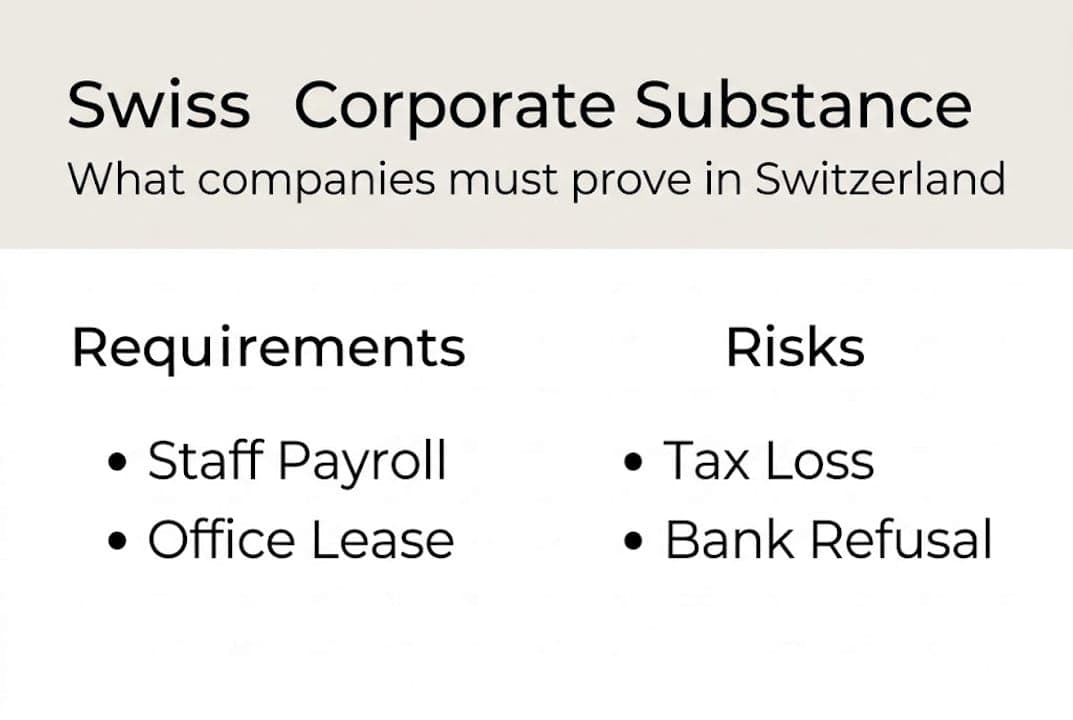
The most direct consequence is the denial of treaty benefits. If the SFTA determines your Swiss entity lacks adequate substance, withholding tax refunds are denied, meaning Switzerland levies its full 35% withholding tax on dividends paid by Swiss companies, with no treaty reduction available. Combined with taxes in your home country, this creates real double taxation that destroys the financial logic of the Swiss structure.
Here are the most serious risks you face without adequate substance:
- Treaty benefit denial: No withholding tax reduction on dividends, interest, or royalties routed through Switzerland.
- Banking rejection: Swiss banks are required to assess substance before opening corporate accounts. Shell companies are routinely denied.
- Transfer pricing challenges: If your Swiss entity prices intragroup transactions without genuine substance to justify its role, tax authorities in multiple countries can challenge those prices.
- Pillar Two top-up tax: Under QDMTT rules from 2024, substance-based exclusions apply to payroll costs and tangible assets. Companies with minimal Swiss substance face top-up taxes that erode any remaining tax advantage.
- Reputational and licensing risk: Regulators and business partners increasingly use substance as a proxy for legitimacy. Being flagged as a low-substance entity can damage licensing applications and commercial relationships.
Steps you can take right now to avoid these outcomes:
-
Hire at least one full-time or part-time employee based in Switzerland, performing genuine functions.
-
Sign a real office lease, even a serviced office, and use it regularly.
-
Appoint a Swiss-resident director with verifiable authority, not just a nominee signatory.
-
Hold and document board meetings in Switzerland at least twice per year, with detailed minutes.
-
Maintain proper Swiss accounting records with a local fiduciary or accounting firm.
-
Ensure the equity ratio stays above 30% if relying on the balance sheet criterion.
For a deeper look at structuring your Swiss entity tax-efficiently while meeting all substance requirements, the Swiss tax optimization guide outlines the current best practices for 2026 and beyond.
The OECD's Pillar Two reforms have added another layer of complexity. Multinationals with Swiss entities now need to consider whether their Swiss operations generate enough substance-based income exclusions to avoid the global minimum tax top-up. The threshold for "genuine" substance has effectively moved upward across the board.
A fresh perspective: What founders often misunderstand about Swiss substance#
Here is something most guides skip over: the biggest substance failures don't happen at company formation. They happen 18 months later, when the founders have moved on, the appointed director has become passive, and the Swiss office is essentially dark.
Setting up substance is a transaction. Maintaining it is a discipline. The SFTA and Swiss banks don't just look at what you built on day one. They look at your ongoing behavior. Are decisions actually being made in Switzerland? Are board meetings real, or are they signed retroactively from a laptop in another time zone? Is the local director genuinely engaged, or are they a friendly name on a letterhead?
We have seen sophisticated entrepreneurs invest significant resources in a proper Swiss structure, only to have it challenged years later because annual maintenance became an afterthought. The documentation gaps, the missed board meeting minutes, the director who stopped attending calls, these are the details that invite audits.
There is also a misunderstanding about what "local presence" means. It is not just about square meters of office space. It is about decisions, accountability, and traceable local activity. Appointing Swiss directors who are genuinely qualified and engaged is worth considerably more than a prestigious address with no activity behind it.
In 2026, data sharing between tax authorities under OECD frameworks is more extensive than ever. The assumption that a Swiss structure operates in a privacy bubble no longer holds. Build substance you would be comfortable defending openly, because at some point, you may have to.
How to get expert help building real substance in Switzerland#
If building real corporate substance feels overwhelming, partnering with local specialists can simplify the process considerably.
At RPCS, we help international entrepreneurs and investors structure Swiss companies that meet substance requirements from day one, not just on paper. Our team supports you with Swiss company formation that includes appointing experienced local directors, securing your Switzerland business address with genuine operational support, and helping you open a Swiss bank account backed by proper substance documentation. We handle the ongoing administrative work, from board meeting coordination to fiduciary oversight, so your Swiss entity stays compliant and defensible through every regulatory review.
Frequently asked
01What does corporate substance mean for a Swiss company?
Corporate substance means showing real business activity in Switzerland, such as having offices, employees, and decision-making power located in the country. As the SFTA confirms, it reflects the economic reality of a company through genuine resources and active operations.
02Why is corporate substance important in Switzerland?
It is crucial for accessing double tax treaties, avoiding double taxation, and meeting regulatory requirements for banking and licensing. Without sufficient substance, the SFTA can deny withholding tax refunds, leading directly to double taxation on cross-border income flows.
03What are the main substance criteria for Swiss companies?
The three main criteria are staff and offices in Switzerland, active management of international holdings, or a strong equity base of at least 30% equity ratio. One criterion typically suffices, though two are required in higher-risk treaty structures.
04Does Switzerland have a minimum substance requirement by law?
There is no fixed statutory minimum, but treaty benefits, favorable tax treatment, and banking access all require [proof of genuine activity](https://www.relocateandsave.com/swiss-holding-company-taxation/) assessed case by case. The absence of a codified threshold does not reduce the practical compliance burden.
05What happens if my Swiss company doesn't meet substance tests?
You may lose treaty benefits and face double taxation; banking and compliance challenges are also very likely. The denial of withholding tax benefits alone can fundamentally undermine the financial rationale of maintaining a Swiss structure.
Sources
Information verified as of 20 August 2026.
- Swiss representation requirement for a GmbH
kmu.admin.ch, verified 20 August 2026
- Swiss representation requirement for an AG
- Registers a Swiss AG must maintain
kmu.admin.ch, verified 20 August 2026
The content on this website is provided for general information purposes only and is general in nature. It does not constitute legal, tax or financial advice and is not a substitute for individual advice in a specific case. No warranty is given as to the accuracy, completeness or currency of the information, and any liability is excluded to the extent permitted by law. Use of this website or contacting us does not create any client, mandate or advisory relationship. For your specific situation we recommend obtaining individual advice from a qualified professional.
Related reading

What Is a Company Secretary? Roles and Duties Explained
Discover what a company secretary is and why the role matters for legal compliance, governance and the smooth running of your business.
Read article
What Is Corporate Compliance? A Guide for Executives
Discover what corporate compliance is, and learn how an effective programme protects your business from fines, liability and reputational damage.
Read article
Nonprofit Board of Directors: Roles and Responsibilities
Discover the essential nonprofit board of directors roles and responsibilities, including the fiduciary duties that underpin good governance.
Read article