
Why Foreign Entrepreneurs Choose Switzerland
- Jan 26
- 12 min read
Updated: Jan 27

Launching an international business is more than just a financial decision—it is about securing long-term trust, operational stability, and a reputation that opens doors worldwide. For entrepreneurs from Asia and the Middle East, Switzerland stands out as a destination where privacy, efficiency, and favorable tax structures sit side by side with global credibility. This article uncovers why Switzerland consistently attracts ambitious founders, offering you practical insights into the unique advantages of Swiss company formation.
Table of Contents
Key Takeaways
Point | Details |
Switzerland’s Business Environment | Switzerland offers political stability, a transparent legal system, and favorable tax structures, making it a preferred location for international entrepreneurs. |
Company Structures | Entrepreneurs can choose between AG and GmbH structures, each with unique benefits impacting liability and compliance, influencing long-term operational costs. |
Tax Efficiency | The Swiss tax regime promotes business growth with competitive rates and canton-specific incentives, rewarding success rather than penalizing it. |
Legal Framework | Switzerland’s clear and organized legal requirements for company formation allow foreign entrepreneurs to establish businesses without bureaucratic obstacles. |
Switzerland’s appeal for global entrepreneurs
When you’re building an international business, location matters. Not just for operations, but for credibility, tax efficiency, and long-term stability. Switzerland has become a magnet for foreign entrepreneurs from Asia and the Middle East, and the reasons go far beyond its chocolate and watches. The country offers a unique combination of factors that simply don’t exist together anywhere else in the world.
The foundation of Switzerland’s appeal rests on three pillars: rock-solid political stability, a transparent legal system, and remarkably favorable tax structures. Unlike many countries where regulations shift with political winds, Switzerland maintains consistent policies that entrepreneurs can actually plan around. Your business doesn’t face the uncertainty of sudden tax changes or regulatory overhauls. The Swiss corporate tax rates rank among the most competitive globally, with cantonal variations allowing entrepreneurs to optimize their structure strategically. When you combine this with Switzerland’s extensive network of bilateral tax treaties, you gain access to favorable treatment in over 100 countries. For founders from Asia and the Middle East expanding internationally, this creates a legitimate hub for managing global operations without unnecessary tax drag.
Beyond taxes, Switzerland delivers what matters most to serious entrepreneurs: operational efficiency and institutional confidence. Opening a Swiss company takes weeks, not months. The banking system here is legendary for reliability, and establishing a Switzerland bank account for your company provides international credibility that resonates with global partners and investors. When clients or investors see a Swiss legal entity on your contracts, they know they’re dealing with a jurisdiction that enforces contracts, maintains confidentiality appropriately, and operates under sophisticated legal frameworks. Switzerland’s infrastructure, from digital systems to professional services, eliminates the friction you might encounter elsewhere. The country attracts top talent in accounting, law, and finance, meaning you get access to world-class advisors when you need them.
What really sets Switzerland apart is its understanding of international business needs. The country doesn’t just tolerate foreign entrepreneurs; it actively facilitates them. Professional services firms specialize in helping non-residents establish and manage companies here. You don’t need to navigate bureaucracy alone. The combination of company formation services in Switzerland that handle legal documentation, notarization, and registration, plus access to specialists in accounting and compliance, means you can focus on building your business rather than fighting red tape.
Pro tip: Before choosing Switzerland, assess whether a GmbH or AG structure aligns with your business model and tax situation, as each offers different liability protections and compliance requirements that impact long-term costs and operational complexity.
Swiss company structures and their advantages
Choosing the right legal structure for your Swiss company is one of the most consequential decisions you’ll make as a foreign entrepreneur. Switzerland offers two primary structures that dominate the business landscape: the Aktiengesellschaft (AG) and the Gesellschaft mit beschränkter Haftung (GmbH). Each serves different business needs, capital situations, and long-term objectives. Understanding the distinction between these structures isn’t just a compliance exercise; it directly affects your tax burden, operational flexibility, and how credible your company appears to international partners.
The AG is Switzerland’s prestige choice for established companies and investors seeking maximum privacy and brand appeal. This structure requires a minimum of 100,000 Swiss francs in capital, though this threshold appeals to serious entrepreneurs with meaningful investment. The AG excels at attracting investors because its share structure and formal governance framework inspire confidence. From an international perspective, an AG carries significant weight. When you’re negotiating with large corporations or seeking venture capital, the AG designation signals financial legitimacy and institutional sophistication. The structure also provides superior privacy protections, keeping your shareholder information confidential from public scrutiny. The GmbH, by contrast, is the workhorse of Swiss small and medium enterprises. It requires just 20,000 Swiss francs in capital, making it accessible for founders bootstrapping their ventures or keeping initial capital investments lean. Swiss GmbH structures offer straightforward management, simpler compliance requirements than the AG, and built-in liability protection for founders. For entrepreneurs from Asia and the Middle East starting their first Swiss operation, the GmbH removes unnecessary complexity while maintaining the credibility and legal protections Switzerland is known for.

Both structures share critical advantages that explain why foreign founders choose Switzerland. Swiss company tax structures provide efficiency through cantonal variation, allowing you to optimize your tax position based on your business profile and revenue sources. Registration is remarkably fast, typically completed within weeks rather than months. You get access to world-class banking, professional services, and a legal framework that actually protects shareholder interests rather than creating bureaucratic obstacles. The choice between AG and GmbH ultimately depends on your growth trajectory and capital position. If you’re building a global enterprise or seeking investor capital, the AG’s prestige and structure make sense. If you’re establishing a lean operation or managing a subsidiary, the GmbH’s accessibility and simplicity deliver everything you need.
Here’s a concise comparison of Swiss AG and GmbH company structures for entrepreneurs:
Feature | AG (Aktiengesellschaft) | GmbH (Gesellschaft mit beschränkter Haftung) |
Minimum Capital | 100,000 Swiss francs | 20,000 Swiss francs |
Shareholder Privacy | Full confidentiality | Shareholders are publicly listed |
Appeal for Investors | Highly attractive, prestigious | Suited for smaller ventures |
Compliance Complexity | More formal requirements | Simpler ongoing compliance |
Suitability | Large/global enterprises | SMEs, lean operations |
Governance | Board of directors required | Direct management possible |
Pro tip: Consult with a tax advisor before selecting your structure, as the choice between AG and GmbH affects your ongoing compliance costs, tax obligations, and future financing options for your Swiss company.
Tax regimes and financial incentives
If taxes were the only consideration, Switzerland wouldn’t stand out. But when you combine competitive corporate rates with canton-specific incentives and a legal framework that actually works, you understand why foreign entrepreneurs from Asia and the Middle East treat Swiss incorporation as a strategic financial move. The Swiss tax system isn’t designed to punish business success; it’s structured to reward it. This fundamental difference reshapes how you think about long-term profitability and wealth preservation.
Swiss corporate tax rates vary by canton, ranging from approximately 11.5 percent to 22 percent at the federal and cantonal combined level. This is substantially lower than most Western nations and dramatically lower than tax systems in many Asian and Middle Eastern countries. But the real advantage goes deeper. Switzerland’s transparent legal tax framework means you’re not navigating murky regulations or worrying about sudden interpretation changes that could trigger audit nightmares. The rules are clear, consistently applied, and designed to accommodate international business operations. Many cantons offer specific tax incentives for holding companies, intellectual property management, and regional headquarters. If you’re building a global operation that manages subsidiaries across multiple countries, Switzerland’s holding company structures can reduce your effective tax rate significantly. These aren’t hidden loopholes; they’re legitimate, well-established benefits that accountants structure into your business model from day one.
Beyond the numbers, Switzerland’s financial services infrastructure amplifies your tax advantages. Access to world-class banking and fiduciary services means your money works harder. You’re not just saving on taxes; you’re optimizing capital deployment across your business ecosystem. When you establish a Swiss company tax structure with proper planning, you gain flexibility in how you recognize income, manage expenses, and time financial decisions. The combination of low rates, cantonal variation, and sophisticated financial services creates an environment where tax efficiency compounds annually.
What makes this particularly attractive for foreign entrepreneurs is the speed of implementation. You don’t spend years navigating bureaucracy to claim these benefits. Swiss accounting services integrate tax planning into your company structure from incorporation forward. Your professional advisors structure your entity, manage your compliance, and identify optimization opportunities continuously. The result is a company that operates profitably while maintaining full legal compliance and international credibility.
Pro tip: Establish your Swiss company in a canton offering specific incentives aligned with your business model (holding companies, IP management, or headquarters functions), and work with your accountant to structure income recognition strategies that maximize tax efficiency within legal bounds.
Legal requirements for foreign founders
Switzerland’s legal framework for company formation is refreshingly transparent. There’s no hidden bureaucracy, no undefined waiting periods, and no vague requirements that shift based on who reviews your application. As a foreign entrepreneur, you face the same clear requirements as any Swiss citizen, which actually works in your favor. The process demands precision and proper documentation, but once you understand what’s required, execution becomes straightforward. This clarity is why so many founders from Asia and the Middle East prefer Switzerland to jurisdictions where rules feel arbitrary or subject to interpretation.
The foundation of Swiss company formation rests on several non-negotiable steps. You must define your corporate purpose clearly in your articles of incorporation. This isn’t bureaucratic theater; it shapes your company’s legal scope and tax treatment. You’ll need to open a capital deposit account with a Swiss bank, depositing your required minimum capital before registration (100,000 francs for an AG, 20,000 for a GmbH). The key step involves notarized public deeds that document your company’s formation and confirm capital deposit. A Swiss notary verifies your identity, confirms document authenticity, and files everything with the Commercial Register. This process protects all parties by creating an undisputable legal record. Foreign founders must provide identity verification, proof of residency, and documentation of capital sources. You don’t need to be physically present in Switzerland, though some cantons prefer video verification calls. The entire process, from deposit account opening to Commercial Register registration, typically takes 2 to 4 weeks when documents are properly prepared.
What distinguishes Switzerland is how the legal framework emphasizes transparency and investor protections rather than creating obstacles. Your company’s governance structures must be defined clearly. If you’re establishing an AG, you’ll need a board of directors (can be one person), but that director must exist and must be named publicly. If you’re hiring a Swiss resident director or a professional nominee director through a service provider, the requirements remain identical. Your accounting records must be maintained meticulously and be accessible for inspection. The Swiss government doesn’t spy on your finances; they verify that your company operates legitimately and complies with tax obligations. This regulated environment actually protects your business. Contracts are enforceable. Intellectual property is protected. Property rights are beyond dispute. For foreign entrepreneurs, this legal certainty eliminates the risk of capricious regulatory changes or corruption that might plague other jurisdictions.
One practical advantage worth highlighting: you don’t personally need to become a Swiss resident to establish a company here. The company exists as a separate legal entity with its own rights and obligations. You can manage it remotely with proper administrative structures. However, if your business generates Swiss source income, you may eventually need a physical presence or a Swiss resident director to manage compliance requirements. This is where professional advisors become invaluable. Many foreign founders hire a Swiss resident director or nominee director service to handle corporate governance formalities while they manage operations from elsewhere.
Pro tip: Before initiating formation, engage a professional service provider to verify all requirements for your specific canton and company structure, ensuring your documentation is correct on first submission and avoiding costly delays or rejections.
Comparing Switzerland to other business hubs
When you’re deciding where to establish your international company, you’re essentially choosing between competing value propositions. London offers fintech infrastructure. Singapore provides Asian market access. Dubai promises zero income tax. But Switzerland offers something different: a complete ecosystem that doesn’t force you to compromise on any critical dimension. You don’t trade political stability for low taxes. You don’t sacrifice banking reliability for regulatory efficiency. This integrated approach is why sophisticated entrepreneurs from Asia and the Middle East consistently choose Switzerland over flashier alternatives.
The comparison becomes clear when you examine concrete factors. Most business hubs excel in one or two areas but carry significant trade offs. Dubai’s tax benefits are genuine, but your company operates in a jurisdiction with limited investor protections and less developed contract enforcement compared to Switzerland. Singapore’s efficiency is legendary, but living costs are astronomical and real estate prices require substantial capital. The United Kingdom and Germany offer robust legal systems, but corporate tax rates run 19 percent and higher. Switzerland’s strategic location and economic resilience create a different equation. You get access to European markets without EU membership constraints. Your company benefits from Switzerland’s top ranked innovation ecosystem and research infrastructure. The multilingual, multicultural workforce means you hire talent that understands global business without the bureaucratic friction that larger nations impose. When you establish a Swiss company, you’re not choosing a tax haven with governance risks or a metropolis with prohibitive costs. You’re choosing an established financial center with credible institutions.
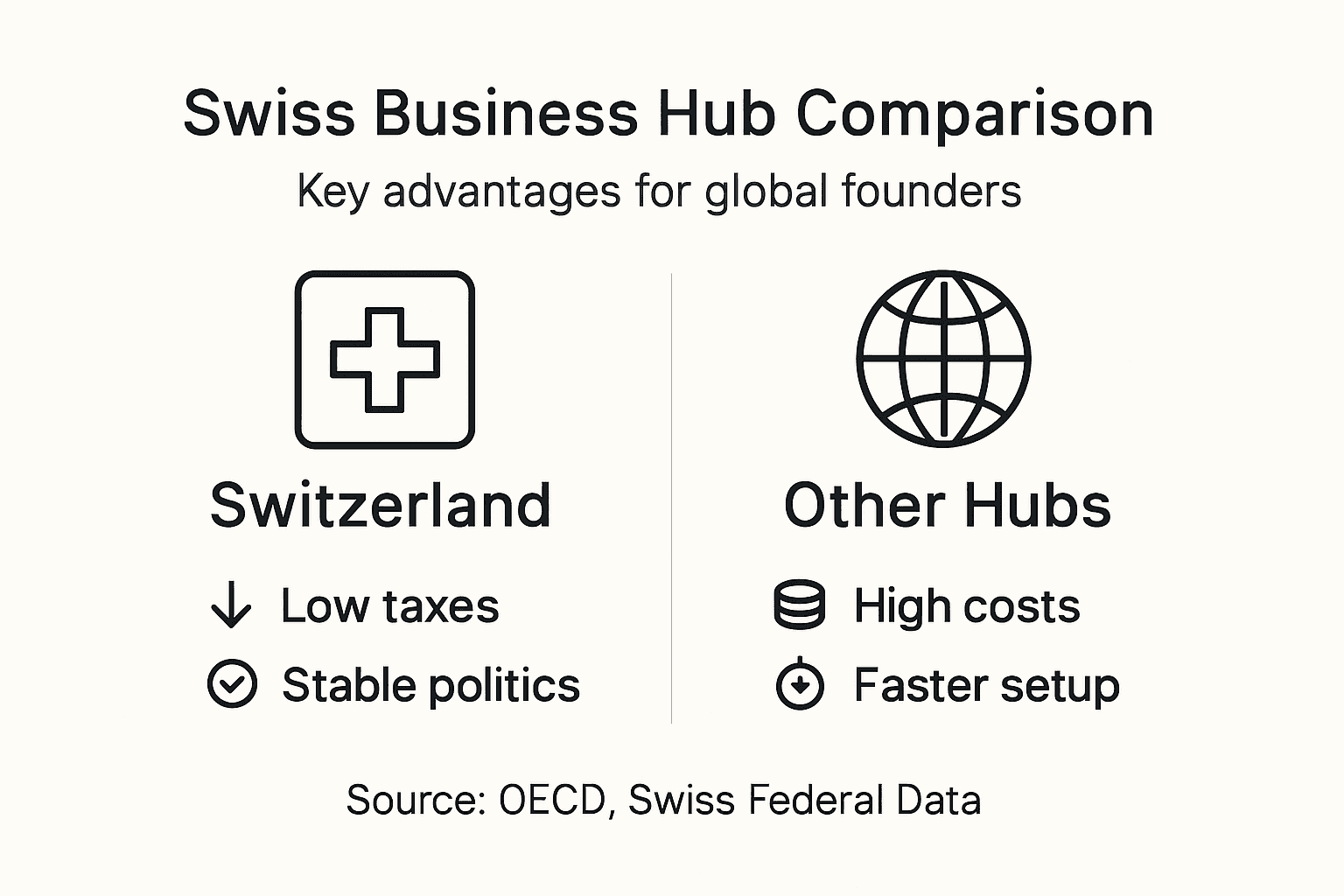
What distinguishes Switzerland is how it combines economic strength with SME support and low taxation. Unlike London, which caters primarily to massive financial institutions, or Berlin, which attracts startups but lacks tax efficiency, Switzerland actively supports entrepreneurs at every stage. Professional service providers specialize in helping foreign founders navigate formation. Banking options accommodate companies of all sizes. Accounting services scale with your business growth. The tax system rewards entrepreneurship through competitive rates and canton-specific incentives rather than penalizing business success. You don’t pay premium prices for basic services. Compare Swiss accounting costs to London or New York, and you’ll immediately see the difference. Your money funds growth rather than overhead.
Practically speaking, Switzerland competes differently than other hubs. It doesn’t market itself aggressively through government incentive programs or flashy startup competitions. Instead, it delivers consistent execution. Your company formation takes weeks, not months. Banking happens without excessive documentation demands. Compliance remains straightforward rather than Byzantine. The benefits of Swiss incorporation accumulate over years as your company operates in a jurisdiction where rules don’t change capriciously, courts enforce contracts reliably, and intellectual property protections work without question. For entrepreneurs building long term enterprises rather than seeking quick exits, this predictability has enormous value.
To better understand Switzerland’s unique position, here’s a summary comparison of leading global business hubs:
Factor | Switzerland | Singapore | Dubai | United Kingdom |
Corporate Tax Rate | 11.5-22% (canton variation) | 17% flat | 9% (0% for some zones) | 19% standard |
Political Stability | Exceptionally high | High | High | High |
Legal System | Transparent, investor-friendly | Efficient, advanced | Developing, less protection | Strong, established |
Banking Reputation | World-class, highly reliable | Robust, modern | Good for expats | Strong but highly regulated |
Company Formation Speed | 2-4 weeks | 2-3 weeks | 1-2 weeks | 2-6 weeks |
International Credibility | Very high | High | Moderate | High |
Pro tip: Before committing to any jurisdiction, compare your specific business model against Switzerland’s actual costs and requirements rather than reputation alone, as many entrepreneurs discover the tax rates and professional services in other hubs cost significantly more than Switzerland’s transparent pricing structure.
Unlock the Full Potential of Swiss Incorporation with Expert Support
Foreign entrepreneurs often face complex challenges when establishing a presence in Switzerland, from choosing the right company structure like GmbH or AG to navigating legal documentation and banking setup. The need for confidentiality, rapid company formation, and strict legal compliance can feel overwhelming for those lacking local knowledge. At https://rpcs.ch, we understand these pain points and offer a comprehensive solution to simplify every step, ensuring you make the most of Switzerland’s stable environment, favorable tax regimes, and international credibility.
Take control of your business future by partnering with Rpcs.ch to streamline your Swiss company formation process. Our expert services cover legal registration, notarization, banking account opening, and ongoing administrative support tailored to foreign founders. Don’t let bureaucracy slow your momentum. Visit why Switzerland is business friendly to learn how we turn Swiss incorporation advantages into your competitive edge. Ready to start? Explore how our Swiss company tax structure services can maximize your tax efficiency and compliance. Begin your journey toward effortless Swiss entrepreneurship today.
Frequently Asked Questions
What are the main reasons foreign entrepreneurs choose to establish a business in Switzerland?
Switzerland offers exceptional political stability, a transparent legal system, and competitive tax structures, making it an ideal location for international business operations.
What are the differences between the AG and GmbH company structures in Switzerland?
The AG (Aktiengesellschaft) requires a minimum capital of 100,000 Swiss francs, is more appealing to investors, and offers greater privacy. The GmbH (Gesellschaft mit beschränkter Haftung) requires 20,000 Swiss francs, is simpler to manage, and is suitable for small to medium enterprises.
How long does it take to set up a company in Switzerland?
The process of establishing a company in Switzerland typically takes between 2 to 4 weeks, assuming all documentation is prepared correctly.
What legal requirements must foreign founders meet to start a business in Switzerland?
Foreign founders must clearly define their corporate purpose, open a capital deposit account, complete notarized public deeds, and provide identity verification and proof of residency, although physical presence in Switzerland is not mandatory.
Recommended