
Swiss AG incorporation guide for global entrepreneurs
- May 4
- 10 min read

TL;DR:
Incorporating a Swiss AG enhances credibility, investor confidence, and tax positioning but requires strict legal compliance.
Key requirements include a minimum of CHF 100,000 share capital, at least one Swiss-resident director, and a physical Swiss registered address.
Proper planning and professional support are crucial to avoid delays, banking issues, and tax complications.
Incorporating a Swiss AG (Aktiengesellschaft, or joint-stock company) is one of the most powerful moves a global entrepreneur can make for credibility, tax positioning, and investor confidence. But the process trips up many non-residents who underestimate Switzerland’s strict legal requirements around capital, directors, and registered offices. Get these wrong and you face registration delays, banking rejections, or tax complications that can cost far more than the original setup fees. This guide breaks each stage into clear, actionable steps so you can move forward confidently and avoid the mistakes that derail most first-time Swiss founders.
Table of Contents
Key Takeaways
Point | Details |
Clear requirements | You need CHF 100,000 capital, a Swiss-resident director, and a registered office to form an AG. |
Seamless process | Swiss AG incorporation can be completed remotely and in as little as 1-2 days with the right preparation. |
Director choices matter | Using an active Swiss resident director ensures banking access and tax compliance, while nominees may cause problems. |
Canton selection | Choose your Swiss canton based on taxes, cost, and registration speed—Zug and Zurich are popular options for founders. |
Avoid shortcuts | Attempting to cut compliance corners risks banking difficulties, tax issues, and long-term headaches. |
What you need before you start: Requirements and preparation
Before you file a single document, you need to know exactly what Swiss law expects from you. The Swiss AG is a prestigious corporate structure, but it comes with non-negotiable minimums that you must satisfy from day one.
Share capital requirements
The minimum share capital for a Swiss AG is CHF 100,000, with at least CHF 50,000 or 20% paid up at the time of incorporation. That paid-in portion must sit in a blocked bank account until the Commercial Register confirms your registration. You can contribute capital in cash or through assets such as equipment, intellectual property, or real estate. Contributions in kind (non-cash assets) are accepted but require a certified valuation report prepared before the notarial deed is signed. This valuation step adds time, so budget for it early.
Director rules
This is where many global founders hit their first real obstacle. At least one director must be a Swiss resident with individual signing authority for the company. That means one board member must live in Switzerland and be authorized to bind the company independently, without co-signature from abroad. You can still hold shares and serve as a board member from outside Switzerland, but the Swiss-resident requirement cannot be waived. Understanding the full scope of director residency rules is essential before you shortlist your team.
Registered office
Your AG must have a physical registered address in Switzerland. A virtual office is acceptable for initial registration, which is good news for remote founders. However, “physical” means a verifiable address where official correspondence can be received and processed. A P.O. box alone will not satisfy authorities. See the full breakdown of registered office requirements to understand what documentation your address provider must supply.
Pre-formation checklist
Requirement | Detail |
Share capital | CHF 100,000 minimum; CHF 50,000 or 20% paid at formation |
Director residency | At least one Swiss-resident director with individual signing power |
Registered office | Physical Swiss address (virtual office acceptable initially) |
Capital contribution type | Cash or in-kind (in-kind requires certified valuation) |
Company name | Must be unique; verified with Commercial Register before filing |
Key documents to gather early:
Certified copies of founders’ passports
Proof of residential address for all directors
Bank confirmation of capital deposit (blocked account)
Draft articles of association (Statuten)
Valuation report if contributing in-kind assets
Pro Tip: Start your name availability check at least two weeks before you plan to sign the notarial deed. Name conflicts cause avoidable delays and the Commercial Register search tool does not catch every potential similarity issue that a notary will flag.
Step-by-step Swiss AG incorporation process
With your requirements organized, follow these steps to efficiently incorporate your Swiss AG. Each stage has a specific sequence and skipping ahead creates errors that require costly corrections.
Step 1: Verify company name availability Search the Swiss Commercial Register database (Zefix) to confirm your intended name is not already taken or confusingly similar to an existing company. Reserve the name informally with your notary.
Step 2: Prepare foundational documents Draft the articles of association covering share structure, board composition, voting rights, and purpose. Prepare the founders’ declaration, capital contribution plan, and any in-kind valuation reports. A detailed guide to preparing Swiss AG documents covers every template and signature requirement.
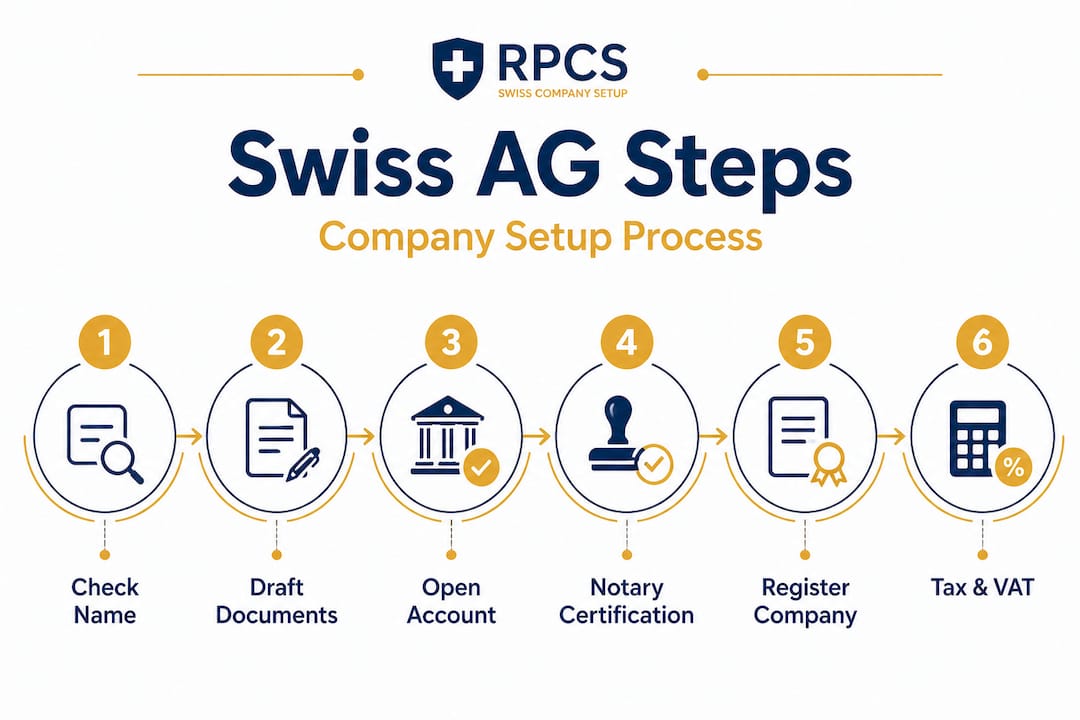
Step 3: Open a capital-blocking bank account Deposit the required paid-in capital into a blocked Swiss bank account. The bank issues a confirmation letter. This letter is mandatory for the notary appointment. Expect this step to take one to three weeks depending on your chosen bank’s due diligence process.
Step 4: Notarial deed certification Appear before a Swiss notary (in person or via power of attorney) to sign the articles of association and founders’ declaration. The notary certifies the entire formation deed. The detailed AG process overview explains precisely what the notary reviews and what documents must be originals versus certified copies.
Step 5: Register with the Commercial Register The notary submits the formation documents to the cantonal Commercial Register. Once approved, your AG receives its unique UID company number and appears publicly in the register. The blocked capital is then released to your company’s operating account.
Step 6: Register with tax authorities Apply for corporate income tax registration at the cantonal level and federal VAT registration if your projected revenue exceeds CHF 100,000 annually. Use the Swiss company formation checklist to track every registration deadline.
Remote incorporation via power of attorney
One of the most practical facts for non-resident founders: the entire process can be done remotely via a notarized power of attorney. You do not need to travel to Switzerland. Your authorized representative signs on your behalf before the Swiss notary. This makes Swiss AG formation genuinely accessible to founders based anywhere in the world.
Shelf AG versus custom formation
Factor | Custom AG | Shelf AG |
Timeline | 4 to 8 weeks | 1 to 2 days |
Upfront cost | CHF 5,000 to 15,000 formation fees | Higher purchase price |
Capital blocking period | Required | Already resolved |
Customization | Full flexibility | Limited initial flexibility |
Best for | Tailored structures | Speed-critical launches |
A shelf AG (ready-made company) is available for immediate setup in one to two days at a higher purchase price but eliminates the capital-blocking wait entirely. If you need a Swiss entity operational within days rather than weeks, a shelf AG is worth the premium.
Formation costs
Formation costs excluding capital typically run CHF 5,000 to 15,000, covering notary fees, Commercial Register fees, and legal advisory. Add the CHF 100,000 minimum share capital and your realistic first-year budget sits around CHF 105,000 to 111,000. This is the honest number to present to your CFO or investors before you commit.
Key considerations and common pitfalls
Once you know the steps, anticipate these critical decision points and avoid rookie mistakes that can derail your entire formation.
The director problem and why it matters more than you think
Choosing a nominee director (a local Swiss resident hired purely to satisfy the legal requirement) feels like an easy solution. But nominee resident directors trigger higher bank scrutiny, AML (anti-money-laundering) flags, and serious challenges when proving tax substance. Swiss banks are sophisticated. They look at whether the listed director genuinely manages the company or is simply a name on paper. If they suspect the latter, account opening gets complicated or denied outright. Explore the full risks in our nominee director risks guide before deciding.
Tax substance: the issue most founders overlook
Swiss corporate tax residency depends on where the company is effectively managed, not just where it’s registered. Tax residency requires genuine effective management in Switzerland, and a founder controlling operations remotely from Dubai or Singapore risks dual-residency claims and loss of Swiss double taxation treaty benefits. The consequence can be significant: paying tax in two jurisdictions simultaneously while losing the favorable Swiss rates you incorporated to access.
Capital and share structure errors
Underestimating the blocked account timeline and missing notary deadlines
Contributing in-kind assets without a certified valuation, which voids the formation
Setting up a single-class share structure when multiple share classes would serve investors better
Forgetting that share capital cannot be reduced below CHF 100,000 without a formal procedure
“The substance requirement is the hidden compliance layer that separates well-structured Swiss AGs from ones that eventually fail bank review or tax audits. Building real operational substance from day one protects your company for the long term.” — Common insight from Swiss formation advisors with multi-jurisdictional experience.
Banking and compliance tips
Contributions in kind are permitted for AG capital but require professional valuation before the notarial deed. Skipping or rushing this step is a common error that causes registrations to be rejected. For founders aiming at a specific bank relationship, align your director choice and office address with that bank’s due diligence profile before you even apply.
Pro Tip: Ask your Swiss formation advisor which banks they have active relationships with. A warm introduction from a recognized local partner cuts your account opening timeline from months to weeks and dramatically improves your approval odds.
For a complete strategic framework, the AG setup guide for global founders covers director strategy, banking preparation, and substance documentation in one place.
Costs, timelines, and canton selection
Having navigated compliance and strategy, let’s break down costs and your best location options. Where you register your AG affects your tax rate, administrative speed, and even your banking relationships.
Canton comparison
Canton | Corporate tax rate (approx.) | Notary speed | Best for |
Zug | ~11% to 12% | Fast | Low-tax holding/trading companies |
Zurich | ~19% to 20% | Fast | Financial services, large operations |
Schwyz | ~13% to 14% | Moderate | Cost-efficient SMEs |
Geneva | ~13% to 14% | Moderate | International/EU-facing businesses |
Zug and Zurich offer faster and cheaper notary processes, making them popular default choices. Zug specifically attracts holding companies and crypto firms due to its low effective corporate tax rates. However, the “right” canton depends on your business model, where your clients are, and whether you need specific regulatory licenses.
Full cost breakdown
Notary fees: CHF 1,500 to 3,000
Commercial Register fee: approx. CHF 600 to 900
Legal and advisory fees: CHF 2,500 to 10,000
Share capital (paid-in minimum): CHF 50,000
Annual accounting and compliance: CHF 3,000 to 8,000
Virtual office (annual): CHF 1,200 to 3,600
VAT registration timeline
VAT registration is required once annual turnover exceeds CHF 100,000. You can voluntarily register earlier if you want to reclaim input tax from the start. Many B2B companies benefit from early voluntary registration even below the threshold. Review Swiss incorporation best practices to determine whether early VAT registration makes financial sense for your specific model.
Timeline summary
Standard custom AG: 4 to 8 weeks from document preparation to registration
Shelf AG: 1 to 3 business days
Bank account opening after registration: 2 to 8 weeks depending on the bank
Expert take: What most guides miss about Swiss AG incorporation
Most guides tell you the rules. Here is what experience adds to that picture.
The Swiss AG is genuinely one of the world’s most credible corporate structures. Investors recognize it. Banks respect it. International counterparties treat it differently than an offshore holding vehicle from a less scrutinized jurisdiction. That credibility is real and worth pursuing. But credibility is not automatic. It is earned by how the company is built, not just that it exists.
The single biggest mistake we see sophisticated founders make is treating the resident director requirement as a formality. They hire the cheapest nominee solution they can find, point to legal compliance, and then wonder why Swiss banks take three months to open an account (or decline entirely). Swiss banks are not just checking boxes. They are assessing whether the company has genuine local management and economic substance. A nominee director who signs documents but has no real operational role broadcasts the opposite message.
The incorporation best practices that actually work long-term involve either hiring a genuinely active Swiss resident director with real authority, or structuring operations so that Swiss-based decisions are visibly documented and defensible under OECD guidelines. This is harder. It costs more. But it protects your tax treaty position, keeps your banking relationship clean, and prevents the painful unwinding process we have seen founders go through when shortcuts catch up with them.
Shareholder anonymity is another underused feature of the AG structure. Unlike a GmbH, the AG allows bearer shares in certain configurations, and the shareholder register is not public. For global investors who value privacy without sacrificing legal standing, this is a genuinely valuable feature. But it only works if the rest of the structure is solid.
The founders who get the most out of their Swiss AG are the ones who treat it as an operating company from day one, not a legal shell to be activated later. The Swiss system rewards substance and penalizes form over function. Build your AG to operate, not just to exist.
Get professional support for your Swiss AG setup
Setting up a Swiss AG correctly the first time saves you from costly corrections, banking delays, and tax complications down the line.

At RPCS, we support international entrepreneurs through every stage of Swiss company formation services, from name reservation and notarial preparation to Commercial Register filing and director coordination. Our network includes qualified Swiss resident directors, established banking partners, and licensed fiduciaries who know exactly what Swiss authorities and banks look for. We also provide Swiss accounting support to keep your AG fully compliant post-registration, and direct assistance with Swiss bank account setup so your capital is released and operational without unnecessary delays. Reach out to discuss your structure and get a clear timeline and cost estimate for your Swiss AG.
Frequently asked questions
Can non-residents incorporate a Swiss AG remotely?
Yes, foreign founders can form a Swiss AG via power of attorney without visiting Switzerland in person. A local authorized representative signs the notarial deed on your behalf.
What is the minimum capital required for a Swiss AG?
A Swiss AG requires at least CHF 100,000 in share capital, with a minimum of CHF 50,000 or 20% paid in at incorporation.
Do all Swiss AGs need a Swiss resident director?
Yes, at least one director must reside in Switzerland and hold individual signing authority. You cannot substitute this requirement with a foreign director alone.
Can I provide capital in assets instead of cash?
Yes, contributions in kind are allowed but require a professionally certified valuation completed before the notarial deed is signed.
What ongoing compliance is required after Swiss AG incorporation?
Swiss AGs must maintain Swiss-resident management, file annual audited or reviewed accounts, and register for VAT once annual turnover exceeds CHF 100,000.
Recommended
Comments