
Swiss Business Permits: Key Steps for Foreign Founders
- Jan 2
- 7 min read

Most American, European, and Asian entrepreneurs are surprised to learn that over 80 percent of Swiss cantons actively encourage international company founders with clear business permit pathways. Navigating Swiss permits matters because each approval directly affects your company’s credibility, tax obligations, and long-term expansion potential. This article breaks down common misconceptions and reveals how strategic permit choices can simplify Swiss GmbH or AG formation for foreign owners.
Table of Contents
Key Takeaways
Point | Details |
Understanding Permit Types | Foreign entrepreneurs must be aware of distinct permit pathways based on nationality and business structure, especially between EU/EFTA and third-country nationals. |
Regulatory Compliance is Critical | Entrepreneurs should meticulously follow regulatory procedures, including preparing comprehensive application packages to avoid delays or penalties. |
Sector-Specific Challenges | Different industries face unique licensing requirements; diligent research and specialized legal counsel can help navigate these complexities efficiently. |
Anticipate Costs and Timelines | Compliance costs and approval timelines vary greatly by sector, so budgeting for potential additional expenses is crucial for successful business establishment. |
Swiss Business Permits Explained and Misconceptions
Navigating the Swiss business landscape requires understanding the nuanced permit requirements for foreign entrepreneurs. While many assume obtaining a business permit is complex, Switzerland actually offers a relatively straightforward process for company formation. Key steps for establishing a business can be efficiently managed through official channels, with most sectors having minimal bureaucratic hurdles.
Contrary to common misconceptions, Switzerland does not impose blanket restrictions on foreign business founders. Different cantons have specific regulations, but the overall approach encourages international entrepreneurship. Business permits typically depend on factors like business type, company structure, and the specific economic sector. For instance, regulated industries such as finance, healthcare, and legal services require more rigorous authorization processes compared to technology or consulting ventures.
The Swiss system divides business permits into several categories, each with unique requirements. These include resident permits, work permits, and business registration permits. Foreign founders must typically demonstrate financial stability, professional qualifications, and a clear business plan. Specific requirements vary based on whether you’re establishing a sole proprietorship, partnership, or corporate entity like a GmbH (Limited Liability Company) or AG (Stock Corporation).
Pro Tip: Consult with a local Swiss business registration expert who understands cantonal nuances to streamline your permit application process and avoid potential administrative complications.
Main Permit Types for Foreign Entrepreneurs
Foreign entrepreneurs seeking to establish businesses in Switzerland encounter distinct permit pathways depending on their national origin and business structure. EU and EFTA nationals enjoy more streamlined processes for company formation, with specific residence permits designed to facilitate entrepreneurial activities.
The Swiss permit system fundamentally differentiates between two primary categories: EU/EFTA nationals and third-country nationals. For EU/EFTA entrepreneurs, a B residence permit valid for five years provides significant mobility and flexibility. These permits require entrepreneurs to demonstrate concrete business plans, including proof of VAT registration, business documentation, and social insurance arrangements. Key legal structures like sole proprietorships, partnerships, GmbH (Limited Liability Companies), and AG (Stock Corporations) each have unique permit requirements.
Third-country nationals face more complex permit acquisition processes. Entrepreneurs must navigate stricter conditions that evaluate potential economic contributions, such as job creation potential and economic diversification. These applicants typically need to secure both residence and work permits, often requiring partnerships with Swiss representatives or local directors. Some entrepreneurs utilize nominee director services to meet residency requirements and simplify the administrative landscape.
Pro Tip: Engage a Swiss business immigration specialist early in your planning process to understand the nuanced permit requirements specific to your national origin and proposed business structure.
Here’s a comparison of permit pathways for Swiss business founders based on nationality:
Nationality Category | Main Permit Type | Key Requirements | Typical Approval Complexity |
EU/EFTA Nationals | B Residence Permit | Business plan, VAT, social insurance proof | Lower, streamlined |
Third-Country Nationals | B + Work Permit | Job creation, Swiss partner, strict review | Higher, multi-step process |
Key Regulatory Requirements and Procedures
Navigating Switzerland’s complex regulatory landscape demands meticulous attention to detail for foreign entrepreneurs. Regulatory procedures vary significantly depending on national origin and business structure, with specific documentation and compliance requirements that must be precisely followed.
The regulatory framework establishes distinct pathways for different entrepreneur categories. EU/EFTA nationals must register their self-employment activities and secure a B permit, demonstrating comprehensive business documentation including VAT registration, social insurance arrangements, and detailed business plans. Third-country nationals face more rigorous scrutiny, requiring extensive evidence of economic contribution, potential job creation, and economic diversification potential. Cantonal migration and labor authorities conduct thorough evaluations of proposed business activities, assessing factors like financial sustainability, market potential, and alignment with Swiss economic interests.
Key procedural requirements include multiple layers of documentation and administrative processes. Entrepreneurs must prepare comprehensive application packages that include business plans, financial projections, proof of professional qualifications, and potential partnerships with Swiss representatives. Permit types range from temporary L permits to more stable B residence permits, with renewal contingent on demonstrating ongoing economic value. Property ownership regulations add another complexity, particularly for third-country nationals who typically require a C permit for real estate investments.
Pro Tip: Engage a Swiss business compliance expert to meticulously review your application documentation and ensure every regulatory requirement is comprehensively addressed before submission.
Sector-Specific Licenses and Approvals
Switzerland’s regulatory landscape features intricate licensing requirements that vary significantly across different industry sectors, demanding precise understanding and strategic navigation. Financial sector businesses encounter particularly rigorous authorization processes monitored by specialized regulatory bodies, with licenses reflecting the complexity and sensitivity of financial operations.
The financial services sector represents the most comprehensive licensing environment. The Swiss Financial Market Supervisory Authority (FINMA) administers multi-tiered licensing frameworks for banks, insurance companies, fund managers, and financial infrastructures. These licenses are not merely administrative formalities but preventive control mechanisms ensuring institutional quality, financial stability, and comprehensive compliance. Some financial activities require ongoing prudential supervision, while others might necessitate one-time registration with less intensive monitoring.
Specialized sector licenses extend beyond financial services, encompassing critical domains like food safety, healthcare, and scientific research. Cantonal authorities issue precise operating permits that not only satisfy domestic regulatory requirements but also ensure international market eligibility. Industries such as food production, diagnostic laboratories, and specialized scientific research facilities must obtain specific authorizations that demonstrate adherence to stringent Swiss and international safety standards. These sector-specific licenses serve dual purposes of regulatory compliance and maintaining Switzerland’s reputation for exceptional quality and precision.
Pro Tip: Retain specialized legal counsel familiar with Swiss sector-specific licensing to navigate the complex approval landscape and ensure comprehensive regulatory alignment.
Compliance Costs, Timelines, and Common Risks
Navigating Switzerland’s complex regulatory environment requires a strategic approach to understanding the intricate landscape of compliance costs and potential risks. The licensing requirements span federal, cantonal, and municipal levels, creating a multifaceted regulatory framework that demands careful navigation, with significant variations in processing times, expenses, and administrative complexity.
Compliance costs in Switzerland are not uniform but fluctuate dramatically based on industry sector, business structure, and specific cantonal regulations. Financial services, healthcare, and technology sectors typically incur the highest compliance expenses, with initial setup costs potentially ranging from 5,000 to 50,000 Swiss francs. These expenses encompass professional consultation fees, documentation preparation, administrative processing, legal reviews, and potential mandatory representation requirements. Timelines for obtaining full regulatory approval can extend from three to twelve months, depending on the complexity of the business model and the specific regulatory scrutiny associated with the chosen industry.
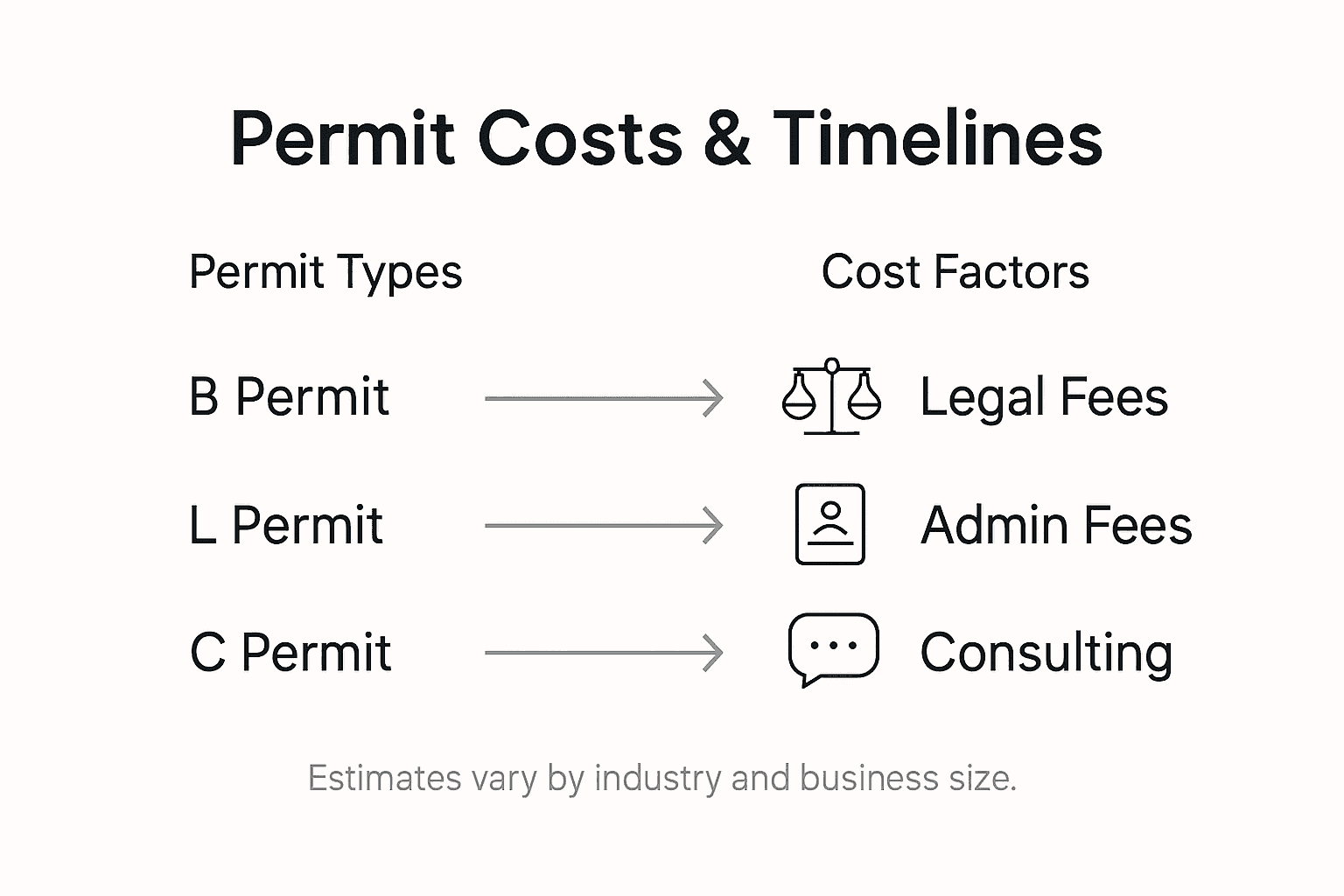
Foreign entrepreneurs must anticipate and mitigate several critical risks inherent in the Swiss regulatory landscape. Common challenges include potential delays in permit processing, penalties for inadvertent non-compliance, inconsistent interpretations of regulations across different cantons, and the substantial financial implications of regulatory missteps. Successful navigation requires meticulous documentation, proactive communication with regulatory bodies, and often engaging specialized local experts who understand the nuanced regional variations in administrative requirements. Entrepreneurs should budget not just for direct compliance costs but also for potential consultancy and legal support to ensure smooth regulatory passage.
Below is a summary of common compliance costs and timelines by sector for Swiss business formation:
Sector | Estimated Setup Cost (CHF) | Typical Approval Time | Main Cost Drivers |
Financial Services | 20,000 – 50,000 | 6–12 months | Licensing, legal, ongoing compliance |
Healthcare | 10,000 – 30,000 | 6–12 months | Regulatory approval, specialist fees |
Technology | 5,000 – 15,000 | 3–9 months | IP registration, permits |
Consulting | 5,000 – 10,000 | 3–6 months | Registration, local representation |
Pro Tip: Allocate a contingency budget of 15-25% above estimated compliance costs to accommodate unexpected regulatory requirements and potential administrative complexities.
Simplify Your Swiss Business Permit Journey with Expert Support
Understanding Swiss business permits involves complex steps like securing B residence permits or work permits, navigating cantonal regulations, and meeting sector-specific licensing requirements. Many foreign founders face challenges such as lengthy approval timelines, strict documentation standards, and uncertainty about local rules. These pain points can delay your company formation and increase compliance risks.
At RPCS, we specialize in guiding international entrepreneurs through the entire Swiss business permit and company setup process. Our comprehensive services cover everything from legal documentation and notarization to VAT registration and banking setup — all tailored to your GmbH or AG formation needs. With our local expertise, you avoid costly errors and time-consuming hurdles while ensuring full compliance with cantonal and federal regulations.
Start your Swiss business confidently today. Visit RPCS to access professional support that accelerates your permit approval and company registration. Don’t let complicated regulations hold you back — get in touch now and secure your Swiss company foundation with trusted experts by your side.
Frequently Asked Questions
What types of permits are required for foreign entrepreneurs in Switzerland?
Foreign entrepreneurs typically need several types of permits, including resident permits, work permits, and business registration permits. Specific requirements vary by business structure and type.
What are the main requirements for obtaining a B residence permit?
To obtain a B residence permit, EU/EFTA nationals must provide proof of a concrete business plan, VAT registration, business documentation, and social insurance arrangements, among other financial requirements.
How do permit requirements differ for EU/EFTA nationals and third-country nationals?
EU/EFTA nationals enjoy streamlined permit processes, primarily requiring a B residence permit. In contrast, third-country nationals face stricter conditions, needing both a residence and a work permit, often with additional evaluation of economic contributions.
What are common compliance costs and timelines for starting a business in Switzerland?
Compliance costs vary by sector, typically ranging from CHF 5,000 to CHF 50,000. Approval times can range from three to twelve months, depending on the complexity of the business and regulatory requirements.
Recommended
Comments