
Complete Guide to Swiss Company Registration Process
- Nov 22, 2025
- 7 min read
Updated: Dec 29, 2025

Setting up a company in Switzerland is more popular than ever among american entrepreneurs, with over 40,000 foreign firms calling the country home. Switzerland’s reputation for business stability and clear legal systems makes it an appealing choice for those aiming to branch into the European market. Whether you are looking for flexible management or scalable growth, understanding Swiss company registration basics gives you a head start on entering one of the world’s most reliable business environments.
Table of Contents
Key Takeaways
Point | Details |
Company Structures | Switzerland primarily offers AG and GmbH as corporate structures, each suited for different business types and sizes. |
Registration Process | Entrepreneurs must follow a detailed registration process involving several key steps, including selecting a business structure and preparing incorporation documents. |
Compliance Obligations | Companies in Switzerland must adhere to strict regulatory standards, including taxation, labor laws, and corporate governance requirements. |
Cost Considerations | Establishing a Swiss entity involves initial setup costs and ongoing administrative expenses, which should be budgeted carefully by international entrepreneurs. |
Understanding Swiss Company Registration Basics
Switzerland offers an attractive and strategic environment for international entrepreneurs seeking to establish a robust business presence. According to usemultiplier.com, the Swiss company registration process involves navigating specific legal requirements and understanding the unique corporate landscape that makes Switzerland a premier business destination.
When considering company registration in Switzerland, entrepreneurs have multiple corporate structure options, with the most common being Aktiengesellschaft (AG) and Gesellschaft mit beschränkter Haftung (GmbH). Each structure presents distinct characteristics and requirements. The AG is ideal for larger enterprises seeking public investment, while the GmbH works well for smaller to medium-sized businesses wanting more flexible management and lower initial capital requirements.
The registration process demands meticulous preparation and adherence to Swiss regulatory standards. Key preliminary steps include:
Selecting an appropriate business structure
Choosing a unique company name
Determining initial share capital
Preparing comprehensive incorporation documents
Securing a local registered business address

Opening a Swiss bank account
International entrepreneurs must also recognize that Switzerland’s business environment prioritizes transparency, compliance, and professional standards. While the process might seem complex, working with specialized corporate services can streamline your registration journey and ensure you meet all legal and administrative requirements.
For a comprehensive walkthrough of the specific incorporation steps, check out our Company Formation Checklist Switzerland: Step-by-Step Guide, which provides detailed insights into navigating the Swiss company registration landscape.
Types of Swiss Legal Business Entities
Switzerland offers a diverse range of legal business entities designed to accommodate various business needs and strategic objectives. Understanding these structures is crucial for international entrepreneurs seeking to establish a robust corporate presence in the Swiss market.
The primary legal business entities in Switzerland include:
Aktiengesellschaft (AG): A stock corporation characterized by:
Minimum share capital of CHF 100,000
Shares can be publicly traded
Suitable for larger enterprises
Requires at least one Swiss resident director
Provides limited liability protection
Gesellschaft mit beschränkter Haftung (GmbH): A limited liability company featuring:
Minimum share capital of CHF 20,000
More flexible management structure
Ideal for small to medium-sized businesses
Lower administrative requirements
Restricted transferability of ownership shares
Holding Company: A specialized corporate structure designed for:
Investment and asset management
Tax optimization strategies
Wealth preservation
Minimal operational requirements
Potential tax advantages
Branch Office: An extension of a foreign company that:
Does not create a separate legal entity
Requires registration in the Swiss commercial register
Directly represents the parent company’s operations
Simplifies market entry for international businesses
For entrepreneurs specifically interested in the advantages of establishing a Swiss GmbH, our guide on Swiss GmbH advantages provides comprehensive insights into this versatile business structure. Each entity type offers unique benefits, and selecting the right one depends on your specific business goals, capital requirements, and operational complexity.
Step-by-Step Swiss Company Formation Process
The Swiss company formation process requires meticulous planning and adherence to specific legal requirements. According to usemultiplier.com, the registration journey involves several critical steps designed to ensure transparency, compliance, and legal validity for international entrepreneurs.
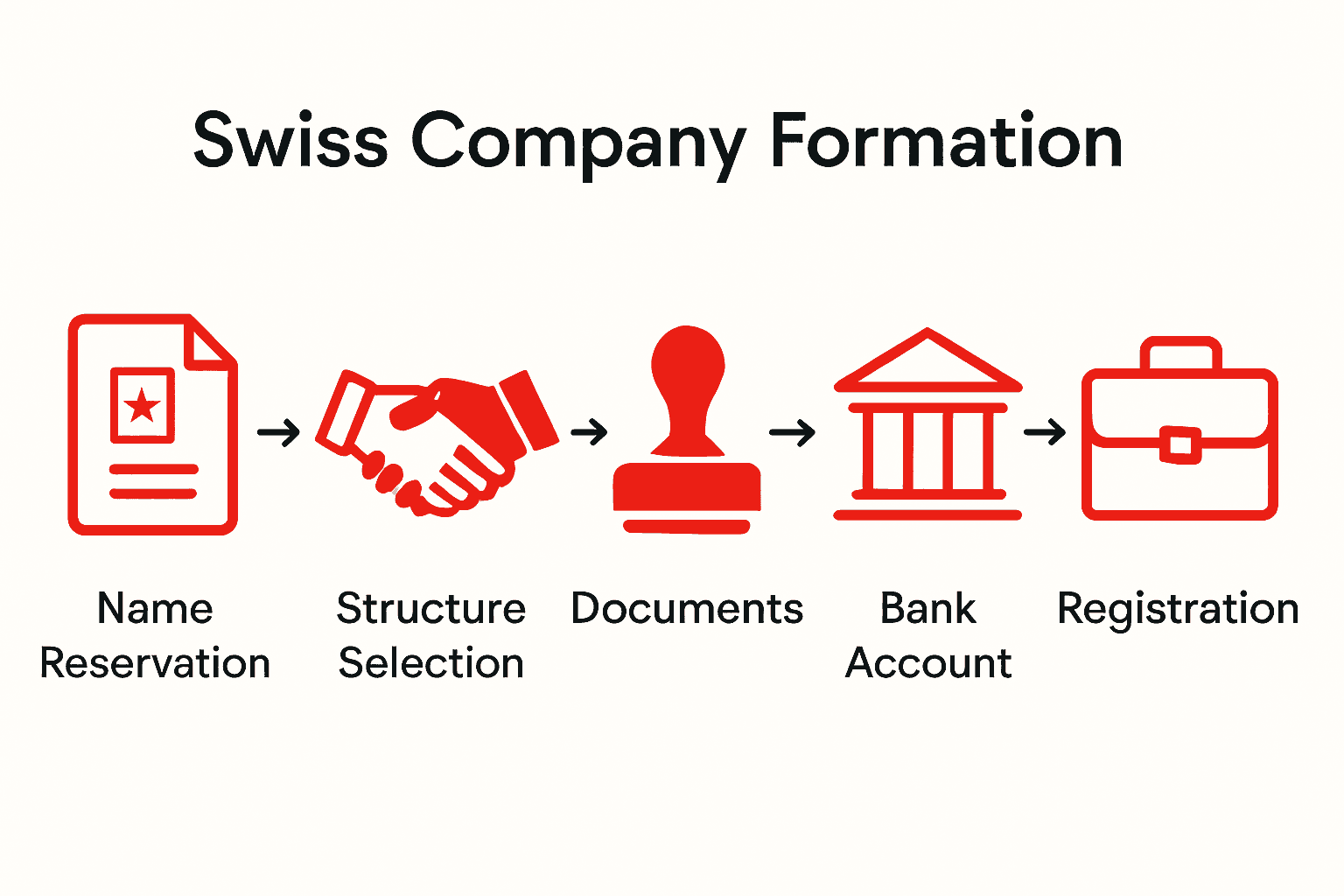
The comprehensive company formation process typically encompasses the following key stages:
Name Reservation and Preliminary Research
Conduct thorough name availability check
Verify no existing trademark conflicts
Reserve proposed company name with Swiss authorities
Prepare initial business concept documentation
Corporate Structure Preparation
Select appropriate legal entity type (AG or GmbH)
Draft comprehensive articles of association
Define initial share capital requirements
Determine shareholder and directorship structure
Financial and Legal Documentation
Prepare detailed incorporation documents
Open a Swiss bank account for capital deposit
Validate minimum capital requirements
Obtain necessary corporate identification numbers
Official Registration Process
Schedule notarization of incorporation documents
Register with the Swiss Commercial Register
Obtain official business registration number
Complete tax registration procedures
Entrepreneurs should recognize that while these steps might seem complex, working with specialized corporate services can significantly streamline the registration process. Each stage demands precision and compliance with Swiss regulatory standards.
For a more detailed exploration of the incorporation timeline and specific procedural nuances, our Swiss Incorporation Timeline guide provides comprehensive insights into navigating this intricate process effectively.
Legal Requirements and Compliance Obligations
Navigating the complex landscape of Swiss business compliance requires a comprehensive understanding of legal obligations. According to usemultiplier.com, businesses must meticulously address multiple regulatory requirements spanning taxation, labor laws, and industry-specific regulations.
Key Compliance Dimensions for Swiss company operations include:
Taxation and Financial Reporting
Mandatory VAT registration
Annual financial statement submissions
Precise tax reporting protocols
Corporate income tax declarations
Maintenance of standardized accounting records
Labor and Employment Regulations
Mandatory employee insurance schemes
Adherence to Swiss employment contract standards
Compliance with worker protection legislation
Social security contribution management
Workplace safety and health regulations
Corporate Governance Requirements
Regular commercial register updates
Transparent shareholder information disclosure
Documented board meeting protocols
Internal control system maintenance
Strict anti-money laundering compliance
Industry-Specific Licensing
Obtain relevant operational permits
Meet sector-specific regulatory standards
Maintain ongoing professional certifications
Comply with specialized industry regulations
Regular compliance audits and inspections
International entrepreneurs must recognize that Swiss regulatory frameworks prioritize precision, transparency, and systematic compliance. Failure to meet these rigorous standards can result in significant financial penalties and potential business operational restrictions.
To ensure seamless navigation of these complex requirements, consulting with specialized Swiss corporate compliance experts becomes not just recommended, but essential for sustainable business operations.
Costs, Taxes, and Ongoing Administration
Establishing and maintaining a Swiss company involves strategic financial planning and understanding the comprehensive cost structure. According to usemultiplier.com, the financial landscape encompasses registration fees, share capital requirements, and ongoing operational expenses that international entrepreneurs must carefully navigate.
Initial Establishment Costs typically include:
Company registration fees (CHF 500 - CHF 2,000)
Notary and legal documentation expenses
Initial share capital requirements
Bank account opening charges
Commercial register submission fees
Corporate Tax Structure:
Federal corporate tax rate: 8.5%
Cantonal and municipal tax rates: 1% - 16%
Effective total corporate tax range: 11.9% - 24.5%
Potential tax reductions for holding companies
Advantageous tax treaties with multiple countries
Ongoing Administrative Expenses:
Annual accounting and bookkeeping services
Mandatory financial statement preparation
Statutory audit requirements
Compliance and regulatory reporting
Annual commercial register maintenance
The total annual administrative costs for a small to medium-sized Swiss company typically range between CHF 5,000 and CHF 20,000, depending on complexity and specific business requirements. International entrepreneurs should budget accordingly and anticipate these recurring expenses as part of their Swiss business strategy.
For businesses seeking a comprehensive understanding of financial commitments, our Swiss Incorporation Timeline guide offers detailed insights into the financial aspects of establishing and maintaining a Swiss corporate entity.
Simplify Your Swiss Company Registration Journey Today
Navigating the intricate Swiss company registration process can feel overwhelming, especially when dealing with legal requirements such as selecting the right corporate structure, preparing incorporation documents, and ensuring regulatory compliance. Whether you plan to establish an AG or GmbH, overcoming challenges like notarization, bank account setup, and ongoing administration demands precise knowledge and local expertise. You do not have to face these complexities alone.

Partner with RPCS to transform this daunting process into a streamlined experience. Our professional services cover every step including legal documentation, registration, banking, and continuous corporate support designed specifically for international entrepreneurs. Take advantage of our expertise to ensure rapid setup, confidentiality, and full compliance with Swiss laws. Discover more about how to navigate Swiss company formation efficiently and explore the benefits of Swiss GmbH registration with trusted guidance at your side. Don’t wait to secure your business’s future in Switzerland. Visit RPCS now and start your company registration with confidence.
Frequently Asked Questions
What are the main types of business entities in Switzerland?
Switzerland primarily offers four legal business entities: Aktiengesellschaft (AG), Gesellschaft mit beschränkter Haftung (GmbH), Holding Company, and Branch Office. Each type has distinct characteristics and is suited for different business needs.
What is the minimum share capital required to register an AG or GmbH in Switzerland?
The minimum share capital for an Aktiengesellschaft (AG) is CHF 100,000, while for a Gesellschaft mit beschränkter Haftung (GmbH), it is CHF 20,000. These requirements ensure a financial foundation for the business entity.
What are the key steps in the Swiss company registration process?
The main steps include selecting a company name, determining the business structure, preparing incorporation documents, opening a Swiss bank account, and officially registering with the Swiss Commercial Register.
What are the ongoing compliance obligations for a Swiss company?
Companies in Switzerland must adhere to taxation and financial reporting laws, labor regulations, corporate governance requirements, and industry-specific licensing. Regular audits and compliance checks are also necessary to maintain operational legitimacy.
Recommended
Comments