
Swiss VAT Registration Explained: Compliance for Foreign Firms
- Jan 25
- 13 min read
Updated: Jan 27

Entering the Swiss market brings both opportunity and complexity for foreign entrepreneurs in technology and finance. Setting up a company means understanding each layer of Swiss VAT law, where failing to register after reaching CHF 100,000 in worldwide taxable turnover can expose your business to compliance risks and penalties. Getting these basics right is vital, from knowing what counts as a Swiss supply to choosing a fiscal representative who keeps your operations on track right from day one.
Table of Contents
Key Takeaways
Point | Details |
Swiss VAT operates as an all-phase tax. | Businesses can deduct VAT paid on inputs from VAT collected on outputs, ensuring only the added value is taxed. |
Mandatory registration threshold is CHF 100,000. | Foreign companies generating over this amount in Switzerland must register for VAT, regardless of other factors. |
Choose a fiscal representative if non-resident. | Foreign firms without a permanent establishment must appoint a Swiss fiscal representative for compliance. |
Maintain meticulous record-keeping. | Companies must ensure accurate invoicing and bookkeeping to manage VAT liabilities and avoid hefty penalties. |
Swiss VAT Registration Fundamentals
Swiss VAT, officially known as value-added tax, functions as an indirect tax collected at each stage of the supply chain. Unlike sales taxes that apply once at the point of purchase, VAT operates as an all-phase tax with input tax deduction), meaning businesses can deduct the VAT they pay on inputs from the VAT they collect on outputs. This system ensures only the actual added value gets taxed as products and services move through the economy. For foreign entrepreneurs entering the Swiss market, understanding how this mechanism works is critical because it directly affects pricing, cash flow, and compliance obligations.
The Swiss Federal Tax Administration (SFTA) sets the framework for VAT collection, and the current standard rate sits at 8.1%, with reduced rates of 2.5% for essentials like food and 3.7% for accommodations and printed media. When you establish operations in Switzerland, your obligation to register for VAT depends primarily on your annual turnover. The registration threshold stands at 100,000 Swiss francs annually, meaning once your revenue crosses this level, registration becomes mandatory rather than optional. Foreign companies operating in Switzerland face the same requirements as domestic entities, though certain special rules apply to cross-border services and digital deliveries. Your Swiss Business Number, obtained during company registration, works alongside your VAT number to track tax obligations.
Before diving into registration, you’ll need to determine whether your business activities actually trigger VAT liability in Switzerland. Services provided to foreign clients, exports of goods, and certain financial services qualify for VAT exemption or zero-rating. By contrast, selling goods or services within Switzerland to Swiss customers almost always means VAT registration is necessary. This is where mistakes commonly occur, especially with tech and finance companies offering digital products or consulting services across borders. The distinction between what qualifies as a Swiss supply versus a foreign supply can be surprisingly nuanced, particularly when clients are located abroad but your business is physically based in Switzerland.
Here is a summary of VAT rates and how they apply to different business activities in Switzerland:
Type of Supply | VAT Treatment | Common Examples |
Domestic sales | Standard rate (8.1%) | Retail, consulting |
Essential goods (e.g., food) | Reduced rate (2.5%) | Supermarkets, groceries |
Accommodations, printed media | Special rate (3.7%) | Hotels, newspapers |
Exports to non-Swiss clients | Zero-rated | International shipments |
Certain financial services | Exempt | Investment advisory |
Pro tip: Before registering for VAT, conduct a thorough analysis of your expected annual turnover and the geographic location of your customers, as this determination shapes whether registration is mandatory or optional and significantly impacts your cash flow management from day one.
Types of VAT Registration and Thresholds
Switzerland operates a single VAT registration system rather than multiple tiers, but understanding the threshold mechanics is essential for foreign companies planning to operate here. The key number to remember is CHF 100,000 in annual taxable turnover. Once your business crosses this threshold, VAT registration becomes mandatory regardless of business structure or industry sector. This applies equally to technology startups launching digital platforms, finance companies offering advisory services, and traditional goods-based businesses. The threshold captures all types of supplies: goods sold, services rendered, and even rental income from commercial property. For foreign entrepreneurs, this means you cannot avoid registration by operating through a smaller entity or claiming temporary status; once you hit that revenue mark, compliance is non-negotiable.
What makes the Swiss system distinctive is how it treats specific business activities. Services provided to customers outside Switzerland often qualify for zero-rating or exemption, which can actually reduce your VAT burden significantly. By contrast, services delivered to Swiss residents or businesses located in Switzerland count toward your taxable turnover threshold. This creates a planning opportunity for tech and finance companies with international clients, where geographic location of customers directly impacts registration obligations. Additionally, Switzerland recognizes both voluntary and mandatory registration scenarios. If you’re below the CHF 100,000 threshold but anticipate growth, you can voluntarily register for VAT, which unlocks input tax deduction benefits immediately. Non-resident companies face slightly different rules, but the CHF 100,000 threshold still applies when they maintain a place of business or fixed establishment in Swiss territory.
The registration process itself triggers when your accountant or tax advisor files the VAT registration application with the State Secretariat for Finance (SSEF). Unlike some jurisdictions with complex tiered systems, Switzerland keeps this straightforward. However, the simplicity masks an important consideration: once registered, you must file VAT returns quarterly or annually depending on your turnover volume. Companies exceeding CHF 500,000 in annual turnover must typically file quarterly, while smaller operations may qualify for annual filing. This filing cadence affects your accounting workload and cash flow timing, particularly when managing input tax recovery. Working with experienced accountants familiar with Swiss VAT liability rules for foreign companies ensures you understand these nuances before registration.
Below is a comparison of mandatory versus voluntary VAT registration for foreign companies:
Registration Approach | Key Benefit | Main Drawback | Typical User |
Mandatory (≥ CHF 100k) | Legal compliance required | No input tax claim before reached | All large businesses |
Voluntary (< CHF 100k) | Immediate input tax recovery | Added compliance costs | Startups planning for growth |
Pro tip: Calculate your projected annual turnover realistically before launch; if you anticipate exceeding CHF 100,000 within the first 12 months, register voluntarily from day one to capture input tax deductions on startup expenses rather than dealing with retroactive adjustments.
Registration Requirements for Foreign Firms
Foreign companies entering Switzerland face specific VAT registration requirements that differ in important ways from domestic entities. The baseline rule remains simple: if your company generates more than CHF 100,000 in taxable turnover from supplies within Switzerland, registration is mandatory. However, the mechanics of compliance become more complex for non-resident firms. Foreign companies must register for Swiss VAT and, critically, must appoint a Swiss fiscal representative if they lack a domicile, registered office, or permanent establishment within Swiss territory. This fiscal representative acts as your legal point of contact with the Swiss tax authorities, receiving correspondence and handling compliance matters on your behalf.

The registration process requires preparing and submitting comprehensive documentation to establish your company’s legitimacy and tax status. You’ll need to provide commercial register extracts proving your company’s legal existence in your home country, detailed business activity descriptions outlining what you actually sell or produce, and proof that your turnover calculations are accurate. The application itself goes through the cantonal tax authority in the region where your fiscal representative is based, not directly to the Federal Tax Administration. This geographical component matters because processing timelines and specific requirements can vary slightly by canton. Additionally, you must furnish a power of attorney document authorizing your chosen fiscal representative to act on your behalf for all VAT matters. This document requires notarization in many cases, adding another administrative layer that foreign entrepreneurs often underestimate.
What makes this process smoother is understanding that your fiscal representative does not need to be an accountant or lawyer; many tax advisors and consulting firms in Switzerland offer this service specifically for foreign companies. When selecting your fiscal representative, you’re essentially choosing who will receive your VAT assessment notices, file your returns, and communicate with authorities. This person or entity becomes your direct link to Swiss tax compliance. The representative must be established in Switzerland and maintain a Swiss address, but they handle the bureaucratic side while your actual business operations can remain entirely remote. Many foreign firms use their accounting service provider as their fiscal representative, creating a seamless workflow where your accountant manages both bookkeeping and tax representation simultaneously.
Pro tip: Designate your fiscal representative before reaching the CHF 100,000 turnover threshold rather than scrambling to find one afterward; this allows smooth registration and prevents the messy retroactive compliance situations that cost time and money.
Key Roles and Responsibilities for VAT Compliance
Once registered for Swiss VAT, your company takes on specific obligations that extend far beyond simply collecting and remitting tax. Your organization becomes responsible for ensuring correct VAT collection on all taxable supplies, maintaining meticulous invoicing records that comply with Swiss standards, and managing comprehensive bookkeeping systems that track every transaction. Foreign companies liable to Swiss VAT must ensure correct VAT collection, invoicing, bookkeeping, periodic VAT returns, and payment compliance. This means your internal systems need to capture not just revenue figures, but the VAT component of each transaction separately. For technology and finance companies operating with digital invoicing, this often requires updating accounting software or implementing new internal controls to flag taxable versus exempt supplies. The responsibility sits with your company’s management and accounting team to ensure these systems function correctly before the first VAT liability period closes.
Your fiscal representative handles much of the direct communication with Swiss tax authorities, but this does not eliminate your company’s underlying obligations. Think of your fiscal representative as your authorized agent rather than a shield from compliance duties. You still need to provide your fiscal representative with accurate financial information, supporting documentation, and timely responses to any tax authority inquiries. The representative files your periodic VAT returns (typically quarterly or annually depending on your turnover), but you must supply the underlying data. This creates a shared responsibility structure where your company ensures data accuracy and your representative ensures proper filing and compliance with procedural requirements. When tax authorities request additional documentation or clarification about your VAT calculation, your fiscal representative may request this information from you, and delays in your response delay the entire process.
Record-keeping becomes your operational anchor for VAT compliance. You must maintain detailed records of all supplies made, VAT charged, input tax deducted, and supporting documentation for every significant transaction. Swiss authorities expect these records to be retained for at least ten years, accessible in Switzerland, and producible on demand during audits. For companies with multiple revenue streams or complex service offerings, this documentation burden can become substantial. Many foreign firms underestimate the administrative weight of VAT compliance when they focus only on the registration process itself. The good news is that modern accounting software handles much of this automatically if properly configured, but manual reconciliation and monitoring remain essential. Your accounting service provider can manage this workload, but you must ensure they have access to complete transaction data from all your business channels.
Pro tip: Implement VAT compliance workflows into your accounting software immediately upon registration, assigning responsibility for VAT classification on each transaction to the team member recording sales, rather than trying to reclassify everything during quarterly reconciliation.
Costs, Risks, and Common Pitfalls
VAT compliance carries real financial weight that many foreign entrepreneurs underestimate during their launch planning. The direct costs start with appointing a Swiss fiscal representative, typically running between CHF 1,500 and 3,500 annually depending on your transaction volume and complexity. Then comes accounting and bookkeeping support to maintain your VAT records, which adds another CHF 3,000 to 8,000 yearly. For companies with significant international operations, you might need specialized VAT advisory services to navigate cross-border rules, pushing costs higher. But the hidden expenses often hurt more than the visible ones. Late VAT payments trigger interest charges at around 5 percent annually, compounding quickly if cash flow tightens. Penalties for incorrect VAT calculations or missing documentation can reach 40 percent of the unpaid tax amount, turning a minor bookkeeping error into a serious financial problem. These penalties exist because Swiss tax authorities take VAT compliance seriously, and they audit foreign companies at higher rates than domestic firms.
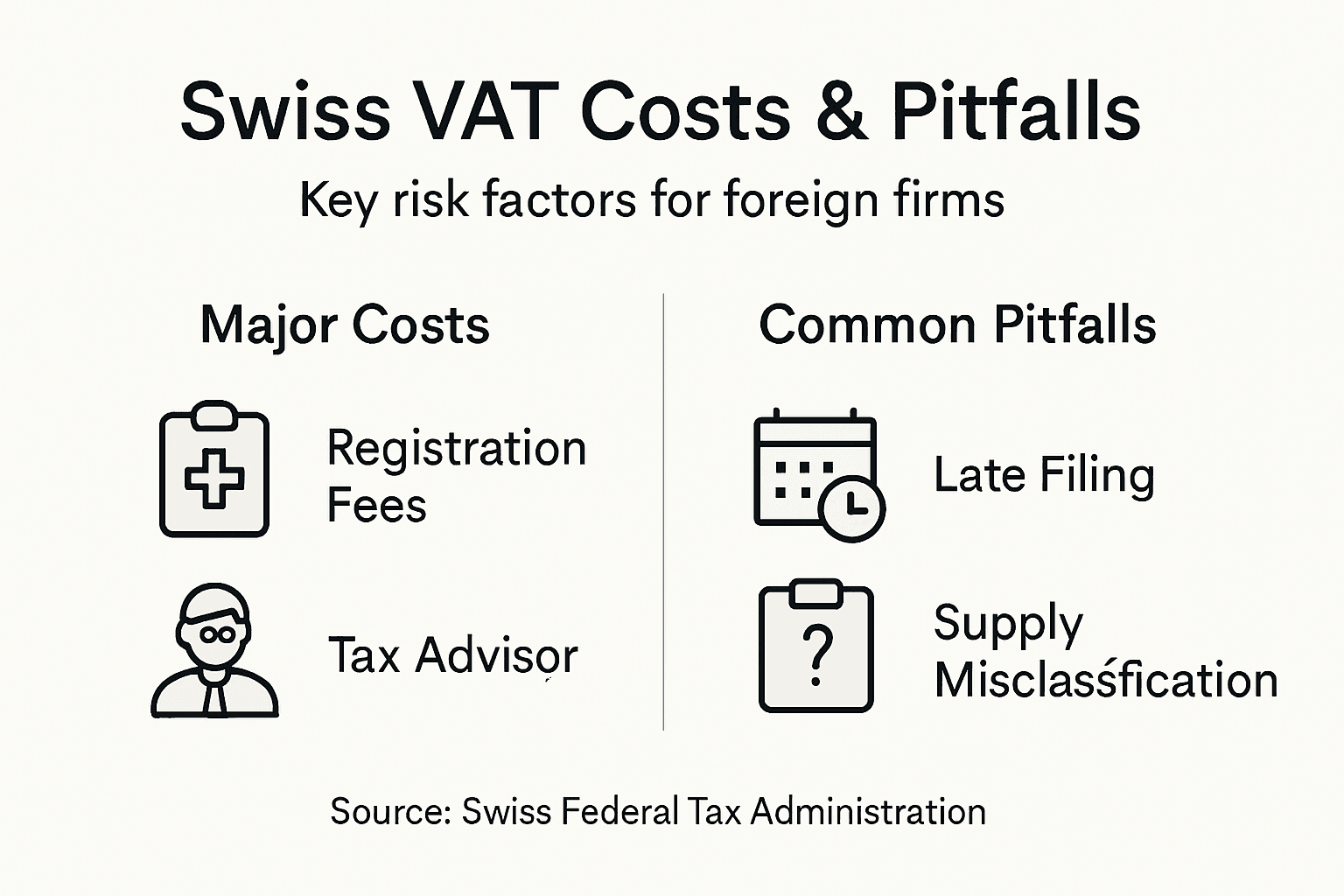
The most dangerous pitfall involves misclassifying your supplies as exempt when they actually qualify as taxable. Technology companies often believe their software licensing or digital services fall outside VAT scope, only to discover during an audit that Swiss authorities classify these activities differently. Finance companies face similar risks with investment advisory services, which may trigger VAT obligations despite existing tax treaties. Another common mistake involves failing to properly track and document input tax deductions. Foreign firms sometimes assume they cannot deduct VAT on services purchased from vendors outside Switzerland, missing opportunities to recover tens of thousands in input tax. The consequence is overpaying VAT for years without realizing it. Additionally, many companies neglect to distinguish between Swiss customers and foreign customers when invoicing, leading to incorrect VAT calculations that compound across multiple transactions. A technology startup selling to five Swiss customers and fifty international clients might accidentally charge Swiss VAT to the international customers or fail to charge it to the Swiss ones, creating exposure across their entire customer base.
Timing presents another critical risk factor. If you approach the CHF 100,000 threshold rapidly, you might miss the registration deadline, creating back-tax liabilities the moment you register. Swiss authorities calculate VAT owing retroactively to the date you should have registered, not from the date you actually did. This can mean suddenly owing tens of thousands in VAT plus penalties. Your fiscal representative cannot help you recover from this situation; you become personally liable. Similarly, foreign entrepreneurs often underestimate their Swiss tax residency status. Spending too much time physically in Switzerland or establishing certain business activities there can trigger income tax obligations beyond VAT, creating unexpected compliance burdens. The safest approach involves consulting with experienced advisors before launch rather than trying to figure compliance out as you go.
Pro tip: Request a pre-launch VAT compliance review from your accounting service provider six months before you expect to hit CHF 100,000 in turnover, allowing time to implement proper systems and classify all your revenue streams correctly before registration becomes mandatory.
Deregistration Process and Alternatives
Not every Swiss VAT registration lasts forever. Business circumstances change, revenue fluctuates, and sometimes companies decide to exit the Swiss market or restructure their operations. If your taxable turnover drops below CHF 100,000 for a full calendar year, you become eligible for VAT deregistration in Switzerland. Similarly, if you cease business activities entirely, deregistration becomes necessary to avoid ongoing compliance obligations and potential penalties for non-filing. However, deregistration is not automatic. You must actively request it in writing to the Federal Tax Administration, submitting the application within 60 days after the end of the tax period in which you no longer meet the registration requirements. This timing matters because late submissions can trigger penalties and complicate your final tax settlement.
The deregistration application requires supporting documentation proving your turnover has genuinely fallen below the threshold or that business operations have stopped. You cannot simply declare lower revenue without evidence; the Federal Tax Administration asks for detailed turnover records, customer lists, and operational documentation to verify your claim. Additionally, you must file a final VAT return covering the period from your last regular return through your deregistration date, settling any outstanding VAT obligations. This final return often requires careful calculation because you may need to account for inventory held at deregistration or reverse input tax deductions on assets used during your registered period. Many companies discover at this stage that they owe unexpected amounts because they did not track certain transactions properly throughout their registered years. Your fiscal representative can guide you through these calculations, but the accuracy remains your responsibility.
Alternatives to full deregistration exist if you want to maintain flexibility. Some companies intentionally remain registered even when their turnover drops below CHF 100,000 because the administrative burden of deregistration exceeds the benefit of exiting the system. This voluntary continued registration makes sense if you anticipate growing back above the threshold within a few years. Another option involves restructuring your business. If you operate multiple entities or subsidiaries, you might consolidate operations or separate them in ways that optimize your VAT position without triggering deregistration. However, these restructuring strategies carry their own compliance complexities and tax implications. Foreign entrepreneurs sometimes consider whether to maintain a skeleton Swiss operation that stays below the threshold while shifting revenue to a holding company elsewhere. These approaches require careful planning with qualified advisors because Swiss authorities scrutinize artificial structures designed solely to avoid VAT registration.
A critical consideration involves the financial reconciliation process at deregistration. If you held significant inventory at the time of deregistration, you may owe VAT on the deemed supply of those goods. Similarly, if you deducted input tax on assets like computers or furniture, you may need to reverse portions of those deductions based on how long you use the assets after deregistration. These adjustments can create unexpected tax bills if you are not prepared. Professional guidance during the deregistration process prevents surprises and ensures you settle your final obligations correctly, avoiding future audit exposure.
Pro tip: Begin your deregistration planning process at least three months before you expect to fall below the CHF 100,000 threshold, ensuring your accounting systems are prepared to document the final period accurately and your fiscal representative can file timely and complete final returns.
Simplify Your Swiss VAT Registration Journey with Expert Support
Navigating Swiss VAT registration can be daunting for foreign companies especially when facing the CHF 100,000 turnover threshold and strict compliance requirements. The complexity of appointing a Swiss fiscal representative, managing ongoing invoicing and record-keeping, and avoiding costly mistakes demands specialized knowledge. Do not let VAT obligations become a barrier to your Swiss market entry or growth. Our platform at https://rpcs.ch streamlines company formation and provides end-to-end support with VAT registration, accounting, and legal guidance tailored for international entrepreneurs.
Start confidently today by partnering with professionals who understand your unique needs. Visit Swiss Company Formation Services to establish your business structure compliantly, benefit from expert VAT compliance advice, and ensure your fiscal representative is in place before reaching critical thresholds. Act now to avoid penalties and secure your path to success in Switzerland. Learn more and get a personalized consultation at https://rpcs.ch.
Frequently Asked Questions
What is Swiss VAT and how does it work?
Swiss VAT, or value-added tax, is an indirect tax collected at each stage of the supply chain. Businesses can deduct the VAT paid on inputs from the VAT they collect on outputs, ensuring that only the actual added value is taxed as products and services move through the economy.
When is VAT registration mandatory for foreign companies in Switzerland?
VAT registration becomes mandatory for foreign companies when their annual taxable turnover exceeds 100,000 Swiss francs. This applies regardless of the business structure or industry sector, and both goods and services contribute to the turnover.
What are the consequences of not registering for VAT when required?
Failing to register for VAT when required can lead to back-tax liabilities, as Swiss tax authorities calculate VAT owing retroactively to the date registration should have occurred. This can result in significant financial penalties and interest charges on unpaid taxes.
What documentation is required for VAT registration as a foreign firm?
Foreign companies must provide commercial register extracts from their home country, detailed descriptions of their business activities, and proof of accurate turnover calculations when applying for VAT registration. Additionally, a power of attorney document authorizing a Swiss fiscal representative is usually required.
Recommended