
Key Documents for Company Registration in Switzerland
- Jan 16
- 7 min read
Updated: Jan 19

More than 30 percent of American and European entrepreneurs find Swiss company registration procedures far more complex than they expect. Facing a maze of detailed legal requirements and strict document checks, it is common to feel challenged by unfamiliar Swiss regulations. This step-by-step guide breaks down each part of the process, making it easier for international founders to confidently collect, prepare, and submit everything needed for a seamless GmbH or AG registration in Switzerland.
Table of Contents
Quick Summary
Key Point | Explanation |
1. Gather Necessary Documentation | Collect identification documents for shareholders and directors before starting Swiss company registration. |
2. Prepare Comprehensive Statutory Documents | Create articles of association and other required documents that comply with Swiss commercial law. |
3. Ensure Notarization and Authentication | Have a licensed Swiss notary verify and notarize all founding documents for legal recognition. |
4. Submit Well-Organized Documents | Compile and present all required documents to the commercial register for validation and registration. |
5. Obtain Confirmation of Registration | After verification, receive your official registration confirmation document to confirm your company’s legal status. |
Step 1: Gather Essential Personal and Corporate Information
Registering a company in Switzerland requires strategic preparation and precise documentation. When establishing your Swiss company, you will need to collect a comprehensive set of personal and corporate details that form the foundation of your legal business entity.
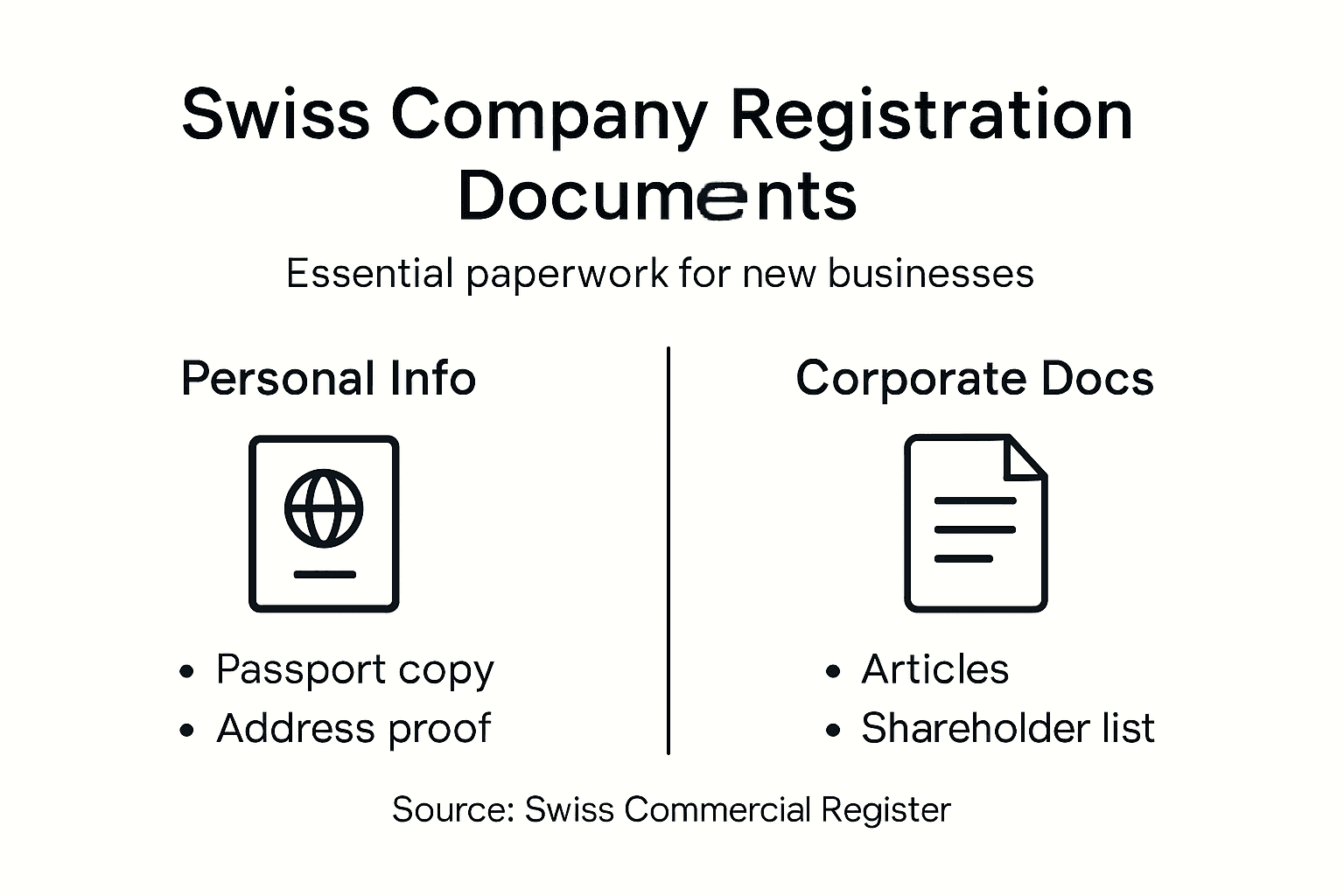
The process begins with identifying key individuals involved in the company. This means gathering identification documents for all shareholders and directors, including valid government issued passports or national ID cards. For foreign investors, additional documentation like residency permits or proof of international business experience might be necessary. Commercial registration requirements specify that every person involved must provide accurate personal information to ensure proper legal compliance.
Your corporate documentation will require selecting a unique company name that adheres to Swiss regulations. This involves checking the commercial register to confirm the name has not already been taken and complies with legal naming conventions. You will need to specify the precise legal structure of your business - whether you are forming a GmbH (limited liability company) or an AG (stock corporation) - as each has specific documentation requirements. Supporting documents like articles of association, proof of initial capital, and detailed business plans must be prepared with Swiss legal standards in mind.
To clarify the differences between Swiss company types, see this comparison:
Feature | GmbH (Limited Liability) | AG (Stock Corporation) |
Minimum Capital | CHF 20,000 | CHF 100,000 |
Shareholder Liability | Limited to capital contribution | Limited to capital contribution |
Management Structure | Flexible, may be simplified | Requires board of directors |
Public Disclosure | Less strict | More detailed public reporting |
Pro Tip: Work with a Swiss corporate registration specialist who understands local nuances to streamline your documentation gathering process and prevent potential administrative delays.
Step 2: Prepare Statutory Documents for Swiss Registration
Preparing statutory documents is a critical phase in establishing your Swiss company, requiring meticulous attention to legal details and comprehensive documentation. Your goal is to create a robust legal foundation that meets Swiss commercial registration requirements.
The core of your statutory documentation will be the articles of association, which serve as the foundational legal document outlining your company’s operational framework. These documents must comprehensively detail the company’s purpose, governance structure, shareholder rights, and operational guidelines. For GmbH and AG structures, you will need to prepare notarized founding documents that explicitly state the company’s capital structure, management composition, and specific business objectives.

Additional statutory documents will include a formal business registration application, detailed shareholder agreements, proof of initial capital contribution, and comprehensive corporate bylaws. Each document must be precisely drafted to comply with Swiss commercial law, ensuring transparency and legal validity. Pay special attention to specifying the exact roles of directors, the process for future amendments, and the precise mechanisms for corporate decision making.
Here’s a summary of the key documents required and their importance for Swiss company registration:
Document Type | Purpose | Business Impact |
Articles of Association | Defines company purpose and structure | Ensures legal and operational clarity |
Shareholder Agreements | Outlines rights and responsibilities | Prevents internal disputes |
Proof of Capital | Demonstrates required financial readiness | Validates company’s credibility |
Identification Documents | Verifies identity of all involved parties | Ensures compliance and transparency |
Corporate Bylaws | Details rules for management and operations | Establishes governance standards |
Pro Tip: Consider engaging a Swiss legal professional to review your statutory documents to ensure absolute compliance and prevent potential registration complications.
Step 3: Arrange Authentication and Notarization Requirements
Authentication and notarization represent critical legal milestones in your Swiss company registration process, transforming your business documents from drafts into legally recognized instruments. Navigating this phase requires precision and understanding of Swiss legal protocols.
The authentication process demands comprehensive verification of all founding documents by a licensed Swiss notary. This official will meticulously review your company’s founding documents, including articles of association, shareholder agreements, and corporate bylaws. During this review, the notary confirms the legal validity of your documentation, verifies the identities of all founding members, and ensures that all statutory requirements are precisely met. For corporations and limited liability companies, this notarization is mandatory and serves as an official validation of your company’s legal establishment.
During the authentication process, you will need to provide original documents, passports of all shareholders and directors, proof of initial capital, and any additional supporting documentation. The notary will create an official notarial deed that certifies the authenticity of your incorporation documents. This deed is crucial for subsequent registration with the commercial register and represents a definitive legal confirmation of your company’s formal constitution.
Pro Tip: Prepare multiple certified document copies and schedule your notarization appointment well in advance to prevent potential administrative delays.
Step 4: Submit Required Documents to Swiss Authorities
Submitting your company registration documents is the pivotal moment that transforms your business concept into a legally recognized Swiss enterprise. This step requires meticulous preparation and strategic document presentation to ensure smooth processing by Swiss administrative authorities.
The commercial register submission demands comprehensive documentation that validates your company’s legal standing. You will need to compile a complete package including your notarized founding documents, proof of initial capital deposit, shareholder information, articles of association, and identification documents for all founding members. The cantonal commercial register will conduct a thorough review to verify your company name’s uniqueness and ensure full compliance with Swiss corporate regulations.
Prepare multiple certified copies of each document and organize them systematically before submission. Each canton might have slightly different administrative requirements, so confirming specific local protocols with the relevant commercial register is crucial. Your submission package will typically be reviewed within 5 to 10 business days, after which you will receive official confirmation of your company’s registration and receive a unique company identification number that enables you to commence business operations in Switzerland.
Pro Tip: Request a preliminary document review from the commercial register to identify and resolve any potential compliance issues before your formal submission.
Step 5: Verify Compliance and Registration Approval
The final stage of your Swiss company registration journey involves a critical verification process that transforms your business from a concept to a legally recognized entity. This step requires patience and careful attention to ensure every regulatory requirement is meticulously met.
Commercial register verification represents the official confirmation of your company’s legal status. Swiss authorities conduct a comprehensive review examining multiple aspects of your submitted documentation. They will scrutinize your company name for uniqueness, validate capital requirements, assess statutory documentation, and confirm that all founding members meet legal standards. This thorough examination ensures that only compliant businesses receive official registration.
Once the commercial register completes its review, you will receive an official registration confirmation document. This crucial certificate serves as legal proof of your company’s existence and enables you to open bank accounts, sign contracts, hire employees, and commence business operations. The document will include your unique company identification number a key reference for all future official interactions. Pay close attention to the details in this document and store it securely as it represents the official recognition of your Swiss business venture.
Pro Tip: Request multiple certified copies of your registration document immediately after approval to expedite future administrative processes.
Simplify Your Swiss Company Registration with Expert Support
Registering a company in Switzerland involves navigating complex legal requirements such as preparing notarized founding documents, fulfilling authentication and notarization requirements, and ensuring full compliance with the commercial register. These challenges can overwhelm international entrepreneurs who face language barriers and unfamiliar legal procedures. Common pain points include gathering precise identification documents for shareholders and directors, drafting accurate articles of association, and meeting cantonal submission protocols.
Avoid costly delays and legal pitfalls by partnering with professionals who understand every detail of Swiss company formation. At RPCS, we specialize in facilitating the registration of GmbH and AG structures with comprehensive guidance on legal documentation, capital proofs, notarization, and registration submission. Our service helps you save time and reduces the stress of meeting Switzerland’s statutory requirements.

Take control of your Swiss business startup today. Visit RPCS to access tailored company formation solutions. Discover how our expertise can accelerate your compliance process, ensure accurate submissions to the commercial register, and provide ongoing support including accounting and legal advisory. Don’t wait until delays affect your business launch. Start your hassle-free Swiss company registration now with RPCS.
Frequently Asked Questions
What essential documents are required for company registration in Switzerland?
To register a company in Switzerland, you need various essential documents including the articles of association, shareholder agreements, proof of initial capital, identification documents for all founding members, and corporate bylaws. Start by gathering these documents to ensure a smooth registration process.
How do I prepare the articles of association for my Swiss company?
The articles of association serve as the foundational legal document outlining your company’s purpose, governance structure, and operational guidelines. Draft these articles comprehensively and ensure they comply with Swiss commercial law to establish a robust legal foundation for your business.
What is the role of a notary in the company registration process in Switzerland?
A notary is responsible for authenticating and notarizing your company’s founding documents, ensuring their legal validity. Schedule an appointment with a licensed Swiss notary to complete this essential step prior to your document submission.
How long does the commercial register take to review my submission?
The commercial register typically reviews your submission within 5 to 10 business days to verify your company’s legal standing and documentation compliance. Prepare for this timeline and ensure your documents are organized to expedite approval.
What happens after my company is registered in Switzerland?
Once your company is registered, you will receive an official registration confirmation document, which acts as legal proof of your company’s existence. Store this document securely, as it will be essential for opening bank accounts, signing contracts, and initiating business operations.
Recommended