
Swiss Business Residency: Essential Guide for Global Entrepreneurs
- May 1
- 10 min read

TL;DR:
Swiss business residency requires a self-employment permit, not automatic upon company registration.
Success depends on a credible business plan, canton selection, and demonstrating genuine local economic engagement.
Switzerland lacks a dedicated startup visa, making the process more complex than some international competitors.
Many international founders approach Switzerland expecting something like a “business visa” — a streamlined pathway that converts company registration into legal residency almost automatically. That assumption is wrong, and it costs people months of preparation and thousands of dollars in avoidable mistakes. Swiss residency for business follows a specific legal route tied to self-employment permits, economic contribution requirements, and cantonal approval processes that vary significantly from one region to another. This guide breaks down exactly how the system works, what barriers you will face, and how to position your application for success.
Table of Contents
Key Takeaways
Point | Details |
No startup visa | Switzerland does not offer a dedicated startup visa, so founders must use the self-employment B permit pathway. |
Cantonal differences matter | Success depends on tailoring your business case to the priorities of individual Swiss cantons. |
Legal duties continue | Securing residency is only the start—ongoing compliance with Swiss laws and regulations is essential. |
Global comparison | Swiss business residency has more hurdles compared to programs in Canada or Estonia, but offers unique advantages if navigated wisely. |
Plan strategically | A carefully structured application and local engagement greatly increase your odds of approval. |
What Swiss residency for business really means
Switzerland does not have a single, clearly labeled “entrepreneur visa” or “startup visa.” For non-EU and non-EFTA nationals, the path to legally living and working in Switzerland as a business owner runs through a specific legal instrument. Swiss residency for business primarily involves obtaining a B permit for self-employment under Art. 19 of the FNIA (Foreigners and Integration Act, also known as AIG in German).
Let’s define a few terms that matter here:
B permit: A renewable annual residency permit for foreigners living and working in Switzerland, including the self-employed.
FNIA (AIG): The Federal Act on Foreign Nationals and Integration, which governs immigration and employment rules for non-Swiss residents.
Self-employment: In the Swiss legal context, this means you own and operate a business and are not working for an employer, which triggers a different regulatory review than standard employment.
Third-country nationals: Anyone who is not a citizen of an EU or EFTA member state. These applicants face stricter scrutiny and a formal cantonal review process.
Swiss residency does not come with company incorporation. You can legally form a GmbH or AG in Switzerland without living there, but if you want to live in Switzerland and manage that company, you need the appropriate permit — and those are two entirely separate applications.
The important thing to understand is that residency is not citizenship, and it is not a passive benefit. It requires active economic engagement in Switzerland, not just a registered address at a serviced office. Authorities want to see that you are genuinely running your business from Swiss soil, not just holding a mailing address while living elsewhere.
Pro Tip: If you are an EU or EFTA citizen, the rules are considerably more flexible. EU/EFTA nationals can self-register for self-employment with cantonal authorities without going through the same quota-based discretionary process that applies to third-country nationals.
How the Swiss business residency process works
With the basics defined, let’s move into the concrete steps and requirements you will face if you want Swiss residency for your business. This process is structured, but it is also discretionary — meaning authorities have genuine latitude to approve or reject applications based on how convincing your economic case is.
Here is a realistic step-by-step breakdown:
Draft a credible business plan. This is the single most important document in your application. Swiss cantonal authorities do not just want a business summary. They want financial projections, a market analysis, a description of how your business benefits the Swiss economy, and a clear employment plan. Vague plans rarely pass.
Select the right canton. Switzerland has 26 cantons, each with its own economic development priorities and immigration office. You apply in the canton where your business will actually operate. Your choice of canton dramatically affects your approval chances (more on this in a later section).
Submit your application to cantonal authorities. The cantonal migration office reviews your application against local economic priorities and the requirements of Art. 19 FNIA. They check that you meet the requirements to move to Switzerland as an entrepreneur, including economic benefit, viability, and local contribution.
Cantonal approval and federal forwarding. If the canton approves, they forward your file to the State Secretariat for Migration (SEM) for final federal approval. Both layers must agree.
Visa issuance and entry. Once approved, you receive a visa to enter Switzerland. After arrival, you register with local authorities and receive your B permit.
Annual renewal. Your B permit must be renewed each year. Authorities check that you are still operating your business actively and that your economic contribution remains real.
The Swiss business visa guide provides a closer look at the documentation requirements for each stage. Common pitfalls include submitting incomplete financial projections, choosing a canton with no alignment to your industry, and failing to demonstrate genuine management presence in Switzerland.

Pro Tip: Timeline matters. The full process from application submission to permit in hand can take four to eight months. Do not plan a launch date that depends on approval happening quickly.
Swiss system vs. other countries: The competitive reality
After understanding how Switzerland approaches business residency, it is important to see how this system compares globally — and why some in the startup world want change.
Switzerland lacks a dedicated startup visa, while competitors like Canada and Estonia have built streamlined, internationally marketed programs that attract founders in weeks rather than months. This is not just an inconvenience — it is a structural disadvantage in the global race for entrepreneurial talent.
Country | Startup visa program | Processing time | Key advantage |
Canada | Startup Visa Program | 12 to 16 months | Pathway to permanent residency |
Estonia | Startup Visa | 30 to 90 days | Digital-first, EU market access |
Germany | Freelancer and startup visa | 3 to 6 months | Clear criteria, federal consistency |
Switzerland | No dedicated program (B permit) | 4 to 8 months | Stability, banking, tax benefits |
The Swiss Startup Association has publicly called for reform, noting the complexity of the current system compared to competitors. To put the scale in perspective, there were approximately 750,000 B permits in circulation at the end of 2025, demonstrating significant demand for Swiss residency across all categories.
What makes Switzerland difficult for international founders is not just the absence of a startup visa. It is also the lack of clear, standardized criteria. Canada’s Startup Visa has a published point-based framework. Estonia’s digital residency model has an explicit public checklist. Switzerland’s cantonal system means that the exact criteria shift depending on where you apply, who is reviewing your file, and what the local economic priorities happen to be that year.
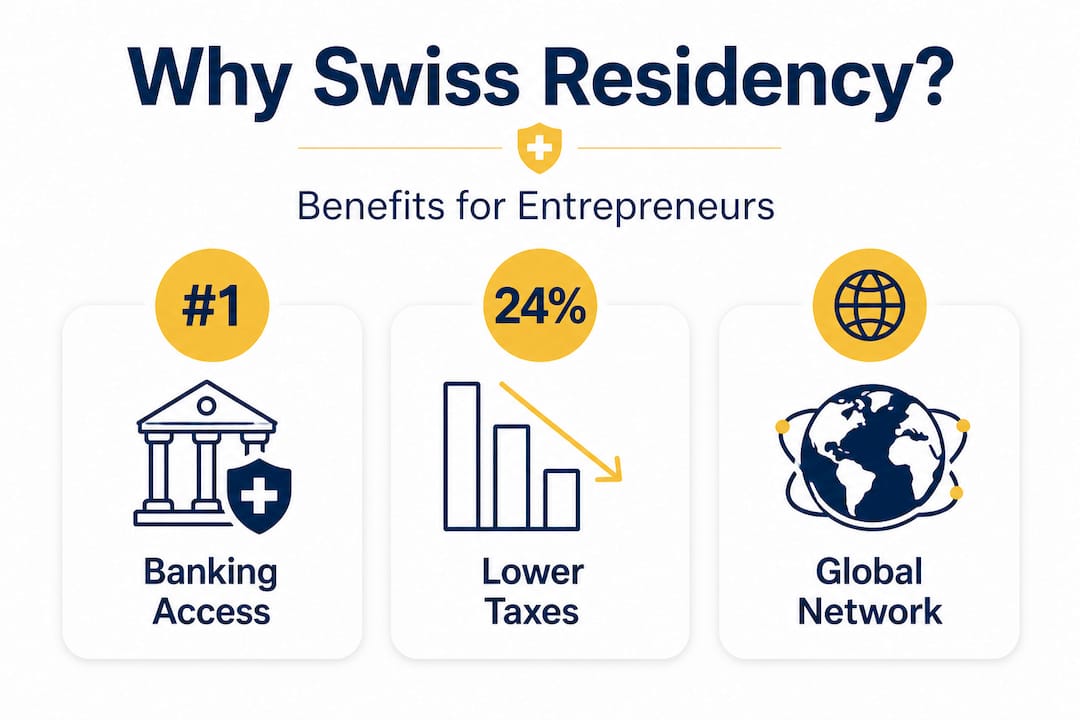
That said, understanding why Switzerland attracts startups in the first place helps calibrate expectations. The benefits — political neutrality, world-class banking, some of Europe’s lowest corporate tax rates in competitive cantons, and access to top-tier talent — remain genuinely exceptional. The difficulty of entry is a feature of exclusivity, not a signal that the effort is not worth it.
The benefits of Swiss residency for entrepreneurs go well beyond a nice address. They include access to Swiss financial infrastructure, credibility in global markets, and a stable legal environment that many other jurisdictions simply cannot match.
Cantonal strategies: Why location and alignment matter
Now that we have compared Switzerland internationally, it is crucial to recognize that the real engine of decision-making is local — at the canton level. Federal law sets the framework, but cantons interpret and enforce it. Choosing the wrong canton is one of the most common and costly mistakes foreign founders make.
Different cantons have built distinct economic identities, and your business needs to fit that identity convincingly:
Zug: Famous for its “Crypto Valley,” Zug is strongly aligned with fintech, blockchain, and digital assets. Tax rates here are among the lowest in Switzerland.
Vaud (Lausanne): Home to major pharmaceutical companies, EPFL, and a deep medtech ecosystem. Strong for life sciences and academic-adjacent ventures.
Zurich: Switzerland’s financial hub. Highly competitive for banking, professional services, and technology companies.
Geneva: International business and diplomacy. Strong for global trading companies, NGOs, and financial services with international exposure.
Basel-Stadt: Life sciences and pharmaceutical manufacturing. Home to Novartis and Roche headquarters.
Cantonal variations are key: cantons like Zug and Vaud favor fintech and medtech respectively, and success genuinely hinges on aligning your business with local priorities and submitting structured applications that speak the canton’s economic language.
Canton | Key industries | Tax rate (corporate) | Notes |
Zug | Fintech, blockchain, trading | ~11% | Lowest effective rates in Switzerland |
Vaud | Medtech, biotech, academic | ~14% | Strong R&D ecosystem |
Zurich | Finance, tech, consulting | ~19% | Largest talent pool |
Geneva | Trading, finance, NGOs | ~14% | International environment |
Basel-Stadt | Pharma, life sciences | ~13% | Industry-specific strength |
Understanding foreign ownership rules in each canton also plays a role, particularly if your business involves real estate, specific regulated industries, or joint venture structures with Swiss partners.
Pro Tip: Most cantonal economic development offices offer pre-screening consultations for serious applicants. Use them. A 30-minute conversation with the right cantonal official can tell you whether your business concept fits local priorities before you invest months in a full application.
Beyond the permit: Legal obligations and business setup
Securing your permit is just the start. Running a business as a Swiss resident means ongoing legal and operational responsibilities that many founders underestimate.
Here is what happens after you receive your B permit:
Register your company. If you have not already done so, you need to formally register your business with the appropriate cantonal commercial register. GmbH structures require a minimum share capital of CHF 20,000. AG structures require CHF 100,000.
Open a Swiss business bank account. Swiss banks conduct rigorous due diligence, including anti-money laundering checks, KYC documentation, and business plan reviews. Understanding Swiss banking requirements before you approach a bank saves considerable time and frustration.
Register for taxes. Switzerland has a three-tier tax system: federal, cantonal, and municipal. You need to register with the relevant tax authorities and understand your VAT obligations if your revenue exceeds CHF 100,000 per year.
Set up payroll and social insurance. If you employ anyone in Switzerland, you must register with the cantonal compensation office (AHV/AVS) and manage social security contributions. This applies even if you are your own sole employee.
Annual permit renewal documentation. Each year, you need to demonstrate continued economic activity, tax compliance, and active management of your Swiss business. Missing this review can result in non-renewal.
The business immigration guide covers these post-permit obligations in detail, which is especially valuable for founders who are new to Swiss regulatory frameworks. A particularly common pitfall is overlooking canton-specific reporting requirements that exist in addition to federal obligations. For example, some cantons require separate annual declarations of business activity from self-employed permit holders, in addition to standard tax filings.
Consequences of non-compliance are serious. Your permit renewal can be denied, your business registration can be challenged, and in severe cases, you may face deportation proceedings. Switzerland enforces its rules with precision.
Pro Tip: Work with a local fiduciary or accounting firm from day one. In Switzerland, a fiduciary is not just an accountant — they handle tax registrations, annual filings, payroll compliance, and often serve as a registered address provider for your company.
The real story: What most guides won’t tell you about Swiss business residency
We have covered the facts, but here is a direct perspective drawn from hands-on experience working with international entrepreneurs navigating the Swiss system.
The most persistent and damaging misconception is this: “I formed a GmbH in Zug, so my residency application should be straightforward.” It is not. Company formation and residency are parallel tracks that meet only when the authorities are satisfied that you are genuinely building something real in Switzerland. Simply holding shares in a Swiss company, or having a registered office managed by a third party, is not enough to anchor a self-employment permit.
What actually drives success is credible local engagement. Applicants who walk into cantonal reviews with a clear economic narrative — jobs for Swiss residents, revenue generated inside Switzerland, partnerships with local institutions — succeed at far higher rates than those with technically perfect paperwork but no genuine local story. Switzerland’s immigration system is not trying to attract logo addresses. It wants business builders who will contribute to the local economy.
The policy environment is also shifting. The Swiss Startup Association and various innovation advocates are pushing for a formal startup visa, and early-stage discussions at the federal level have begun. If those reforms pass, the entry pathway for founders could look very different in the next few years. Understanding founder shares in Switzerland and how equity structures interact with permit applications is one area where the rules could evolve meaningfully.
The most practical mindset shift you can make is this: stop thinking about Swiss residency as something you extract from a bureaucratic process, and start thinking about it as something you earn by demonstrating genuine commitment to building in Switzerland. That reframing changes how you write your business plan, which canton you choose, which local partners you engage, and ultimately whether you succeed.
Launch your Swiss business with expert support
Navigating Swiss business residency is manageable — but only when you have the right structure in place before you start. Most founders who struggle do so because they tried to piece together the process on their own, without local expertise or a coordinated setup strategy.
At RPCS, we specialize in exactly this kind of structured, end-to-end support for international entrepreneurs. From company formation services tailored to your industry and target canton, to Swiss bank account solutions that navigate the due diligence process with you, to full Swiss accounting support that keeps your compliance clean year after year — we handle the operational complexity so you can focus on your business. Our clients are founders, investors, and corporate leaders who want Switzerland done right from day one.
Frequently asked questions
Is there a Swiss startup visa for international founders?
No, Switzerland does not have a dedicated startup visa as of 2026. Founders must apply for self-employment through the B permit system, as there is no dedicated startup visa despite ongoing calls for reform.
What is required to obtain Swiss residency for my business?
You must establish economic value in Switzerland, submit a detailed business plan, and apply for a B permit as a self-employed non-EU/EFTA entrepreneur under Art. 19 FNIA, with both cantonal and federal approval required.
Does my company registration automatically grant me Swiss residency?
No, registering a company is a separate process from obtaining residency. You must also hold the right permit and meet all legal requirements, as B permit for self-employment is granted independently of company formation.
How do cantons impact my residency application?
Cantons have both distinct economic priorities and direct approval authority, which means your approval odds rise significantly when your business aligns with local strategies, as cantonal alignment is a documented factor in permit outcomes.
Recommended
Comments