
Why Switzerland for Startups: Global Credibility, Real Advantages
- Feb 2
- 8 min read
Updated: Feb 12

Every international founder hears stories about Swiss bureaucracy, but many are surprised by how accessible and efficient the Swiss startup ecosystem truly is. For entrepreneurs from North America and Asia, establishing a company in Switzerland offers more than just favorable tax rates, it provides global credibility and robust public support. This guide brings clarity to Swiss startup foundations, corrects common misconceptions, and highlights the strengths that make Switzerland a prime destination for ambitious tech ventures.
Table of Contents
Key Takeaways
Point | Details |
Switzerland as a Startup Hub | Switzerland offers a unique ecosystem for startups, combining robust public support with a stable regulatory environment. |
Company Structures for Founders | Various legal structures like AG and GmbH provide strategic options catering to different business needs and appeal to international investors. |
Global Standing and Credibility | Swiss startups benefit from the country’s strong global reputation, enhancing trust and attracting international business relationships. |
Operational and Cost Considerations | Entrepreneurs should prepare for potentially higher operational costs and complexity in regulatory compliance compared to other startup destinations. |
Swiss Startup Foundations and Misconceptions
Switzerland has emerged as a premier destination for innovative startups, offering a sophisticated ecosystem that combines strategic advantages with robust support mechanisms. Despite popular misconceptions about complexity, the Swiss startup landscape presents remarkable opportunities for international entrepreneurs seeking a credible and stable business environment.
The Swiss innovation infrastructure is powered by robust public support systems, with agencies like Innosuisse providing comprehensive startup assistance. Their targeted programs help entrepreneurs transform innovative concepts into marketable ventures through strategic funding, networking opportunities, and specialized training initiatives. Key benefits include:
Direct financial support for early-stage innovation projects
Professional coaching and mentorship programs
International market testing resources
Networking platforms connecting researchers and entrepreneurs
Swiss Scientific Research plays a critical role in startup development. The Swiss National Science Foundation collaborates closely with innovation agencies to facilitate startup creation, particularly those emerging from scientific research institutions. Scientific research translation into practical applications represents a unique strength of the Swiss startup ecosystem.
Contrary to common perceptions, establishing a startup in Switzerland is more accessible than many international entrepreneurs realize. The country’s regulatory environment prioritizes innovation while maintaining rigorous standards of corporate governance. Startups benefit from:
Transparent legal frameworks
Robust intellectual property protections
Streamlined business registration processes
Advanced digital infrastructure
High-quality talent pool
Switzerland’s startup ecosystem is not just about funding—it’s about creating sustainable, globally competitive innovations.
Global Reputation Matters. Swiss startups inherently carry a stamp of credibility that can significantly accelerate international business relationships. The country’s reputation for precision, reliability, and excellence translates directly into enhanced trust for emerging companies.

Pro tip: Before launching your startup in Switzerland, thoroughly research specific canton regulations, as cantonal differences can impact business formation strategies.
Types of Swiss Company Structures for Founders
Switzerland offers multiple sophisticated legal structures for entrepreneurs, providing flexibility and strategic options for business formation. Understanding these structures is crucial for international founders seeking to establish a credible and efficient business presence in the country.
Swiss legal structures for entrepreneurs primarily include three key business forms that cater to different entrepreneurial needs and growth strategies:
Sole Proprietorship: Simplest form, ideal for individual entrepreneurs
Limited Company (AG): Suitable for larger enterprises with significant capital
Limited Liability Company (GmbH/SARL): Perfect for small to medium-sized businesses
The Company Limited by Shares (AG/SA) represents the most attractive option for venture-backed startups. This structure offers several compelling advantages:
Limited liability protection for shareholders
Ability to raise significant external capital
Credible international business reputation
Transparent corporate governance framework
Easier attraction of professional investors
Choosing the right legal structure is not just a bureaucratic decision—it’s a strategic foundation for your startup’s future growth.
For smaller and more intimate business ventures, the Limited Liability Company (GmbH/SARL) provides an alternative with more flexible governance. Swiss startup legal structures reveal that this model suits family businesses and smaller entrepreneurial teams seeking more personalized management approaches.
Key considerations when selecting a business structure include capital requirements, liability exposure, tax implications, and long-term growth strategies. Each structure comes with unique regulatory requirements, particularly regarding residency and officer appointments.
Here’s a quick comparison of the main Swiss company structures for founders:
Structure Type | Minimum Capital Required | Suitable For | International Appeal |
Sole Proprietorship | CHF 0 | Solo entrepreneurs | Limited credibility |
Limited Liability Company (GmbH/SARL) | CHF 20,000 | Small teams/family businesses | Moderate reputation |
Company Limited by Shares (AG/SA) | CHF 100,000 | Scalable venture-backed startups | High global trust |
Pro tip: Consult with a Swiss corporate legal specialist to precisely understand the nuanced differences between AG and GmbH structures for your specific startup scenario.
Key Characteristics of the Swiss Startup Ecosystem
Switzerland has cultivated a world-class startup environment that consistently ranks among the most innovative and dynamic ecosystems globally. International entrepreneurs are increasingly drawn to its unique blend of strategic advantages, cutting-edge research infrastructure, and supportive regulatory frameworks.
Swiss startup ecosystem strengths reveal a comprehensive landscape that supports entrepreneurial growth across multiple dimensions:
Strong venture capital accessibility
Highly skilled international workforce
Robust government innovation policies
Strategic research and development infrastructure
Collaborative entrepreneurial networks
The ecosystem demonstrates exceptional performance in specialized Deep Tech sectors, with particular excellence in:
Cleantech innovations
Biotech research
Fintech solutions
Medical technology developments
Advanced engineering technologies
Switzerland’s startup ecosystem transforms intellectual potential into global market innovations.
Deep Tech startup investments highlight the nation’s remarkable capacity to generate high-impact technological ventures. International investors are increasingly recognizing Switzerland’s potential, contributing significant capital to cutting-edge research and entrepreneurial initiatives.
Unique ecosystem characteristics include dense research clusters, strong university-industry partnerships, and a globally oriented market perspective. These factors create an environment where innovative ideas can rapidly transform into scalable, internationally competitive businesses.
Pro tip: Leverage Switzerland’s research networks and innovation grants by connecting directly with cantonal economic development offices and university technology transfer centers.
Legal and Tax Frameworks for International Startups
Switzerland presents an exceptionally attractive legal and tax environment for international startups, characterized by strategic flexibility, competitive rates, and robust regulatory frameworks that support entrepreneurial growth and global business expansion.
Corporate tax landscape for international entrepreneurs offers remarkable advantages across multiple dimensions:
Competitive corporate income tax rates (12-24%)
Multi-tiered taxation system (federal, cantonal, municipal)
Extensive double taxation treaty network
Intellectual property income tax incentives
Transparent regulatory compliance
The Swiss tax framework provides strategic benefits for international startups through several key mechanisms:
Flexible corporate structures
Predictable tax calculation methods
Low effective tax rates
Robust legal protections
International investment friendliness
Switzerland transforms complex tax regulations into entrepreneurial opportunities.
Unique aspects of the Swiss legal framework include sophisticated transfer pricing regulations aligned with OECD standards, which provide clarity and predictability for international businesses. The system’s design actively encourages foreign investment while maintaining stringent compliance requirements.
Entrepreneurs can leverage cantonal variations in tax rates and regulations, allowing strategic positioning within different Swiss jurisdictions. This nuanced approach enables startups to optimize their financial structures and minimize tax liabilities legally and effectively.
Pro tip: Consult a Swiss tax specialist to navigate cantonal differences and structure your startup for maximum tax efficiency.
Operational Costs, Risks, and Compliance Requirements
Navigating the operational landscape of Swiss startup environments requires a strategic understanding of the complex interplay between costs, regulatory compliance, and potential business risks. International entrepreneurs must approach their Swiss venture with comprehensive awareness and meticulous planning.
Key operational considerations for startups include:
Office space and infrastructure expenses
Regulatory registration and maintenance costs
Workforce recruitment and compensation
Technical and administrative compliance requirements
Insurance and legal protection expenses
The financial framework for international startups involves several critical risk management strategies:
Comprehensive initial capital planning
Robust compliance documentation systems
Regular financial and legal audits
Strategic risk mitigation protocols
Transparent financial reporting mechanisms
Successful Swiss startup operations demand precision, preparation, and proactive risk management.
Companies must anticipate potential challenges such as higher operational costs compared to other European markets, stringent regulatory requirements, and complex administrative procedures. These factors necessitate a sophisticated approach to business establishment and ongoing management.
Entrepreneurs should develop comprehensive financial models that account for Swiss-specific operational expenses, including specialized accounting services, legal consultations, and compliance management. Understanding the nuanced cost structures helps prevent unexpected financial challenges and ensures sustainable business growth.
Pro tip: Budget an additional 15-20% above your initial operational cost estimates to accommodate Swiss regulatory and administrative requirements.
Comparing Switzerland to Other Startup Destinations
Switzerland stands distinctively apart from other global startup ecosystems, offering a unique combination of strategic advantages that set it apart from traditional innovation hubs like Silicon Valley, Israel, and Singapore. Understanding these differentiating factors is crucial for entrepreneurs evaluating international startup environments.
Swiss innovation performance benchmarks reveal remarkable competitive advantages across multiple dimensions:
Superior research and development infrastructure
Exceptional public and private sector investment
Unparalleled collaboration between academia and industry
Highly skilled and specialized workforce
Stable political and economic environment
Compared to other leading startup destinations, Switzerland demonstrates distinctive strengths:
Higher research commercialization rates
More stable regulatory frameworks
Lower startup failure risks
Greater intellectual property protections
Enhanced cross-sector innovation collaboration
Switzerland transforms innovation potential into sustainable, globally competitive ventures.
Global innovation leadership comparisons highlight Switzerland’s remarkable position, consistently outperforming larger economies through strategic focus on high-value technological innovations. Unlike ecosystems driven purely by venture capital, Switzerland prioritizes deep technological development and long-term sustainability.
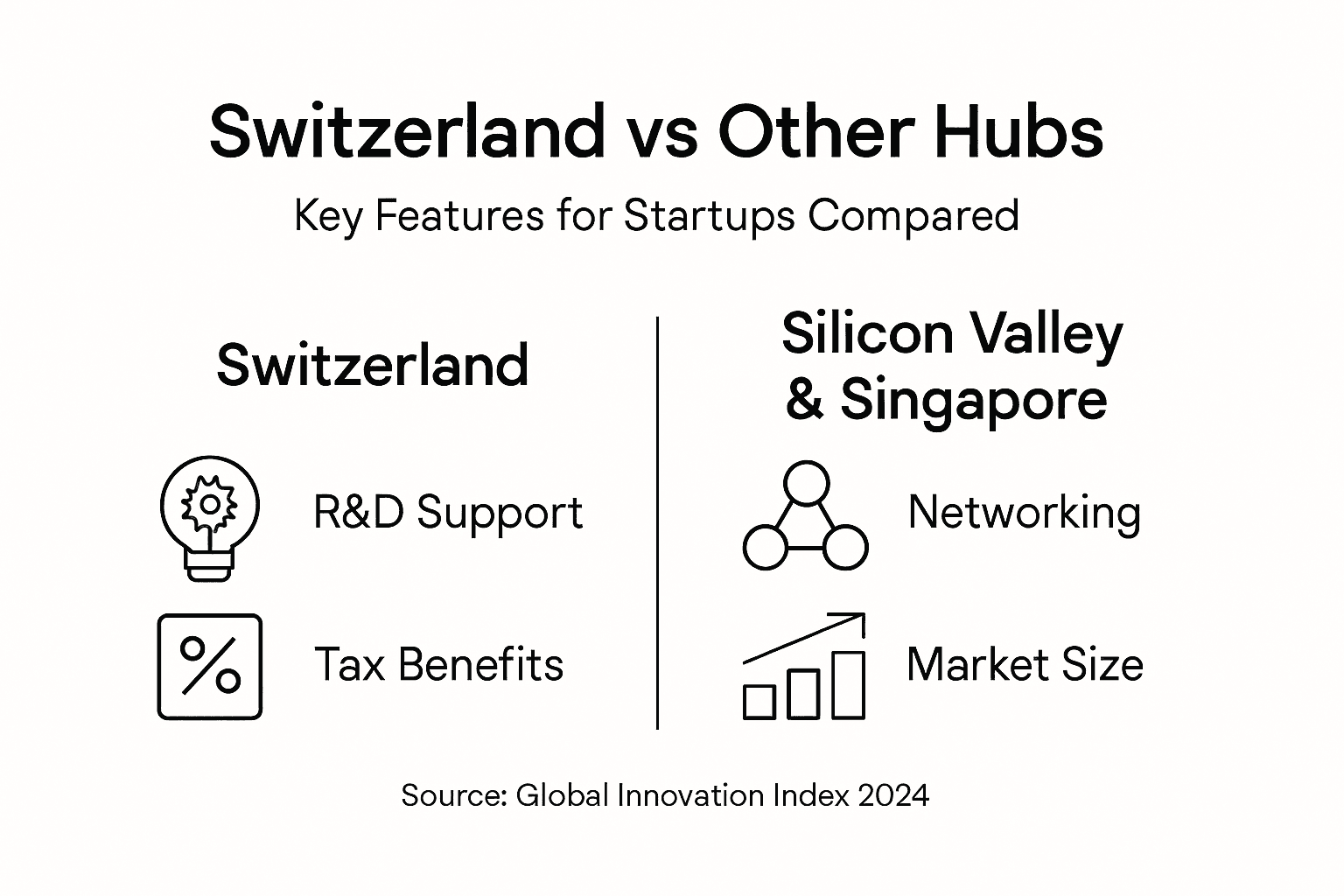
Entrepreneurs considering Switzerland will find a markedly different environment from traditional startup hubs. The Swiss model emphasizes quality over quantity, precision over volume, and sustainable innovation over rapid scaling. This approach attracts entrepreneurs seeking stable, credible, and strategically positioned business environments.
See how Switzerland stacks up against other top startup destinations:
Factor | Switzerland | Silicon Valley | Singapore |
R&D Infrastructure | World-class | World-class | Strong |
Regulatory Stability | Very high | Moderate | High |
IP Protection | Exceptional | Strong | Strong |
Talent Pool | Specialized, global | Large, diverse | Highly skilled |
Failure Risk | Low | Moderate | Moderate |
Pro tip: Conduct comprehensive due diligence by connecting with Swiss cantonal economic development offices to understand nuanced regional innovation support mechanisms.
Unlock Your Startup Potential in Switzerland with Expert Support
Launching a startup in Switzerland offers unmatched global credibility, strong legal frameworks, and strategic tax advantages. However navigating the complexities of choosing the right company structure such as an AG or GmbH and ensuring full regulatory compliance can be daunting for international entrepreneurs. This article highlights critical steps including understanding cantonal regulations and securing proper legal protections that are essential for sustainable growth in Switzerland’s deep tech and innovation-focused ecosystem.
Take control of your Swiss startup journey today by partnering with trusted professionals who simplify company formation, banking arrangements, and ongoing administrative support. At rpcs.ch, we specialize in guiding foreign investors through every step, turning these challenges into clear opportunities for global success. Benefit from our expertise in legal documentation, tax optimization, and risk management to accelerate your startup establishment. Visit rpcs.ch now and secure your path to launch with confidence and speed.
Frequently Asked Questions
What are the main advantages of starting a business in Switzerland?
Switzerland offers numerous advantages for startups, including a strong innovation infrastructure, transparent legal frameworks, robust intellectual property protections, and access to a high-quality talent pool. These factors create a credible and stable environment for businesses.
How does the Swiss startup ecosystem support entrepreneurs?
The Swiss startup ecosystem provides various types of support, such as financial assistance from agencies like Innosuisse, mentorship programs, networking opportunities, and resources for international market testing to help entrepreneurs turn innovative ideas into marketable ventures.
What legal structures are available for startups in Switzerland?
Entrepreneurs can choose from different legal structures, including Sole Proprietorships, Limited Companies (AG), and Limited Liability Companies (GmbH/SARL). Each structure has its unique benefits, such as liability protection and capital raising capabilities, catering to various business needs and growth strategies.
How does Switzerland compare to other startup destinations?
Switzerland has distinctive advantages over other startup destinations, such as a higher commercialization rate of research, lower startup failure risks, and exceptional intellectual property protections. Its model emphasizes sustainable innovation and strategic collaboration between academia and industry.
Recommended
Comments