
Swiss Corporate Governance Basics: Guide for Entrepreneurs
- Apr 10
- 8 min read

TL;DR:
Swiss corporate law applies equally to startups and multinationals, requiring compliance from day one.
The main Swiss company types are AG for larger or public firms and GmbH for smaller, private businesses.
Ongoing governance, including resident directors and ESG reporting, ensures transparency and longevity.
Swiss corporate governance is not reserved for multinational giants or billionaire investors. Whether you’re launching a two-person startup or relocating an established business to Zurich, the same legal framework applies to you. Many international founders assume that setting up in Switzerland is simply a matter of picking a name and opening a bank account. That assumption is expensive. From mandatory resident directors to board accountability rules and ESG reporting thresholds, Swiss law sets clear expectations from day one. This guide breaks down the core structures, required bodies, and evolving best practices so you can move forward with confidence and avoid the compliance traps that catch most foreign entrepreneurs off guard.
Table of Contents
Key Takeaways
Point | Details |
AG vs. GmbH structures | Swiss AGs suit larger or public firms, while GmbHs work best for smaller companies or startups. |
Legal compliance essentials | Swiss law mandates local directorships and core governance bodies for all companies. |
Modern governance reforms | Recent reforms expand digital meetings, gender quotas, and ESG reporting obligations. |
Best practices boost trust | Following the Swiss Code of Best Practice signals credibility to investors and partners. |
Expert guidance matters | Local compliance partners help international entrepreneurs avoid costly mistakes and simplify the setup process. |
Swiss corporate structures: AG vs. GmbH
Switzerland’s business landscape is built on two dominant corporate forms, each with distinct capital requirements, governance expectations, and ideal use cases. Understanding which one fits your situation is the first real decision you’ll make as a founder.
The primary corporate entities in Switzerland are the stock corporation (AG, or Aktiengesellschaft) and the limited liability company (GmbH, or Gesellschaft mit beschränkter Haftung). An AG requires minimum share capital of CHF 100,000, with at least CHF 50,000 paid up at formation. A GmbH requires CHF 20,000, fully paid. That capital gap matters a lot when you’re bootstrapping.
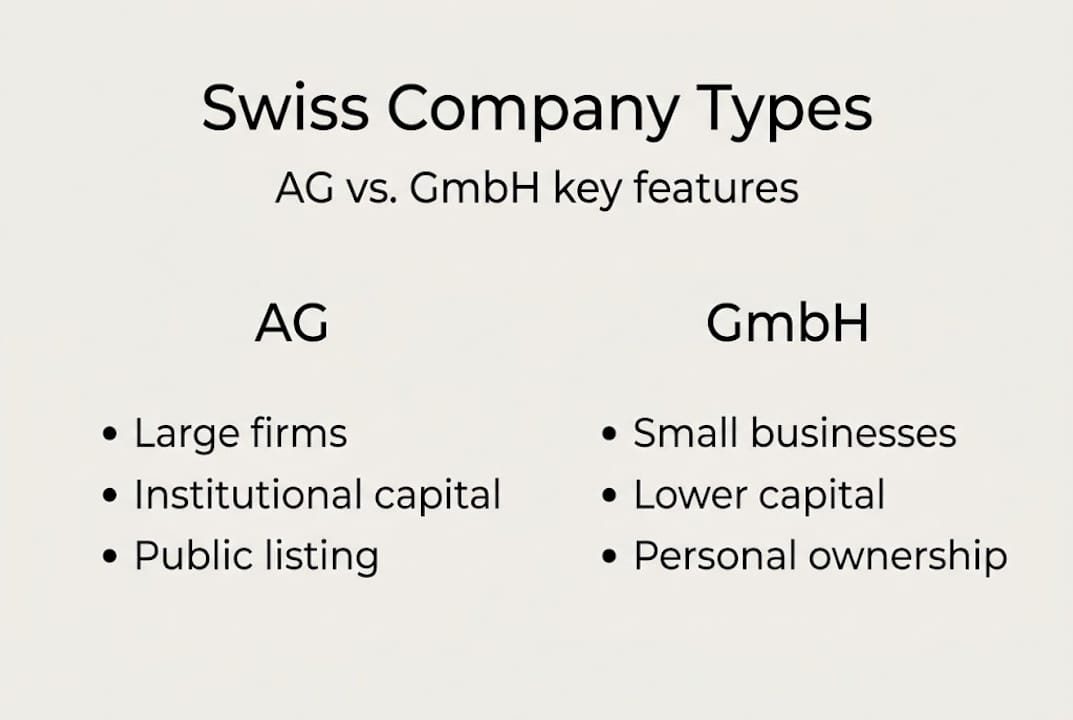
The AG suits larger businesses, companies planning to raise institutional capital, or ventures that may eventually list on a stock exchange. The GmbH works better for smaller enterprises, family-owned businesses, or international founders who want a lean, private structure without the overhead of a full board apparatus. You can explore the full range of Swiss legal entity options to see how each form fits different business models.
Feature | AG | GmbH |
Minimum capital | CHF 100,000 | CHF 20,000 |
Capital paid at formation | CHF 50,000 | CHF 20,000 (full) |
Shares | Freely transferable | Registered, restricted |
Public listing possible | Yes | No |
Board of directors required | Yes | Manager(s) required |
Best for | Larger firms, investors | Startups, SMEs |
Both structures share core formation steps: notarization of founding documents, entry in the Swiss Commercial Register, and appointment of at least one Swiss-resident director or manager. The GmbH formation steps follow a defined sequence that typically takes two to four weeks when documents are in order.
One trend worth noting: since 2021, more GmbHs than AGs have been registered annually, yet AGs still dominate economically by total assets and revenue. That tells you something useful. The GmbH is winning on volume because it’s accessible. The AG is winning on scale because institutional money prefers it. For a deeper look at how Swiss law treats both forms, the rules around Swiss corporate law for AG & GmbH are worth reviewing before you commit.
Pro Tip: Don’t just pick the cheaper structure. Pick the one that fits where you want to be in five years. Switching from GmbH to AG later is possible but involves costs and restructuring that are avoidable with early planning.
Core governance rules under Swiss law
Once you know your company type, the legal framework governing how it must operate becomes your next priority. Swiss corporate governance is not a loose set of suggestions. It is codified law with real liability consequences.

Swiss corporate governance is governed mainly by Title 26 of the Swiss Code of Obligations (CO), covering shareholders’ meetings, board duties, and compensation. For listed companies, additional rules from the Financial Market Infrastructure Act (FMIA) and stock exchange directives apply on top of the CO.
For an AG, three key bodies are mandatory: the shareholders’ general meeting (the supreme authority, which elects the board), the board of directors (responsible for strategy and non-delegable duties like organizational oversight), and the auditors. The board can delegate day-to-day management to executives, but it cannot delegate its core supervisory function. That distinction matters when things go wrong.
Here are the non-delegable board duties under Swiss law:
Overall management and strategic direction of the company
Defining the organizational structure
Setting up accounting, financial controls, and planning systems
Appointing and supervising key management
Preparing the annual report and shareholders’ meeting
Notifying the court in cases of over-indebtedness
For a GmbH, the structure is simpler. There is no mandatory board, but at least one manager must be appointed, and that manager carries similar fiduciary duties. The Swiss board of directors role in an AG is more formalized, with clear lines of accountability that courts take seriously.
Key principle: Swiss law holds board members personally liable for decisions made in bad faith or in violation of their duties. This is not a technicality. Courts have enforced it.
Listed AGs face a stricter layer of rules, including mandatory audit and compensation committees, independence requirements for board members, and detailed disclosure obligations. If your company is private, you have more flexibility, but the core duties still apply. Understanding company directorship explained in the Swiss context will save you from costly misunderstandings about what your role actually requires.
Swiss best practice codes and modern reforms
Statutory rules set the floor. Best practice codes raise the ceiling. For entrepreneurs who want to attract serious investors or partners, knowing both matters.
The Swiss Code of Best Practice for Corporate Governance (SCBP), published by economiesuisse, is a non-binding “comply or explain” code. It was revised in 2023 following the corporate law reform, and it covers board composition, director independence, committee structures, and sustainability. Non-binding does not mean irrelevant. Institutional investors and banks use it as a benchmark when evaluating governance quality.
The 2023 corporate law reform brought several concrete changes that affect you directly:
Virtual and hybrid shareholder meetings are now legally recognized, removing geographic barriers for international shareholders
Capital bands allow boards to adjust share capital within a defined range without a full shareholder vote each time
Statutory say-on-pay now applies to all AGs, giving shareholders a binding vote on board and executive compensation
Gender quotas require large listed firms to have at least 30% women on their boards by 2026 and 20% in executive management
Women on boards of Switzerland’s top 100 firms stood at 24% in 2021, with the trajectory pointing toward the 30% quota deadline. For most private companies, quotas don’t apply directly, but they signal where Swiss governance norms are heading.
The governance rules for founders section of our resource library covers how these reforms translate into practical decisions at the formation stage. And if you’re tracking how Swiss company law 2025 changes affect investor rights and reporting, that’s worth a read before your next funding conversation.
Pro Tip: Even if the SCBP doesn’t legally apply to your company, voluntarily aligning with its principles sends a clear signal to banks, investors, and partners that your governance is serious. That credibility has real monetary value.
Practical compliance: Resident directors, ESG, and reporting
Knowing the rules is one thing. Implementing them without gaps is another. Here’s what compliance actually looks like on the ground for foreign founders.
For company formation, both AG and GmbH require at least one Swiss-resident director or manager with sole signatory power. Foreign investors can own 100% of the company, but local representation is not optional. This is the most common stumbling block for international founders who assume remote ownership means remote management.
The formation process for both structures follows a clear sequence:
Draft and notarize the articles of association
Deposit share capital in a blocked bank account
Register with the cantonal Commercial Register
Obtain a VAT number if turnover thresholds apply
Set up statutory accounting from day one
For a practical walkthrough, the GmbH setup steps guide covers each stage in detail.
On the ESG front, non-financial reporting became mandatory from 2022 for large companies, covering climate impact, human rights, and supply chain due diligence. The first reports were due in 2024. The thresholds that trigger this obligation: 500 or more employees, and either CHF 20 million in total assets or CHF 40 million in revenue. Private companies can hit these numbers faster than they expect.
Watch this: Shareholder activism is rising in Switzerland. Even private companies with concentrated ownership have seen organized campaigns around governance transparency and ESG performance. Don’t assume small means invisible.
For annual reporting steps and how to structure your compliance calendar, planning ahead by at least one fiscal year is the standard we recommend.
Pro Tip: Map your projected growth against ESG reporting thresholds from the start. If you expect to cross the 500-employee mark within three years, building reporting infrastructure now costs far less than retrofitting it under deadline pressure.
Why Swiss governance is stricter—but fairer—than you think
Most foreign founders arrive in Switzerland seeing governance requirements as friction. Resident director rules, notarization, ESG thresholds, say-on-pay votes: it looks like a bureaucratic wall designed to slow you down. We’d push back on that reading.
Swiss governance standards are strict because they are designed to protect every party in the transaction, not just the largest one. The local representation requirement, for example, ensures there is always a legally accountable person on Swiss soil. That protects your creditors, your employees, and ultimately your own reputation. The building compliance and trust approach that Swiss law enforces is actually a competitive asset in global markets where counterparties are increasingly skeptical of opaque offshore structures.
The board independence tradition in Switzerland predates similar reforms in the US and EU by years. Switzerland did not adopt these standards because regulators forced it. The business community led the way because credibility drives deal flow. For international entrepreneurs, meeting Swiss standards signals something that no marketing budget can buy: that your company is built to last, governed with integrity, and ready for serious partners.
How RPCS can simplify your Swiss company compliance
If you’re ready to navigate Swiss governance with confidence, here’s how RPCS helps at every stage.
Setting up a Swiss company correctly from the start is the single best investment you can make in long-term compliance. RPCS provides end-to-end support for company formation services, covering both AG and GmbH structures, notarization, Commercial Register entry, and banking setup.
Beyond formation, staying compliant requires ongoing attention to accounting, statutory filings, and reporting obligations. Our Swiss accounting services keep your books clean and your obligations met, so you can focus on building the business. If you need a recognized Swiss business address to satisfy residency and registration requirements, we handle that too. From first registration to annual reporting, RPCS is your operational backbone in Switzerland.
Frequently asked questions
What are the main differences between an AG and a GmbH in Switzerland?
An AG requires CHF 100,000 in minimum capital (CHF 50,000 paid at formation) and suits larger or publicly oriented ventures, while a GmbH requires CHF 20,000 fully paid and fits startups or smaller private businesses.
Do I need a Swiss resident to form a company?
Yes. At least one director or manager must be a Swiss resident with signatory rights, even if all shareholders are foreign nationals. This applies to both AG and GmbH structures.
How does Swiss law address board diversity and gender quotas?
Large listed companies must reach at least 30% women on their boards by 2026 and 20% in executive management, as mandated by the 2023 corporate law reform.
When are ESG and non-financial reports required?
Companies with 500 or more employees and either CHF 20 million in assets or CHF 40 million in revenue must publish non-financial reports covering climate, human rights, and related topics, with the first reports due from 2024.
Can Swiss companies opt out of audits?
Privately held companies that meet specific size criteria can opt out of the standard audit requirement. Listed AGs have no such option and must undergo full statutory audits.
Recommended
Comments