
Swiss corporate governance: what founders need to know
- Apr 7
- 8 min read

TL;DR:
Swiss corporate governance balances legal requirements with operational flexibility, emphasizing accountability and local legitimacy.
Choosing between AG and GmbH affects capital, privacy, and market ambitions; AG is suited for investors, GmbH for SMEs.
Recent reforms focus on transparency, ESG integration, and shareholder rights, shaping future compliance and investor trust.
Many international entrepreneurs assume Swiss companies run on a single, rigid governance model. They don’t. Switzerland has built one of the world’s most flexible yet tightly regulated corporate frameworks, and recent reforms have made it even more dynamic. Whether you’re setting up a new venture or investing in an existing Swiss entity, understanding how governance actually works here can mean the difference between a smooth launch and costly compliance surprises.
Table of Contents
Key Takeaways
Point | Details |
Legal foundations | Swiss corporate governance is underpinned by clear statutory requirements and flexible best practice guidelines. |
Entity selection | Choosing between AG and GmbH shapes responsibilities, privacy, and growth potential for founders. |
Mandatory compliance | All Swiss companies must implement core governance bodies and adhere to evolving laws and reforms. |
Modern trends | ESG, board independence, and activist shareholder demands are increasingly crucial in Swiss governance. |
Expert support | Specialized guidance makes navigating Swiss rules and company setup faster and more secure for international entrepreneurs. |
What is Swiss corporate governance and why does it matter?
Corporate governance refers to the system of rules, practices, and processes by which a company is directed and controlled. In Switzerland, this system balances strong legal requirements with genuine operational flexibility, making it attractive to global founders while still demanding real accountability.
The Swiss Code of Obligations is the cornerstone of this framework. Swiss corporate governance is primarily governed by Title 26 of the Swiss Code of Obligations, covering both stock corporations (AG) and limited liability companies (GmbH). For international entrepreneurs, this matters immediately because the rules you follow depend on which entity you choose and how you structure its leadership.
Here’s why getting this right from day one is critical:
Legal standing: Non-compliance can invalidate board decisions or expose directors to personal liability.
Banking access: Swiss banks scrutinize governance structures before opening corporate accounts.
Investor confidence: Properly governed companies attract capital faster and on better terms.
Tax efficiency: Governance structures directly affect how profits are distributed and taxed.
For foreign founders, the Swiss corporate law overview is especially relevant because Switzerland requires at least one director with Swiss residency and signatory authority. This isn’t just paperwork. It signals to regulators, banks, and partners that your company has genuine local accountability.
The board of directors holds ultimate responsibility for the company’s strategic direction, financial oversight, and legal compliance. These duties cannot be delegated away, no matter how lean your operation is.
Pro Tip: Review the director residency requirement before you finalize your founding documents. Many foreign founders discover this requirement late and face delays in registration or banking setup.
Understanding governance isn’t just about following rules. It’s about building a company that Swiss institutions, partners, and investors will actually trust.
Choosing the right entity: AG vs GmbH explained
Once you understand what Swiss corporate governance requires, the next decision is structural. Which entity fits your goals? This single choice shapes your capital requirements, privacy options, administrative burden, and long-term investor appeal.
Switzerland offers two primary corporate forms for entrepreneurs. The AG and GmbH differ significantly in how they’re governed, funded, and perceived by the market.
Feature | AG (Aktiengesellschaft) | GmbH (Gesellschaft mit beschränkter Haftung) |
Minimum capital | CHF 100,000 (CHF 50,000 paid-in) | CHF 20,000 (fully paid-in) |
Shareholder privacy | High (shares not in public register) | Lower (members listed publicly) |
Share transferability | Easy, no restrictions by default | Requires approval |
Stock exchange listing | Possible | Not possible |
Governance complexity | Higher | Lower |
Best for | Investors, scaling, IPO plans | SMEs, startups, cost-conscious founders |
The capital requirements for AG and GmbH reflect their intended use cases. The AG is designed for companies that want to raise capital from multiple investors, maintain shareholder anonymity, and eventually list on a stock exchange. The GmbH is built for simplicity. It costs less to set up and involves fewer governance layers.

An important trend worth noting: more GmbHs than AGs have been registered since 2021, with the AG requiring a minimum capital of CHF 100,000 and the GmbH just CHF 20,000 fully paid-in. This shift reflects a broader move toward leaner, more agile company structures among international founders.
Who chooses what in practice?
Tech startups and VC-backed ventures almost always choose AG for the share flexibility and investor-friendly structure.
Consulting firms, family offices, and solo founders typically prefer GmbH for its lower setup cost and simpler management.
Holding companies often use AG to manage subsidiaries and protect asset privacy.
Pro Tip: If you plan to bring in equity investors within the next three years, start with an AG. Converting from GmbH to AG later is possible but involves notarial costs and administrative work that you can avoid by planning ahead. Learn more about why choose GmbH if simplicity is your priority.
Core Swiss governance bodies and best practices
Regardless of whether you choose an AG or GmbH, Swiss law defines specific governance bodies that must exist and function properly. Ignoring these structures, even informally, creates legal risk.
For an AG, three mandatory bodies are required: the General Meeting of Shareholders, the Board of Directors, and External Auditors (when thresholds are met). Here’s how each one works:
General Meeting of Shareholders: The supreme governing body. It elects the board, approves financial statements, and decides on major structural changes. Must meet at least once per year.
Board of Directors: Holds ultimate management authority. Responsible for strategy, accounting supervision, risk management, and reporting. Certain duties are non-transferable by law.
External Auditors: Required when a company exceeds specific size thresholds. They verify financial statements and report to shareholders, not management.
The audit requirement depends on company size:
Company size | Audit type required |
Large company (listed or exceeds 2 of 3 thresholds) | Ordinary audit |
Medium company (exceeds 1 threshold) | Limited audit |
Small company (below all thresholds) | Audit exemption possible |
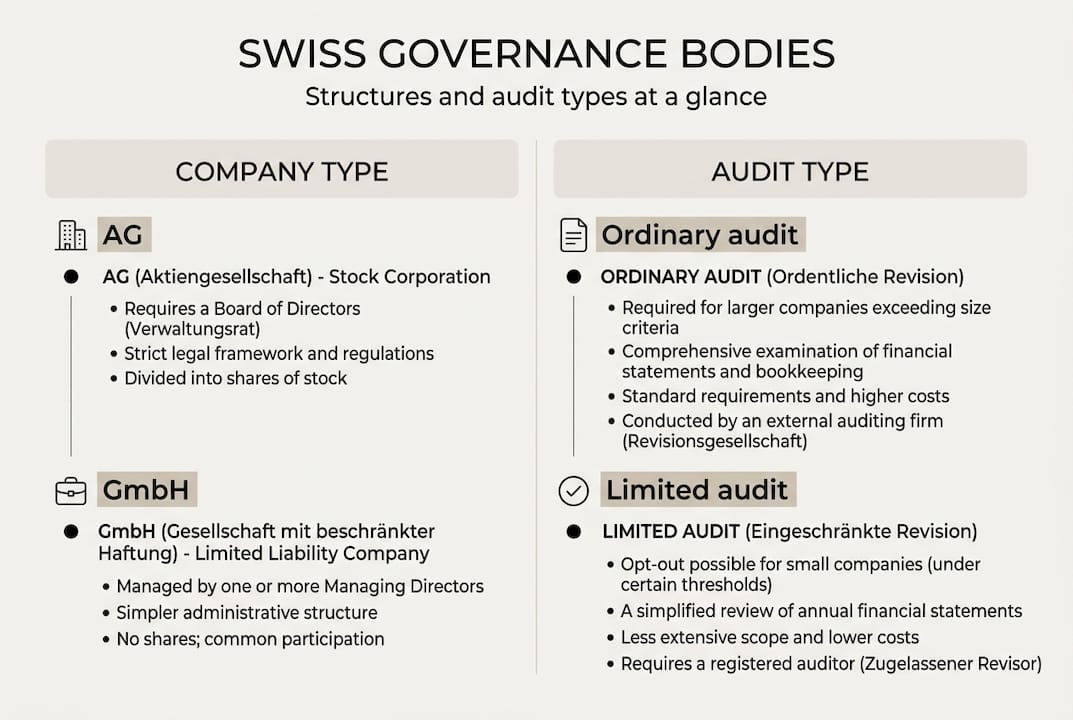
Thresholds include balance sheet total, revenue, and number of employees. Most early-stage foreign-founded companies qualify for audit exemption, which reduces administrative cost significantly.
Beyond the legal minimum, Switzerland has a non-binding best practice framework called the Swiss Code of Best Practice for Corporate Governance (SCBP), published by economiesuisse. It was revised in 2023 following the corporate law reform. The SCBP operates on a “comply or explain” principle: companies either follow its guidelines or publicly explain why they don’t.
The SCBP emphasizes long-term sustainable value creation, independent board oversight, and transparent communication with shareholders. These aren’t just ideals; they’re benchmarks that investors and auditors increasingly use to evaluate Swiss companies.
The role of the Swiss board of directors is often underestimated by foreign founders who treat it as a formality. It isn’t. Strategy, internal controls, and financial supervision are duties the board cannot legally hand off to management or external advisors. Understanding Swiss governance best practices early saves you from costly restructuring later.
Recent reforms, ESG, and Swiss governance trends
Swiss corporate law isn’t static. The 2023 reform introduced changes that every founder or investor operating in Switzerland needs to understand, regardless of company size.
Key 2023 reforms include virtual and hybrid shareholder meetings, enhanced shareholder rights, say-on-pay provisions integrated into the Code of Obligations, and mandatory non-financial (ESG) reporting for large companies. These changes modernize Swiss governance and bring it closer to EU standards, which matters if you have European investors or partners.
Here are the top governance trends shaping Swiss companies right now:
Board independence: Investors and regulators expect more independent directors, especially in larger AGs.
ESG integration: Environmental, social, and governance reporting is now mandatory for large firms and increasingly expected by institutional investors in smaller ones.
Shareholder activism: More shareholders are using new rights to challenge board decisions on compensation and strategy.
Beneficial ownership transparency: The upcoming LETA register will require disclosure of ultimate beneficial owners, a significant shift for privacy-focused structures.
Investment Screening Act: Expected around 2027, this will introduce foreign investment review for certain sectors, affecting international investors in Switzerland.
On gender diversity: large companies with over 250 full-time employees now face gender quota requirements for boards and executive management. This applies to both listed and certain unlisted companies above the threshold.
Pro Tip: Even if your company is small today, build ESG-aware governance habits early. Institutional investors, Swiss banks, and larger corporate partners increasingly run ESG due diligence on suppliers and investees, not just listed companies. Following Swiss governance rules from the start positions you ahead of the curve.
The direction is clear. Swiss governance is moving toward greater transparency, broader accountability, and stronger alignment with global standards. Founders who treat compliance as a foundation rather than a burden will find it easier to scale, raise capital, and build lasting credibility in the Swiss market.
Our take: Flexibility, best practices, and blind spots for foreign founders
After working with international entrepreneurs setting up Swiss companies, one pattern stands out. Most founders spend enormous energy on the checklist: entity type, capital deposit, director appointment. Far fewer invest in understanding what real board engagement looks like in Switzerland.
The “comply or explain” principle is a perfect example. Many founders treat it as optional guidance. In practice, sophisticated investors and auditors read non-compliance as a governance red flag. It signals that leadership isn’t serious about accountability.
A Swiss-resident director is another area where founders miss the point. It’s not just a legal box to check. Banks, regulators, and business partners use that residency as a proxy for genuine local commitment. A well-chosen resident director adds credibility that no legal document alone can provide.
The ESG and shareholder activism trends are the biggest blind spots we see. Founders building for five-plus years need to understand that the governance environment they’re entering today will look quite different by 2028. Explore the Swiss startup steps to build a structure that holds up under future scrutiny, not just today’s requirements.
How RPCS can help you build a compliant Swiss company
Navigating Swiss corporate governance from abroad is genuinely complex. The entity choice, director requirements, governance bodies, and evolving ESG obligations all interact in ways that are hard to manage without local expertise.
RPCS specializes in exactly this. From selecting the right structure to handling registration, banking setup, and ongoing compliance, the Swiss company formation services at RPCS are designed for international entrepreneurs who want to get it right the first time. The platform also offers Swiss accounting support to keep your governance and financial reporting aligned with Swiss law as your company grows. You don’t need to figure this out alone.
Frequently asked questions
What are the main differences between Swiss AG and GmbH for foreign founders?
AG suits larger ventures and investors due to capital flexibility and shareholder privacy, while GmbH is preferred by SMEs for its simplicity and lower minimum capital of CHF 20,000 fully paid-in versus CHF 100,000 for an AG.
Is a Swiss-resident director mandatory for all companies?
Yes. At least one director must be resident in Switzerland and hold signatory authority to fulfill legal and regulatory compliance requirements.
What is the ‘comply or explain’ principle in Swiss corporate governance?
It’s a non-binding guideline from the SCBP where companies either follow best practice standards or transparently justify any deviations to shareholders and the public.
How did Swiss corporate governance law change after 2023?
The reforms enabled virtual shareholder meetings, enhanced shareholder rights, integrated say-on-pay provisions, and introduced ESG reporting obligations for large companies.
Do Swiss companies face gender quotas or special disclosure duties?
Large companies above 250 full-time employees face gender quota requirements for boards and executive management, and listed companies must comply with the SIX Directive on Corporate Governance for disclosure.
Recommended
Comments