
Why Choose GmbH Structure for Swiss Companies
- Dec 24, 2025
- 8 min read

Selecting the right corporate structure can set international ventures apart in the fiercely competitive tech and finance worlds. For American entrepreneurs and investors, the Swiss GmbH has become a go-to choice, offering robust legal protection and unrivaled credibility. With Switzerland’s minimum share capital as low as 20,000 Swiss Francs, this model delivers a strategic blend of security and flexibility while promising strong tax benefits and simplified cross-border operations for globally minded founders.
Table of Contents
Key Takeaways
Point | Details |
Limited Liability Protection | Swiss GmbH structures provide strong protection for personal assets by limiting liability to shareholders’ investments only. |
Flexible Establishment | Entrepreneurs can create a Swiss GmbH with a minimum capital of 20,000 Swiss Francs, making it accessible for startups and small to medium-sized enterprises. |
Tax Optimization Opportunities | The Swiss GmbH benefits from competitive tax rates and various incentives, facilitating strategic financial advantages for international businesses. |
Compliance and Governance | Establishing and maintaining a Swiss GmbH requires adherence to strict legal frameworks and ongoing compliance to ensure transparency and credibility. |
What Is a Swiss GmbH Structure?
A Swiss GmbH (Gesellschaft mit beschränkter Haftung) represents a sophisticated legal business entity designed specifically for entrepreneurs seeking robust corporate protection in Switzerland. This specialized company structure offers international founders a powerful vehicle for establishing a credible and legally secure business presence.
At its core, a Swiss GmbH is a limited liability company where shareholders’ personal assets remain distinctly separate from the company’s financial obligations. Swiss corporate law defines this structure as a legal entity with its own distinct personality, providing significant protective mechanisms for business owners. The primary characteristic is that shareholders’ liability is strictly limited to their invested capital, which means personal wealth remains shielded from potential corporate financial challenges.
The Swiss GmbH structure presents remarkable advantages for small and medium-sized enterprises. Unlike traditional business models, this approach allows entrepreneurs to create a corporate entity with minimal initial capital requirements. Typically, founders can establish a GmbH with as little as 20,000 Swiss Francs, which can be contributed in cash or through valuable assets. According to Swiss corporate regulations, the company gains legal independence, enabling it to enter contracts, own property, and conduct business transactions under its own legal identity.

The structure is particularly attractive for international entrepreneurs because it offers flexibility, credibility, and strong legal protections. Investors appreciate that Swiss GmbH entities demonstrate a commitment to professional business practices and provide a transparent operational framework recognized globally.
To clarify the advantages, here is how a Swiss GmbH supports international entrepreneurs:
Advantage | Description | Business Impact |
Limited Liability | Personal assets protected | Reduces financial risk |
Credibility | Recognized legal structure | Enhances trust with partners |
Flexible Governance | Straightforward management | Eases market entry, control |
Tax Efficiency | Competitive effective rates | Increases overall profits |
International Compatibility | Double tax treaties, global recognition | Simplifies cross-border business |
Pro Tip: Legal Strategy: Before establishing a Swiss GmbH, consult with a local legal expert who specializes in Swiss corporate law to ensure your specific business requirements align perfectly with this corporate structure.
Key Features and Legal Requirements
A Swiss GmbH comes with specific legal requirements that entrepreneurs must carefully navigate to ensure proper establishment and ongoing compliance. The commercial registration process is fundamental to the company’s legal existence, establishing the company as a recognized legal entity with distinct rights and obligations.
The core legal framework for a Swiss GmbH includes several critical components that differentiate it from other business structures. Founders must meet minimum capital requirements, typically 20,000 Swiss Francs, which can be contributed through cash or valuable assets. The company must have at least one director who can be either a Swiss resident or a foreign national, providing flexibility for international entrepreneurs. Key legal requirements include:
Mandatory registration in the Swiss commercial register
Minimum share capital of 20,000 Swiss Francs
At least one shareholder (individual or corporate entity)
Detailed articles of association
Comprehensive documentation of ownership structure
Annual financial reporting and accounting compliance
Governance and management represent another crucial aspect of the Swiss GmbH structure. The company must maintain transparent decision-making processes, with shareholders having direct rights to participate in critical corporate decisions. Directors carry significant responsibilities, including financial management, strategic planning, and ensuring strict adherence to Swiss corporate regulations.
The legal framework provides robust protection for both shareholders and external stakeholders. Limited liability means personal assets remain protected, while the structured governance model ensures accountability and transparency. International investors find this approach particularly attractive due to Switzerland’s reputation for strong legal standards and predictable business environments.
Pro Tip: Compliance Strategy: Engage a local Swiss corporate lawyer during the GmbH formation process to ensure precise compliance with all regulatory requirements and avoid potential legal complications.
Tax Advantages and Financial Benefits
The Swiss GmbH structure offers extraordinary tax optimization opportunities that make it an incredibly attractive option for international entrepreneurs seeking strategic financial advantages. Switzerland’s competitive tax landscape provides businesses with a unique environment characterized by favorable corporate tax rates and numerous strategic financial incentives.
Swiss cantons implement different tax strategies, creating a flexible landscape where businesses can optimize their tax positioning. The corporate tax rates typically range between 11.5% and 16.5%, which is significantly lower compared to many European countries. Key tax advantages include:
Reduced effective tax rates through cantonal and municipal tax adjustments
Potential tax exemptions for holding companies
Generous provisions for research and development investments
Favorable treatment of intellectual property and innovation
Substantial deductions for operational expenses
Opportunities for international tax planning
The financial benefits extend beyond standard tax considerations. Swiss GmbH structures provide remarkable flexibility for international investors, allowing them to design sophisticated corporate strategies that minimize tax liabilities while maintaining full legal compliance. The system rewards businesses that demonstrate economic substance, innovative approaches, and strategic reinvestment of corporate earnings.
Moreover, Switzerland’s extensive network of double taxation treaties ensures that international businesses can avoid duplicate taxation, creating a streamlined approach to cross-border financial management. This makes the Swiss GmbH an exceptional vehicle for global enterprises seeking to optimize their financial structures while benefiting from one of the world’s most stable and transparent business environments.
Pro Tip: Tax Optimization: Engage a Swiss tax specialist who understands both international and cantonal tax regulations to develop a comprehensive tax strategy tailored to your specific business model and operational requirements.
Comparing GmbH and AG Structures
Understanding the nuanced differences between Swiss GmbH and AG structures is critical for international entrepreneurs selecting the most appropriate corporate vehicle for their business objectives. Swiss corporate regulations offer two primary company formations that cater to different business scales and strategic requirements.
The fundamental distinctions between GmbH and AG structures emerge in several key areas:
Minimum Capital Requirements:
GmbH: 20,000 Swiss Francs
AG: 100,000 Swiss Francs
Shareholder Anonymity:
GmbH: Limited public disclosure
AG: Enhanced shareholder privacy
Management Structure:
GmbH: More flexible management options
AG: More complex governance requirements
Ideal Business Stages:
GmbH: Small to medium enterprises
AG: Large corporations and established businesses
The GmbH structure provides remarkable flexibility for smaller entrepreneurial ventures, offering lower initial capital requirements and simplified administrative processes. Entrepreneurs can establish their business with minimal bureaucratic overhead, making it an attractive option for startups and innovative small to medium-sized enterprises seeking rapid market entry.
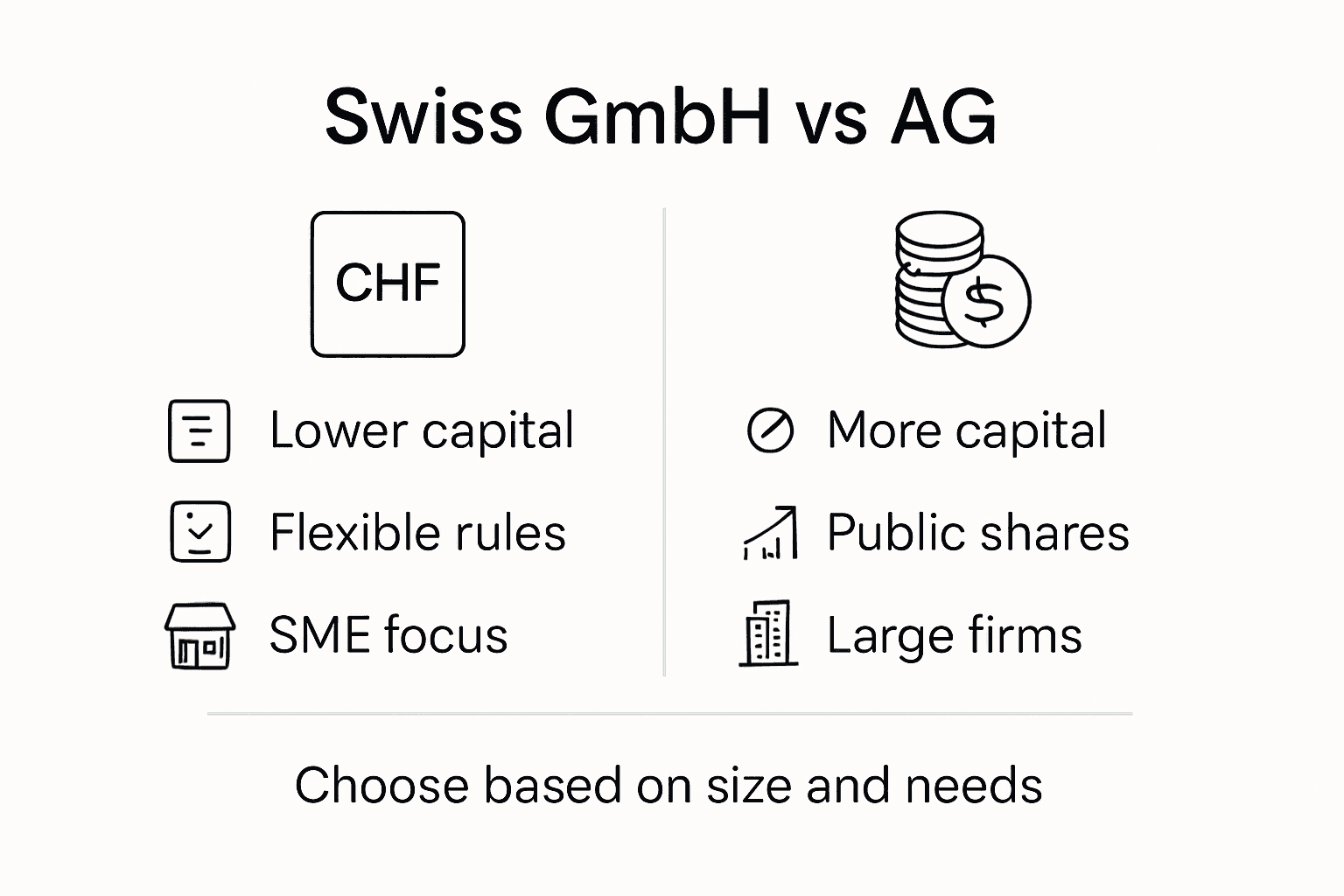
Conversely, the AG structure represents a more sophisticated corporate framework designed for substantial businesses with significant capital investments. Swiss AG formations typically attract larger international corporations, institutional investors, and enterprises planning substantial expansion. The higher capital requirements and more rigorous governance standards ensure enhanced credibility and investor confidence.
Here’s a summary of Swiss GmbH vs. AG to help you select the right structure:
Aspect | Swiss GmbH | Swiss AG |
Minimum Capital | 20,000 CHF | 100,000 CHF |
Shareholder Privacy | Publicly disclosed | Generally anonymous |
Typical Users | SMEs, startups | Large corporations |
Governance Complexity | Simple structure | More formal processes |
Investor Appeal | Local/entrepreneur focus | Suited for stockholders |
Transfer of Shares | More restricted | Freely transferable |
Reputation | Practical, stable | Prestigious, versatile |
Pro Tip: Strategic Selection: Carefully assess your long-term business goals, expected growth trajectory, and capital requirements before selecting between GmbH and AG structures to optimize your corporate strategy.
Formation Process and Ongoing Compliance
Establishing a Swiss GmbH demands meticulous attention to legal and administrative requirements that ensure proper corporate formation and sustained regulatory compliance. The formation process involves several critical steps designed to create a legally robust and transparent business entity.
The comprehensive formation process encompasses multiple essential stages:
Initial Preparation:
Select and reserve a unique company name
Draft comprehensive articles of association
Determine initial share capital (minimum 20,000 Swiss Francs)
Identify and document founding shareholders
Legal Documentation:
Prepare notarized incorporation documents
Validate shareholder identities and contributions
Create detailed corporate governance framework
Establish official company bylaws
Financial and Registration Requirements:
Open a Swiss business bank account
Deposit initial share capital
Register with local commercial registry
Obtain necessary tax identification numbers
Ongoing compliance represents a critical aspect of maintaining a Swiss GmbH. Companies must consistently adhere to strict regulatory standards, including annual financial reporting, tax declarations, and mandatory shareholder meetings. This systematic approach ensures transparency, legal integrity, and continued operational legitimacy within Switzerland’s rigorous corporate governance framework.
The regulatory environment demands precise record-keeping and proactive management. Companies must maintain accurate financial statements, submit annual reports to relevant authorities, and ensure all statutory obligations are met consistently. Foreign entrepreneurs should anticipate comprehensive documentation requirements and potentially engage local legal and accounting professionals to navigate the complex regulatory landscape effectively.
Pro Tip: Compliance Strategy: Develop a comprehensive compliance calendar that tracks all mandatory filing dates, regulatory deadlines, and reporting requirements to maintain seamless corporate governance and avoid potential penalties.
Simplify Your Swiss GmbH Formation with Expert Support
Choosing the Swiss GmbH structure comes with clear advantages, but navigating the complex legal requirements, managing capital registration, and ensuring ongoing compliance can feel overwhelming. If you desire limited liability protection, flexible governance, and access to Switzerland’s favorable tax environment, you need a partner who understands all these challenges and can guide you step-by-step.
At RPCS, we specialize in streamlining the Swiss GmbH setup for international entrepreneurs. Our professional services cover everything from legal documentation and notarization to commercial registration and banking setup. We help you avoid costly mistakes, accelerate formation times, and stay compliant with Swiss corporate law. Take advantage of our expertise to unlock tax benefits and build credibility in the Swiss market confidently. Visit RPCS GmbH formation services now and start your journey toward a stable and successful Swiss company today.
Frequently Asked Questions
What are the main advantages of choosing a GmbH structure for a Swiss company?
The main advantages include limited liability for shareholders, enhanced credibility, flexible governance, tax efficiency, and international compatibility, making it an attractive choice for entrepreneurs.
What is the minimum capital requirement to establish a Swiss GmbH?
The minimum capital requirement to establish a Swiss GmbH is 20,000 Swiss Francs, which can be paid in cash or through valuable assets.
How does a Swiss GmbH differ from an AG structure?
A Swiss GmbH has lower minimum capital requirements (20,000 CHF), simpler governance, and is ideal for small to medium enterprises, while an AG requires 100,000 CHF and is suited for larger corporations with more complex governance standards.
What are the ongoing compliance requirements for a Swiss GmbH?
Ongoing compliance requires maintaining accurate financial records, submitting annual financial reports, conducting mandatory shareholder meetings, and meeting all regulatory obligations set by Swiss corporate law.
Recommended
Comments