
What Is Corporate Governance: A Guide for Business Professionals
- Jun 30
- 8 min read

TL;DR:
Corporate governance is a system of rules, processes, and relationships that directs and controls a company. It ensures accountability, transparency, and fairness among the board, management, and stakeholders. Good governance attracts investment and reduces risks, while poor governance leads to reputational harm, legal penalties, and organizational failures.
Corporate governance is defined as the system of rules, processes, and relationships that direct and control a corporation, ensuring accountability, transparency, and fairness among its board, management, and stakeholders. The OECD/G20 Principles serve as the global benchmark for governance frameworks, recognized as critical to sustainable economic value far beyond basic compliance. For business professionals and founders, understanding what is corporate governance means understanding how power, accountability, and risk are distributed across an organization. This guide covers the core principles, legal foundations, practical benefits, and implementation steps that make governance work in the real world.

What is corporate governance and why does it matter?
Corporate governance is the essential framework that directs and controls companies through established rules, practices, and processes. It defines who makes decisions, how those decisions are made, and who is accountable for the outcomes. Without a clear governance structure, companies face misaligned incentives, ethical failures, and loss of investor confidence.
The OECD/G20 Principles establish that governance promotes sustainable economic value by aligning the interests of management with those of shareholders and broader stakeholders. This alignment is not automatic. It requires deliberate design through charters, board structures, audit committees, and disclosure policies.
Governance also addresses the agency problem: the conflict that arises when managers control a company but shareholders own it. Left unmanaged, this gap produces decisions that benefit executives at the expense of owners. A well-designed governance framework closes that gap through oversight, incentives, and accountability mechanisms.
What are the key principles of corporate governance?
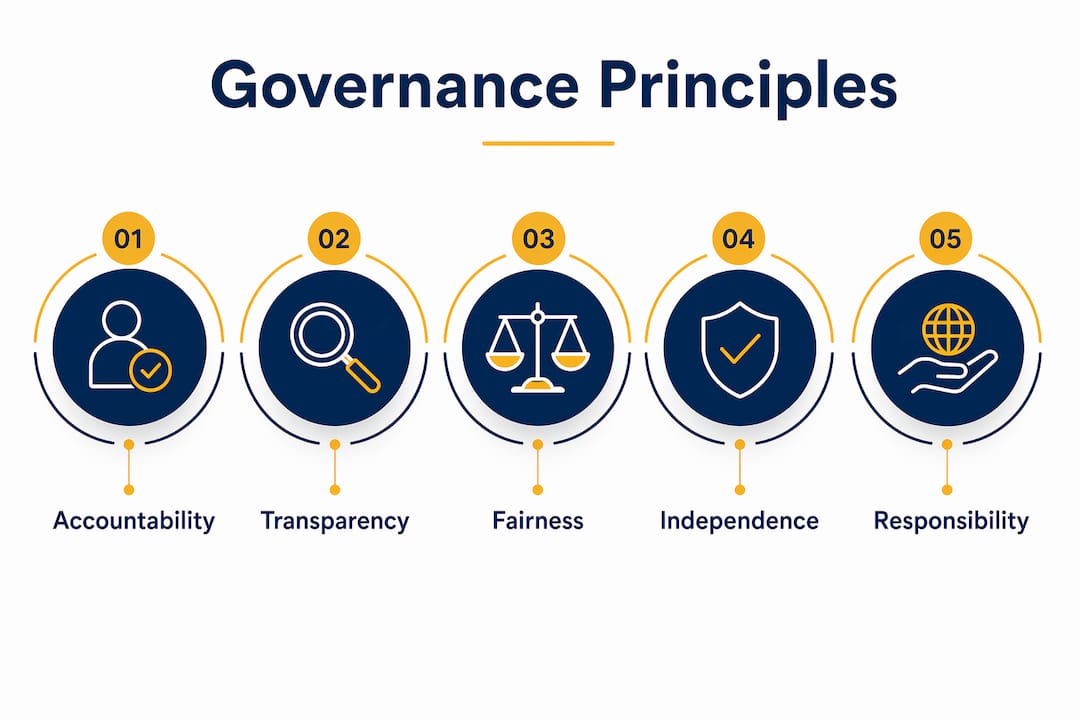
Five core pillars define good governance practices: accountability, transparency, fairness, responsibility, and independence. Each pillar addresses a specific failure mode that organizations face as they grow.
Accountability requires that boards and executives answer for their decisions to shareholders and other stakeholders. Clear reporting lines and performance metrics make accountability concrete.
Transparency demands timely, accurate disclosure of financial results, risks, and material events. Investors price transparency into valuations.
Fairness protects minority shareholders and ensures all stakeholders receive equitable treatment under the company’s governing documents.
Responsibility holds the board and management to ethical standards and legal obligations, including environmental and social duties.
Independence requires that board members make decisions free from conflicts of interest. Board independence is a core pillar necessary for risk mitigation and ethical oversight.
These principles work together. A board that is transparent but not independent will still produce biased decisions. A board that is accountable but not fair will lose the trust of minority investors.
Pro Tip: Embed each governance pillar into a specific board committee. Assign accountability to the audit committee, independence to the nominations committee, and fairness to the compensation committee. This prevents principles from remaining abstract.
How do legal and regulatory frameworks shape governance?
Corporate governance in public corporations is shaped by three overlapping layers: incorporation laws, federal securities regulations, and stock exchange requirements. Each layer addresses different aspects of the ownership-control relationship.
The internal affairs doctrine is the foundational legal rule. It requires that governance relationships follow the laws of the state where a company is incorporated, regardless of where it operates. A company incorporated in Delaware but operating in California follows Delaware corporate law for governance matters. For multinational corporations, this doctrine creates both opportunities and compliance obligations that must be mapped carefully.
Regulatory Layer | Primary Source | Governance Impact |
State incorporation law | Delaware General Corporation Law, state statutes | Board duties, shareholder rights, fiduciary standards |
Federal securities law | SEC regulations, Sarbanes-Oxley Act | Disclosure requirements, audit standards, executive pay |
Stock exchange rules | NYSE, Nasdaq listing standards | Board independence, committee composition, governance codes |
International principles | OECD/G20 Principles | Cross-border governance benchmarks, investor expectations |
Federal securities regulations, including the Sarbanes-Oxley Act of 2002, added mandatory audit committee independence and CEO/CFO certification of financial statements. These rules directly responded to governance failures that destroyed shareholder value. Stock exchange listing standards then layered additional requirements on top, including majority independent boards and separate audit, compensation, and nominations committees.
Pro Tip: If your company operates across multiple jurisdictions, map your governance obligations by layer: incorporation law first, then securities law, then exchange rules. Gaps between layers are where compliance failures hide.
What are the practical benefits and risks of corporate governance?
Strong governance frameworks improve access to capital and help prevent ethical scandals by aligning management with shareholder interests. Research links good governance to higher company valuations and a lower probability of catastrophic governance failures. These are not marginal effects. They show up in credit ratings, IPO pricing, and institutional investor allocation decisions.
Poor governance produces the opposite outcomes. The risks are concrete and well-documented:
Reputational damage from undisclosed conflicts of interest or related-party transactions that surface publicly
Litigation exposure from breach of fiduciary duty claims by shareholders or derivative suits
Regulatory penalties from securities law violations or failure to maintain required disclosures
Organizational failure when board dysfunction prevents timely responses to business crises
Capital flight when institutional investors exit positions due to governance concerns
Governance frameworks include systematic risk management protocols and accountability measures that protect companies from both legal and reputational risks. The protection is only as strong as the implementation. A governance policy that exists on paper but is not enforced provides no real defense.
Good governance also builds what the OECD describes as “patient capital.” Transparent, stable governance environments attract long-term investors who are less likely to exit at the first sign of volatility. That stability lowers the cost of capital over time.
How should organizations implement and maintain effective governance?
Governance focuses on high-level oversight and risk mitigation. Management focuses on daily operations. Conflating the two causes agency problems and misaligned incentives. Boards that drift into operational decisions lose their independence. Management teams that bypass board oversight create accountability gaps.
A practical implementation process follows this sequence:
Define the governance structure. Establish the board composition, committee mandates, and decision-making authority matrix before the company scales.
Draft governing documents. Articles of incorporation, bylaws, board charters, and committee terms of reference must reflect current legal requirements and company size.
Appoint independent directors. At least a majority of board members should have no material relationship with the company or its executives.
Establish audit and reporting cycles. Annual audits, quarterly board reviews, and real-time risk reporting create the information flow governance requires.
Conduct governance reviews. Governance documentation can become obsolete within 18–24 months of significant growth, risking board paralysis or litigation if not updated.
Stakeholder engagement is the often-overlooked dimension of implementation. Effective governance balances the interests of shareholders, employees, suppliers, and the broader community rather than focusing solely on shareholder demands. Companies that ignore employees and suppliers in their governance design face higher turnover, supply chain disruptions, and reputational exposure.
Pro Tip: Schedule a formal governance review every 18 months, not just when a crisis forces it. Tie the review to your annual audit cycle so it becomes a standing agenda item rather than a reactive exercise.
How does good governance support Swiss company formation and compliance?
Swiss corporate governance emphasizes accountability, transparency, and board responsibilities as foundational obligations for founders and entrepreneurs. Swiss law imposes specific duties on board members of both GmbH and AG structures, including fiduciary responsibility, duty of care, and mandatory financial reporting. These are not optional best practices. They are legal requirements enforced by Swiss courts.
Governance quality directly affects a Swiss company’s ability to attract capital. Transparent and accountable practices support patient capital attraction and sustain investor confidence over the long term. For international founders, this matters because Swiss investors and banking partners evaluate governance quality before committing funds or credit lines.
Key governance compliance areas for Swiss companies include:
Board composition and duties under the Swiss Code of Obligations
Annual financial reporting and statutory audit requirements for larger entities
Shareholder meeting procedures and voting rights documentation
Related-party transaction disclosure to prevent conflicts of interest
Risk management documentation aligned with Swiss Financial Market Supervisory Authority expectations for regulated entities
Founders establishing a Swiss AG or GmbH should build governance structures from day one, not retrofit them after problems arise. The role of the board of directors in Switzerland carries legal weight that differs meaningfully from governance norms in other jurisdictions. Understanding those differences before incorporation prevents costly corrections later.
Key Takeaways
Effective corporate governance is the foundation of sustainable company performance, combining legal compliance, board oversight, and stakeholder accountability into a single operating framework.
Point | Details |
Core definition | Governance is the system of rules and processes directing a company toward accountability and transparency. |
Five pillars | Accountability, transparency, fairness, responsibility, and independence form the foundation of any governance framework. |
Legal layers | Incorporation law, securities regulations, and exchange rules each impose distinct governance obligations. |
Dynamic updates | Governance documents can become obsolete within 18–24 months of growth and require scheduled reviews. |
Swiss application | Swiss AG and GmbH structures carry specific board duties and reporting obligations that must be built in from formation. |
Governance as a strategic asset, not a compliance checkbox
Most governance failures I have observed share one trait: the board treated governance as a document to file rather than a system to run. The bylaws were drafted, the committees were named, and then nothing happened until a crisis forced a review. That approach is not governance. It is theater.
The companies that use governance well treat it the way a CFO treats cash flow: as a live signal that requires constant attention. They update their board charters when the business model changes. They rotate committee chairs to prevent entrenchment. They bring in independent advisors before problems surface, not after.
The other pattern worth noting is the tendency to confuse governance with management. I have seen founders who sit on their own boards and genuinely believe they are providing oversight of themselves. That structure does not work. Oversight requires distance. The board’s job is to ask hard questions, not to answer them.
For international founders building Swiss companies, the governance stakes are higher than they expect. Swiss law assigns personal liability to board members for certain failures. That is not a theoretical risk. It is a reason to get governance right before you incorporate, not after your first audit.
Governance is an asset. It lowers your cost of capital, protects you from litigation, and signals to investors that your company is worth trusting with their money. Treat it accordingly.
— Rolands
How Rpcs supports governance compliance for Swiss companies
Rpcs works with international entrepreneurs and investors to build Swiss companies with governance structures that meet legal requirements from day one.

Whether you are forming a GmbH or an AG, Rpcs provides support across the full governance setup: legal documentation, board structure guidance, notarization, registration, and accounting services that keep your financial reporting transparent and audit-ready. For founders who need banking infrastructure to support governance transparency, Rpcs also facilitates Swiss bank account setup as part of the formation process. The Swiss company formation service is built for foreign clients who need local expertise without the guesswork of navigating Swiss law alone.
FAQ
What does corporate governance mean in simple terms?
Corporate governance is the system of rules and processes that controls how a company is directed, who makes decisions, and how those decision-makers are held accountable to shareholders and stakeholders.
What is a corporate governance structure?
A corporate governance structure defines the board composition, committee mandates, and decision-making authority within a company. It typically includes a board of directors, audit and compensation committees, and documented policies for disclosure and risk management.
What is a corporate governance report?
A corporate governance report is a formal disclosure document, usually published annually, that describes a company’s board composition, committee activities, executive compensation, and compliance with applicable governance standards.
Why is corporate governance important in business ethics?
Corporate governance creates the accountability mechanisms that enforce ethical behavior. Without governance structures, management faces no formal check on decisions that may benefit executives at the expense of shareholders or other stakeholders.
How does corporate governance apply to Swiss companies?
Swiss AG and GmbH structures operate under the Swiss Code of Obligations, which imposes specific board duties, financial reporting requirements, and shareholder rights. Founders must build compliant governance structures at incorporation to avoid personal liability and meet investor expectations.
Recommended
Comments