
Roles in a Swiss Company: Legal Duties Explained
- Dec 30, 2025
- 7 min read

Successful incorporation in Switzerland demands careful attention to the legal roles and responsibilities that define every company, especially for American and other international investors. Over 90 percent of Swiss companies are structured as either GmbH or AG entities, each subject to strict governance and compliance requirements. Understanding how Swiss regulations shape key positions and accountability ensures smoother setup and protects investments in this highly regulated European market. This guide breaks down the essential differences and must-know obligations for every entrepreneur and foreign stakeholder.
Table of Contents
Key Takeaways
Point | Details |
Corporate Structures | Switzerland offers two main corporate forms for international entrepreneurs: Stock Corporation (AG) and Limited Liability Company (GmbH), each with unique characteristics. |
Governance Roles | The mandatory roles include a Board of Directors and Company Auditors, which are vital for maintaining legal compliance and financial transparency. |
Legal Responsibilities | Directors must exercise diligence and can be personally liable for damages arising from misconduct, emphasizing the need for clear documentation and defined authority. |
Compliance Challenges | Companies should proactively manage compliance by establishing robust internal controls and conducting regular reviews to identify potential vulnerabilities. |
Swiss Company Roles and Core Definitions
Switzerland offers two primary corporate structures for international entrepreneurs: the stock corporation (Aktiengesellschaft or AG) and the limited liability company (Gesellschaft mit beschränkter Haftung or GmbH). Both entities provide critical legal frameworks for businesses seeking to establish operations in this financially sophisticated European marketplace.
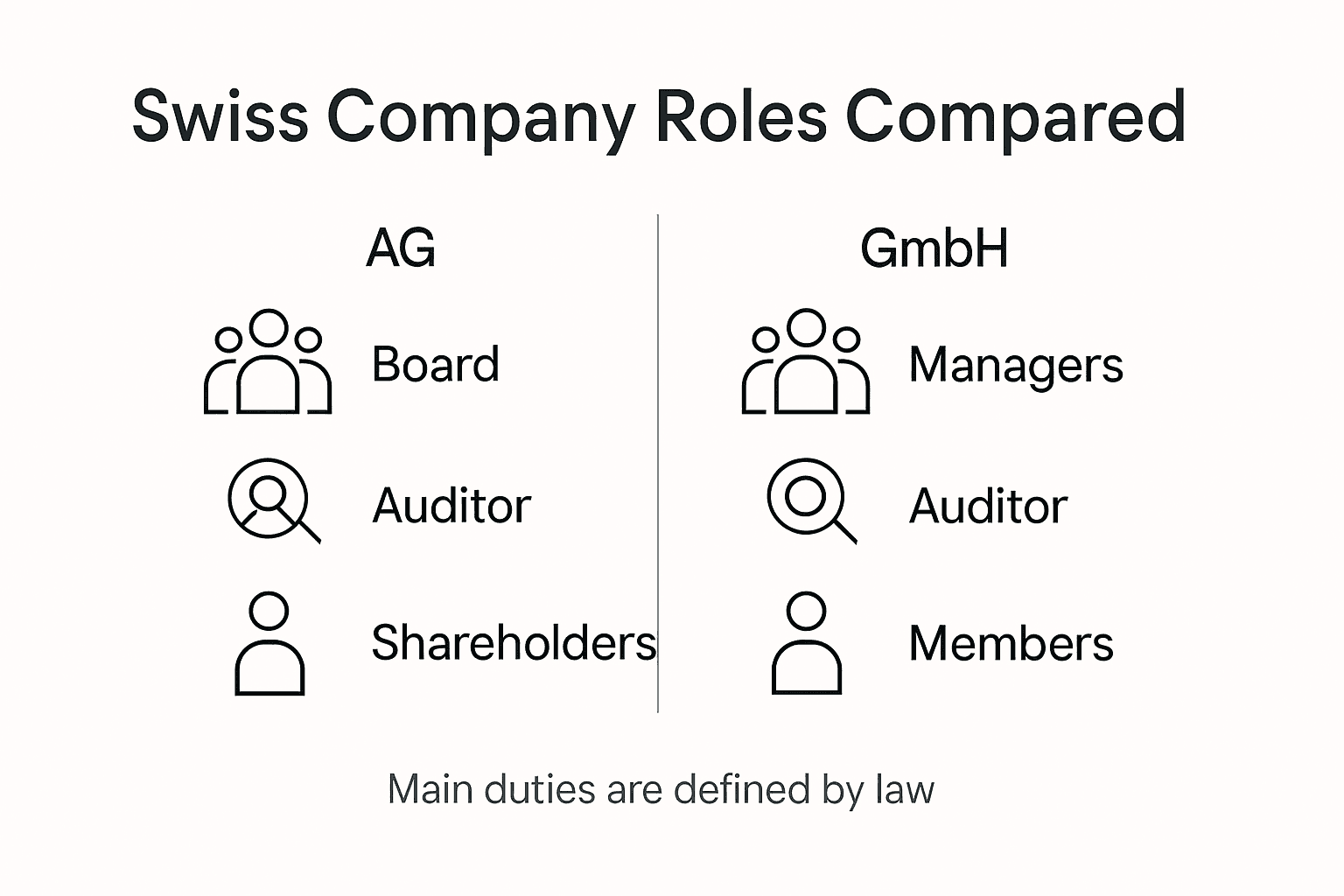
Under Swiss corporate governance regulations, key corporate bodies are legally defined with specific responsibilities, typically including shareholders, management boards, and independent auditors. These roles are meticulously structured to ensure transparent decision making and robust accountability. Each corporate entity must establish clear hierarchies and reporting mechanisms that comply with the Swiss Code of Obligations, which serves as the fundamental legal guideline for corporate organization.
The primary distinctions between AG and GmbH structures center on capital requirements, shareholder configurations, and governance complexity. Stock corporations (AG) generally demand higher initial capital and provide more flexibility for public trading, while limited liability companies (GmbH) offer simpler administrative processes with lower capitalization thresholds. Regardless of chosen structure, Swiss law mandates precise documentation, regular financial reporting, and strict adherence to regulatory standards designed to protect investor interests and maintain economic integrity.
Pro Tip: When selecting between AG and GmbH structures, carefully evaluate your specific business goals, projected growth trajectory, and potential future investment requirements to make the most strategic incorporation decision.
Key Structures: GmbH and AG Compared
Switzerland’s corporate landscape offers two primary business structures that international entrepreneurs must carefully evaluate: the stock corporation (Aktiengesellschaft or AG) and the limited liability company (Gesellschaft mit beschränkter Haftung or GmbH). These company forms represent distinct legal frameworks with unique characteristics for business operations, each designed to accommodate different business scales and strategic objectives.
The AG structure provides more comprehensive options for businesses, particularly those seeking public investment or planning substantial growth. Characterized by share-based ownership, AGs can be publicly traded and typically require higher initial capital investments. In contrast, GmbH structures offer more streamlined administrative processes for smaller entrepreneurial ventures, with lower capitalization requirements and more flexible management configurations.
Key distinctions between these corporate forms include ownership mechanisms, governance complexity, and financial reporting requirements. AG shareholders hold transferable shares and can more easily attract external investors, while GmbH members hold non-transferable quotas with more restrictive ownership transfer protocols. Both structures provide limited liability protection, ensuring that personal assets remain separate from corporate financial obligations. Regulatory compliance demands precise documentation, transparent financial reporting, and adherence to Swiss corporate governance standards for both entity types.
Pro Tip: Consult with a Swiss corporate law specialist to thoroughly assess your specific business model, growth projections, and investment strategies before selecting between AG and GmbH structures.
Here’s how key features of AG and GmbH structures differ in Switzerland:
Aspect | Stock Corporation (AG) | Limited Liability Company (GmbH) |
Ownership Mechanism | Shares, easily transferable | Quotas, transfer restrictions |
Minimum Capital | CHF 100,000 | CHF 20,000 |
Governance Complexity | More complex, board required | Simpler, fewer layers |
Public Trading | Allowed on stock exchange | Not permitted |
Investor Appeal | Suitable for large investors | Geared to small business owners |
Required and Optional Corporate Roles
Swiss corporate governance mandates specific roles that ensure effective management and legal compliance across different company structures. The board of directors represents a critical mandatory role responsible for strategic oversight and legal accountability, with responsibilities that extend beyond mere administrative functions.
In Swiss companies, the board of directors serves as the primary governance body, with specific mandatory and optional roles varying based on company size and structure. Mandatory positions typically include at least one director who is responsible for strategic decision making, financial management, and ensuring regulatory compliance. Optional roles might encompass specialized positions such as chief financial officers, executive managers, and technical directors who support the core leadership team’s objectives.
Statutory requirements also dictate the presence of auditors for certain company sizes, adding an additional layer of financial transparency and accountability. While smaller companies might have more flexible reporting structures, larger corporations must maintain rigorous documentation and independent financial review processes. The composition of these roles can be tailored to meet specific business needs, with the ability to appoint external experts or internal team members depending on the company’s strategic requirements and growth trajectory.
Pro Tip: Carefully document the specific roles and responsibilities for each corporate position to prevent potential governance gaps and ensure clear lines of accountability.
The following table summarizes mandatory and optional company roles under Swiss law:
Role | Mandatory/Optional | Main Responsibility |
Board of Directors | Mandatory | Strategic oversight, compliance |
Company Auditor | Mandatory (if criteria met) | Financial transparency, review |
Executive Manager | Optional | Day-to-day operations |
Technical Director | Optional | Specialty leadership, project support |
CFO | Optional | Financial management and planning |
Legal Duties, Liabilities, and Representation
Corporate legal responsibilities in Switzerland are comprehensive and precisely defined, establishing clear guidelines for corporate governance and individual accountability. The Swiss Code of Obligations mandates that directors and corporate officers must exercise exceptional diligence, maintaining both financial integrity and legal compliance in all business operations.

The board of directors carries collective and individual legal responsibilities that extend beyond routine management. They are personally liable for damages resulting from improper conduct that negatively impacts the company or third-party stakeholders. This liability framework ensures that corporate leaders maintain high standards of professional conduct, with potential financial and legal consequences for negligence or intentional misconduct.
Swiss corporate law requires that at least one company representative must be a resident in Switzerland, ensuring local accountability and facilitating legal communication channels. Representation duties mandate that authorized individuals have explicit power to act on the company’s behalf, with clear documentation defining the scope of their legal authority. These requirements help protect both the company’s interests and those of potential business partners by establishing transparent lines of legal responsibility and communication.
Pro Tip: Maintain meticulous documentation of corporate authorizations and clearly define the legal scope of each representative’s decision-making power to minimize potential liability risks.
Compliance, Mistakes, and Practical Considerations
Corporate compliance in Switzerland represents a complex and dynamic landscape of evolving legal requirements, demanding continuous vigilance and proactive management strategies. The 2023 corporate governance reforms underscore the increasing sophistication of regulatory frameworks, requiring companies to maintain rigorous documentation, transparency, and ethical standards in all operational aspects.
Common compliance challenges frequently emerge from seemingly minor administrative oversights. Directors must be acutely aware of potential pitfalls such as improper shareholder meeting documentation, inaccurate financial reporting, and inadequate management supervision. These mistakes can trigger significant legal consequences, including personal liability for corporate officers and potential reputational damage that extends far beyond immediate financial penalties.
Navigating Swiss corporate compliance requires a multifaceted approach that integrates robust internal controls, precise record-keeping, and a comprehensive understanding of evolving regulatory landscapes. Companies must establish clear conflict-of-interest protocols, maintain transparent communication channels, and develop systematic processes for ongoing legal and administrative compliance. This proactive stance not only mitigates potential risks but also demonstrates organizational commitment to ethical business practices and regulatory integrity.
Pro Tip: Implement an annual compliance review process that systematically evaluates your company’s adherence to current Swiss corporate regulations, identifying potential vulnerabilities before they become critical issues.
Navigate Swiss Company Roles with Confidence and Expert Support
Understanding the complex legal duties and corporate roles within Swiss companies is essential to securing your business’s success and compliance. This article highlights challenges such as mandatory board responsibilities, resident representation requirements, and strict liability risks that can overwhelm international entrepreneurs unfamiliar with Swiss regulations. You need clear guidance on selecting the right corporate structure, defining roles precisely, and ensuring ongoing compliance without exposing yourself to personal liability.
At RPCS, we specialize in simplifying Swiss company formation and management for global investors. Our comprehensive services cover everything from choosing between GmbH and AG entities to handling notarization, registration, banking setup, and ongoing legal and financial administration. We understand the critical importance of proper documentation and transparent governance highlighted in this article. With us, you gain access to trusted legal advice, swift incorporation processes, and tailored risk management solutions designed to prevent common pitfalls such as inadequate role definitions or compliance gaps.
Take control of your Swiss business journey now
Discover how our expert team can guide you through each step of your corporate setup and ongoing responsibilities. Visit RPCS to start your seamless company formation process and secure your business future under Swiss law today. Don’t leave your company’s legal duties to chance when professional support is just a click away.
Frequently Asked Questions
What are the key roles in a Swiss company?
In a Swiss company, key roles include the board of directors, company auditor, executive managers, technical directors, and chief financial officers (CFOs). The board of directors is mandatory and is responsible for strategic oversight, while other roles are optional depending on the size and needs of the company.
What are the legal duties of the board of directors in Switzerland?
The board of directors in Switzerland has collective and individual legal responsibilities. They must exercise diligence and are personally liable for damages from improper conduct that negatively affects the company or third parties, ensuring high standards of professional conduct.
Does a Swiss company need to have a local representative?
Yes, Swiss corporate law requires that at least one company representative must be a resident in Switzerland to ensure local accountability and facilitate legal communication.
What are some common compliance challenges for Swiss companies?
Common compliance challenges include improper documentation of shareholder meetings, inaccurate financial reporting, and inadequate management supervision. These administrative oversights can lead to significant legal consequences, including personal liability for corporate officers.
Recommended
Comments