
Why Register in Swiss Cantons: Tax and Strategic Benefits
- Apr 29
- 9 min read

TL;DR:
Swiss canton selection significantly impacts a company’s total corporate tax burden and incentives.
Cantons like Zug and Nidwalden offer low effective rates, but sector-specific incentives may provide greater value.
Proper registration process and ongoing compliance are crucial for maximizing tax benefits and operational success.
Switzerland surprises most foreign investors with a fact that changes how they think about European incorporation: your total corporate tax bill depends heavily on which Swiss canton you register in, not just the country itself. Two companies incorporated in Switzerland can face tax burdens that differ by nearly ten percentage points depending on their chosen location. That gap translates directly into retained earnings, reinvestment capacity, and long-term competitive advantage. Understanding how cantonal autonomy works, which cantons offer the strongest incentives, and how to navigate the registration process gives you a real edge before you even open your doors.
Table of Contents
Key Takeaways
Point | Details |
Cantonal tax variation | Swiss cantons have highly diverse tax rates, affecting overall business profitability. |
Strategic registration advantages | Choosing the right canton lets you optimize compliance and maximize tax and financial incentives. |
Subsidies after OECD rule | Recent reforms mean innovation grants and subsidies are now central to canton benefits. |
Registration steps matter | Following documented steps and preparing key documents smooths the canton registration process. |
What makes Swiss cantons unique for business registration?
Switzerland operates under a federal system where significant legislative and fiscal power sits with individual cantons, not the central government in Bern. There are 26 cantons in total, and each one functions almost like a small state with its own tax code, regulatory environment, and business promotion policies. For foreign investors, this creates a genuinely competitive marketplace among cantons, each trying to attract companies with favorable conditions.
The total corporate tax burden a business faces in Switzerland combines two layers. The federal corporate income tax (CIT) sits at 8.5% of taxable profit, which translates to an effective rate of roughly 7.83% after deductions. On top of that, each canton and its municipalities levy their own taxes. According to PwC’s tax summary, the combined effective corporate tax rates range from as low as 11.85% in Zug to over 21% in cantons like Bern. That spread is not a rounding difference. It is a strategic decision point that can save a growing company hundreds of thousands of dollars annually.
This cantonal autonomy also extends well beyond tax rates. Each canton controls:
Commercial registration procedures and local filing timelines
Cantonal business licenses for certain regulated sectors
Land use and zoning rules that affect where you can place a registered office
Local incentive programs including grants, reduced tax periods for startups, and sector-specific support
Labor regulations that interact with federal law but carry local interpretation
The regulatory flexibility this creates is one of the advantages of Swiss company setup that many guides undervalue. A tech startup and a trading company have very different optimal cantons, because the factors that matter most to each business, whether that is R&D subsidies, proximity to international airports, or minimal administrative friction, vary significantly.
“Switzerland’s federal structure means choosing your canton is as strategically important as choosing the country itself. The right canton does not just save you taxes; it positions your company inside an ecosystem built for your industry.”
The competitive dynamic among cantons actually benefits you as an investor. Cantons actively recruit businesses, sometimes offering tailored incentive packages to attract strategic sectors. This is not theoretical. Several cantons have established dedicated economic promotion agencies that engage directly with foreign companies exploring Swiss registration.
Comparing tax rates and incentives across Swiss cantons
The numbers tell a clear story. Effective cantonal tax rates range from 11.85% in Zug to 11.97% in Nidwalden and 12.2% in Lucerne, with the full national range sitting between 11.9% and 20.5%. Below is a practical comparison of key cantons for international investors:
Canton | Effective corporate tax rate | Key advantage |
Zug | 11.85% | Lowest rate, strong financial services cluster |
Nidwalden | 11.97% | Low rate, proximity to Lucerne |
Lucerne | 12.2% | Excellent infrastructure, innovation support |
Schwyz | ~13.5% | Low overall tax burden, growing tech presence |
Basel-Stadt | ~13.0% | Strong pharma and life sciences ecosystem |
Geneva | ~13.99% | Global financial hub, international organizations |
Zurich | ~19.7% | Largest market, premier banking infrastructure |
Bern | 21%+ | Federal capital, higher costs overall |
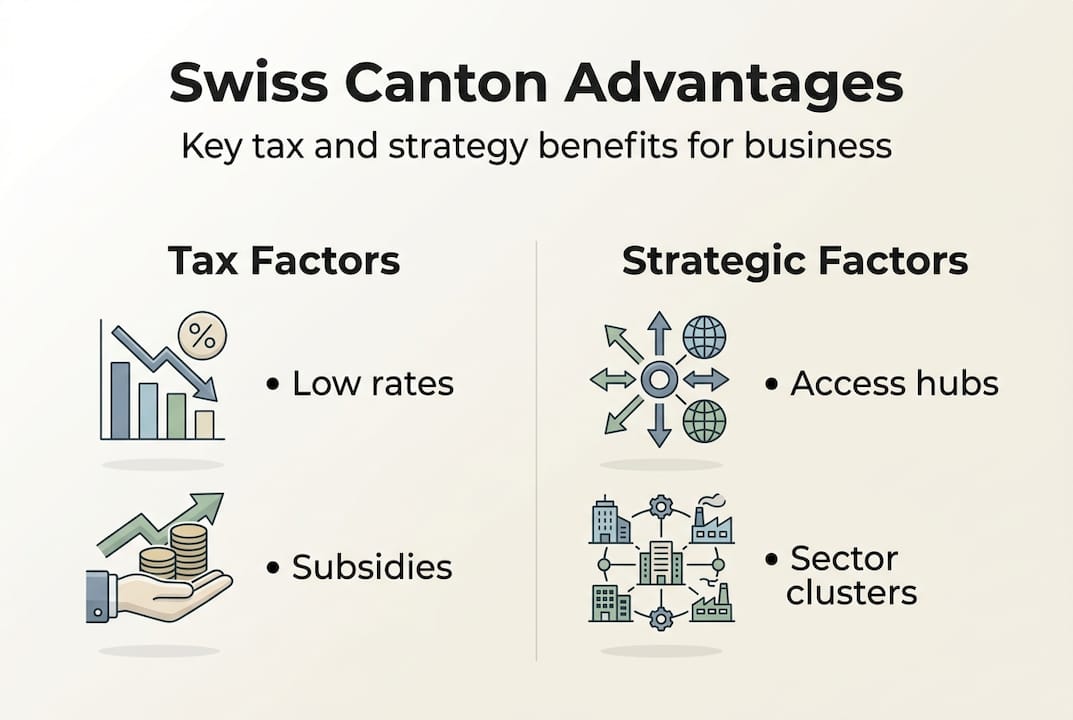
Tax rates are only part of the picture, and this is where the conversation gets more interesting after 2024. The OECD global minimum tax rules, which set a floor of 15% for large multinational groups, prompted Swiss cantons to rethink their incentive strategies. Cantons that previously relied almost entirely on low nominal rates have shifted toward innovation grants and subsidies, including targeted programs like Basel-Stadt’s research and development funding, which supports companies based on tiered percentages of qualifying R&D labor costs and asset depreciation.
This shift matters for your strategic planning. If you are running a company with significant research spending or IP development, the actual value of cantonal subsidies may now exceed the benefit of chasing the lowest headline rate. Key incentive categories now available across multiple cantons include:
R&D tax credits and direct grants tied to qualifying research expenditure
Patent box regimes reducing tax on income derived from Swiss-developed intellectual property
Employment incentives for creating local jobs in priority sectors
Investment allowances for capital expenditure in specific industries
Startup-specific programs offering reduced tax periods during the first years of operation
Understanding Swiss corporate tax advantages in this evolved landscape requires looking at total benefit packages, not just rate cards. A canton offering a 13% rate with a substantial R&D grant program may deliver more value than a canton at 11.85% with no additional support.
Navigating legal and compliance requirements
The registration process itself follows a structured sequence, and understanding it upfront prevents costly delays. Swiss company formation for foreign investors typically involves the following steps:
Choose your legal structure. The two most common forms are the GmbH (Gesellschaft mit beschränkter Haftung, the Swiss limited liability company) and the AG (Aktiengesellschaft, the Swiss corporation). GmbH suits smaller ventures with minimum capital of CHF 20,000. AG suits larger or publicly oriented companies with minimum capital of CHF 100,000.
Select your canton and municipality. Your registered office address determines your cantonal tax jurisdiction. This must be a genuine address, not just a mail drop, though professional business address services satisfy this requirement legally.
Prepare founding documents. This includes the articles of association (Statuten), the list of shareholders, identification documents for all directors and shareholders, and proof of capital deposit in a Swiss bank account.
Notarize the founding documents. Switzerland requires notarization by a Swiss notary for both GmbH and AG formation. The specific notary requirements vary slightly by canton.
Register with the cantonal commercial register (Handelsregister). After notarization, your company is submitted to the canton’s commercial register. Registration typically takes five to fifteen business days depending on the canton.
Register for federal and cantonal taxes. Once registered, you apply for VAT (if turnover exceeds CHF 100,000), corporate income tax registration, and any cantonal-specific filings.
Open a corporate bank account. Swiss banks require company documentation before releasing the capital deposit, effectively completing the formation loop.
The Swiss company formation checklist covers these steps in granular detail, and reviewing key Swiss company documents before you begin saves considerable back-and-forth with local authorities.
Canton choice directly shapes both the legal structure requirements and the ongoing tax obligations you will manage after formation. Some cantons have more efficient commercial registers with faster turnaround times, which matters if you need to start operations quickly. The Swiss registration process guide provides a solid overview of what to expect at each stage.

Pro Tip: Request the specific documentation checklist from your target canton’s commercial register office before you begin collecting signatures. Requirements differ by canton, and a missing apostille or incorrectly translated document can set your timeline back by weeks.
Governance requirements also vary. Some cantons have local presence requirements for at least one director, meaning a Swiss resident director is mandatory. Planning for this early, whether by engaging a nominee director service or hiring locally, prevents a hard stop late in the process.
How to choose the best canton for your business needs
Selecting the right canton is a multi-variable decision, and most foreign investors underestimate how much the non-tax factors matter in practice. Here is a structured framework for evaluating your options:
Tax efficiency. Cantons like Zug at 11.85%, Nidwalden at 11.97%, and Lucerne at 12.2% remain the most attractive for purely tax-driven decisions. If your business model does not depend heavily on R&D credits or sector incentives, these cantons deliver the most straightforward tax efficiency.
Sector-specific incentives. Basel-Stadt and Zurich anchor Switzerland’s life sciences, pharma, and fintech clusters. Geneva connects you to international organizations and global commodity trading networks. Zug has become the crypto and blockchain capital of Europe. Registering where your industry cluster exists gives you access to talent, partnerships, and regulatory familiarity that pure tax calculations miss.
Infrastructure and market access. Zurich’s airport and financial infrastructure make it optimal for companies with heavy international travel needs. Lucerne and Zug offer strong rail connections to Zurich without the higher Zurich tax rate. Geneva serves companies with strong ties to France, the Middle East, and international institutions.
Operating costs. Office rents, labor costs, and service fees differ substantially across cantons. Zug and Geneva carry premium costs relative to Lucerne, Schwyz, or Nidwalden. Running a full cost model inclusive of all operational expenses often changes the ranking from what pure tax rates suggest.
Pro Tip: Look specifically for cantons offering innovation grants or sector-specific incentives if your company carries significant R&D or IP activity. The subsidy value can easily offset a one or two percentage point difference in nominal tax rates, especially during high-investment early years.
Decision factor | Best cantons | Why it matters |
Lowest tax rate | Zug, Nidwalden, Lucerne | Maximizes retained earnings |
Pharma and life sciences | Basel-Stadt, Zurich | Talent pool and regulatory expertise |
Fintech and crypto | Zug, Geneva | Industry cluster and regulatory clarity |
R&D subsidies | Basel-Stadt, Vaud | Direct grant programs for qualifying spend |
Cost efficiency | Schwyz, Nidwalden | Lower rents and services with competitive rates |
International access | Geneva, Zurich | Airport links and global network |
Understanding why choosing a Swiss canton strategically outperforms a generic Swiss incorporation helps frame the entire decision. And for foreign nationals navigating Swiss formation for the first time, the guide on Swiss company formation for foreigners lays out what to expect at every stage.
Expert insights: What most guides overlook
Most articles about Swiss canton selection publish a table of tax rates and call it done. That approach was adequate before the OECD global minimum tax took effect, but it misses the real opportunity that exists right now.
The strategic leverage in 2026 is not in finding the lowest nominal rate. It is in identifying which cantons have built the most valuable subsidy and incentive stacks in response to international tax reform. Cantons cannot compete purely on rate anymore for large multinationals, so they are building richer grant ecosystems, faster permit processes, and sector-specific investment funds. For mid-size international companies and growing startups, these programs are genuinely accessible and frequently underutilized.
We also see many clients focus exclusively on registration and then neglect ongoing optimization. Canton registration is not a one-time event. It creates a relationship with a tax authority that rewards active engagement, proper documentation of qualifying R&D activities, and timely filings. Understanding Swiss corporate tax registration steps as an ongoing discipline, rather than a one-time task, separates companies that merely survive in Switzerland from those that genuinely thrive. The registration decision opens the door. What you do inside that door determines the actual return on your Swiss strategy.
Get expert support for Swiss canton registration
Choosing the right canton and navigating Swiss company formation correctly the first time requires local expertise that most foreign investors simply do not have on day one. Every detail matters, from your registered address to your founding documents to your tax filing cadence.
RPCS specializes in exactly this process. Whether you are registering a GmbH or AG, our team handles Swiss company formation services from initial structure selection through commercial register filing, banking setup, and ongoing compliance support. We also help you establish a credible, legal Swiss business address in your target canton, satisfying local registration requirements without the cost of a full physical office. If you are ready to move from research to action on your Swiss registration, our team is ready to guide you through every step.
Frequently asked questions
Why do Swiss cantons have different tax rates?
Switzerland’s federal structure grants cantons the authority to set their own tax rates independently, creating a competitive landscape where combined effective rates range from 11.85% in Zug to over 21% in cantons like Bern on top of the federal 8.5% CIT. This autonomy lets each canton design its own fiscal policy to attract specific industries and investment profiles.
What are the main steps to register a company in a Swiss canton?
Registration requires selecting a canton, preparing articles of association and shareholder documents, notarizing those documents before a Swiss notary, and filing with the cantonal commercial register. Canton selection directly impacts both ongoing legal obligations and the total tax structure your company operates under.
How has OECD minimum tax changed canton incentives?
The OECD 15% minimum tax floor prompted many cantons to replace or supplement low nominal rates with direct subsidies, R&D grants, and sector incentives. Cantons like Basel-Stadt now offer tiered innovation funding based on qualifying R&D labor costs and asset depreciation, making the incentive package as important as the headline rate.
Which Swiss canton is best for foreign investors?
Zug, Nidwalden, and Lucerne consistently attract foreign investors due to their efficient combined tax rates of 11.85%, 11.97%, and 12.2% respectively, though the best canton for your company also depends on your industry, R&D activity, and operational infrastructure needs.
Recommended
Comments